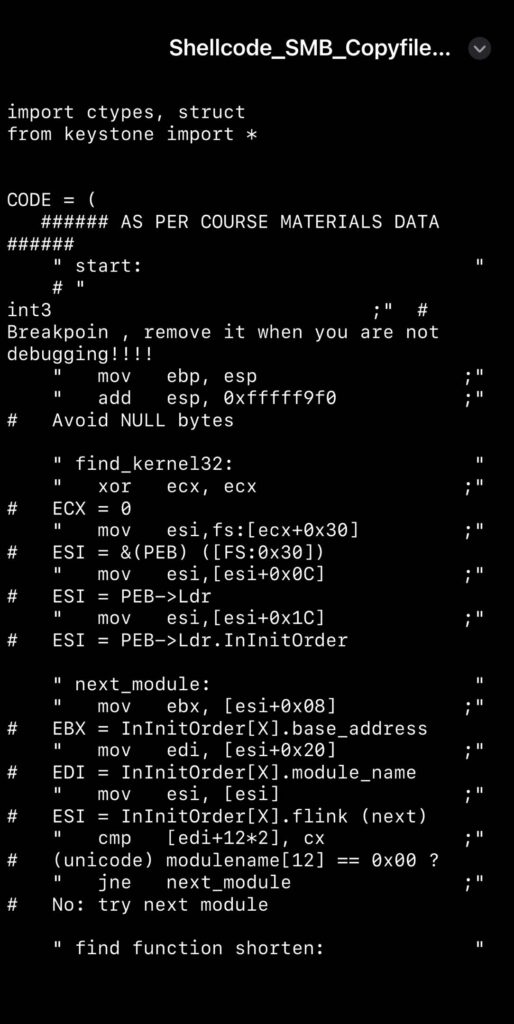
OSED exam dump is a search term used by candidates looking for exploit development reports, Windows debugging notes, shellcode study materials, and preparation resources for the OffSec Exploit Developer certification. The most valuable resources explain how vulnerabilities are analyzed, how Windows security mitigations work, and how reliable exploit development is documented in authorized laboratory environments.
OSED is awarded through OffSec’s EXP-301: Windows User Mode Exploit Development course and practical examination. It is designed for security professionals who want to develop deeper skills in reverse engineering, memory corruption, debugging, and custom exploit development.
This guide explains the available types of OSED study materials, the current examination requirements, and how to evaluate supplementary resources before purchasing.
What Is an OSED Exam Dump?
An OSED exam dump may refer to third-party collections of technical notes, example exploit development reports, debugging exercises, or shellcode learning materials.
The term is not an official OffSec resource category. Some publishers use it broadly to describe exam preparation materials, while others imply access to confidential examination content.
Candidates should distinguish authorized educational resources from unauthorized exam solutions.
A useful OSED study resource should teach transferable technical skills rather than depend on memorizing a particular assignment.
| Resource type | Educational purpose |
|---|---|
| Exploit development notes | Explain vulnerability analysis and debugging |
| Windows memory security guides | Review memory layout and corruption concepts |
| DEP and ASLR references | Explain operating system mitigations |
| ROP study material | Develop understanding of control-flow concepts |
| Shellcode exercises | Study position-independent code |
| Reverse engineering reports | Practice binary analysis and documentation |
| Reporting templates | Organize technical evidence and findings |
Third-party resources should supplement official training, not replace independent examination work.
OSED Exam Format and Requirements in 2026
The OSED exam dump search often reflects a need to understand the practical assessment before choosing study resources.
According to OffSec’s official EXP-301 examination guide, the OSED assessment consists of three independent exploit development tasks.
Candidates must analyze vulnerable software, develop working solutions, and document their technical process.
Current OSED Examination Overview
| Requirement | Official information |
|---|---|
| Certification | OffSec Exploit Developer (OSED) |
| Associated course | EXP-301 |
| Examination format | Proctored practical assessment |
| Independent tasks | 3 |
| Practical examination duration | 47 hours and 45 minutes |
| Report submission period | Additional 24 hours |
| Maximum score | 100 points |
| Passing score | 60 points |
| Required code language | Python 3 |
| Reverse engineering tools during exam | IDA Freeware and WinDbg |
| Submission | PDF report and Python files in a .7z archive |
OffSec requires complete documentation of the work performed for each solved assignment. Inadequate evidence can result in reduced or zero points.
Candidates should review the official OSED Exam Guide before attempting the examination.
Explore OSED Exam Dump Study Resources
CyberServices.Store maintains an OSED resource collection with digital products associated with Windows exploit development and technical reporting.
When evaluating an OSED exam dump resource, check whether its description clearly identifies the topics covered, file format, revision history, and intended educational use.
Relevant preparation subjects include memory corruption, debugger workflows, DEP and ASLR, return-oriented programming, shellcode design, and technical documentation.
The available catalogue and current product options can be reviewed here:
Product descriptions should be checked individually. A catalogue listing does not establish that a resource is authorized by OffSec or that it corresponds to any current examination assignment.
Core EXP-301 Skills for OSED Preparation
The EXP-301 curriculum develops practical Windows user-mode exploit development skills.
Candidates need to understand both how vulnerable software behaves and how operating system protections influence the reliability of a security assessment.
Windows Memory Corruption Fundamentals
Memory corruption occurs when software accesses or modifies memory in ways that violate its intended boundaries or object lifetimes.
These problems may result in crashes, data corruption, or security vulnerabilities.
An exploit developer must understand the relevant program behavior, memory layout, execution context, and conditions required to reproduce a defect.
For preparation, candidates should be comfortable reading debugger output, interpreting exceptions, and distinguishing a software crash from a demonstrated security impact.
Reverse Engineering and Binary Analysis
Reverse engineering helps researchers understand how compiled applications process data and execute instructions.
EXP-301 emphasizes Windows binary analysis, assembly-language fundamentals, and debugger-based investigation.
Candidates should understand registers, stack behavior, calling conventions, memory addresses, and control-flow relationships.
The goal is to develop a reliable understanding of program behavior rather than memorize debugger commands.
Data Execution Prevention (DEP)
DEP is a security mitigation that restricts code execution from designated memory regions.
It helps reduce the exploitability of certain memory corruption vulnerabilities.
OSED candidates study how DEP affects exploit development and why mitigation-aware vulnerability analysis requires an understanding of memory permissions and program control flow.
Address Space Layout Randomization (ASLR)
ASLR introduces unpredictability into memory layouts by randomizing the locations of relevant executable components and memory regions.
This complicates attacks that depend on predictable memory addresses.
A strong technical explanation should distinguish the purpose of ASLR from the conditions under which a specific application may remain vulnerable.
Return-Oriented Programming (ROP)
ROP is an advanced control-flow concept associated with code-reuse techniques.
For OSED exam dump preparation, understanding ROP means studying its relationship to instruction sequences, calling conventions, memory permissions, and operating system mitigations.
Educational reports should explain these concepts using authorized laboratory examples and should not present confidential examination solutions as reusable shortcuts.
Custom Shellcode Development
Shellcode development involves understanding low-level executable instructions, processor architecture, memory constraints, and runtime behavior.
The EXP-301 curriculum includes custom shellcode creation as a major learning objective.
Candidates should study position independence, instruction encoding, debugging, and the effects of application constraints.
The educational value lies in understanding the design decisions and limitations, not simply copying a completed payload.
OSED Exam Dump vs. Official EXP-301 Training
An OSED exam dump and official EXP-301 training serve different purposes.
OffSec maintains the certification curriculum, examination rules, and authorized training laboratories.
Third-party study resources may provide additional explanations, revision notes, or independently created examples.
| Area | Official EXP-301 | Third-party study resources |
|---|---|---|
| Curriculum | Provider-maintained | Publisher-defined |
| Examination rules | Authoritative | Must reference official sources |
| Practice environment | Official labs and challenges | Depends on product |
| Technical notes | Structured course content | Supplementary explanations |
| Reporting practice | Official requirements | Independent examples |
| Updates | Managed by OffSec | Must be verified |
| Examination authorization | Official provider | Not implied by a product label |
The official EXP-301 course page describes 13 training modules and three challenge labs.
Candidates should use those resources as the foundation of their preparation.
How to Evaluate OSED Study Reports
A useful OSED exam dump report should explain the reasoning behind a technical finding.
It should identify the relevant software behavior, describe the observed failure, explain the security concepts involved, and show how the analysis was validated in an authorized environment.
A professional report should answer several questions:
What was analyzed? Identify the software component and relevant assessment scope.
What behavior was observed? Explain the defect or unexpected behavior without overstating the impact.
Which security mechanisms were relevant? Describe how memory protections and application behavior influenced the assessment.
How was the conclusion supported? Reference debugging observations and reproducible evidence.
What should be improved? Provide actionable defensive recommendations where applicable.
Technical Documentation Quality
High-quality study reports distinguish confirmed observations from assumptions.
They should explain debugger findings, relevant code behavior, and the reason a particular result matters.
Avoid resources consisting only of unexplained screenshots or copied code.
OSED Exam Reporting Requirements
Reporting is an essential part of OSED certification.
OffSec requires candidates to document their vulnerability discovery and exploitation process in enough detail for a technically competent reader to reproduce the work.
The official submission package includes a PDF report and separate Python 3 files for solved assignments, archived in .7z format.
A professional report should contain a clear explanation of the environment, technical observations, analysis, validation, and supporting evidence.
Recommended Study Report Structure
| Section | Content |
|---|---|
| Overview | Assessment objective and authorized scope |
| Environment | Relevant software and system configuration |
| Vulnerability analysis | Observed weakness and technical context |
| Debugging evidence | Relevant observations and supporting screenshots |
| Mitigation analysis | Security protections affecting the behavior |
| Validation | Explanation of independently confirmed results |
| Remediation | Recommended security improvements |
| Conclusion | Summary of findings and limitations |
This structure is suitable for independent laboratory practice. During the official examination, candidates must follow OffSec’s exact reporting and submission requirements.
How to Prepare for OSED in 2026
Candidates searching for OSED exam dump materials often want a more efficient study process.
The most effective approach is to develop a repeatable debugging and analysis methodology.
Build the Required Foundations
Review C programming, Python, x86 assembly, Windows internals, memory management, and basic reverse engineering.
These subjects make advanced exploit development concepts easier to understand.
Complete the Official EXP-301 Modules
Work through the official course and associated laboratories.
Focus on understanding why each technique works, what assumptions it requires, and how operating system protections affect the result.
Practice Independent Debugging
Use authorized vulnerable applications and training environments.
Develop the habit of recording observed behavior, analyzing crashes, testing hypotheses, and validating conclusions.
Improve Technical Reporting
Write a structured report for each practice exercise.
Document relevant observations while they are fresh, and verify that the final explanation is clear enough for another technical reader to understand.
Review Examination Restrictions
The official OSED examination restricts certain commercial tools and specifies the permitted reverse engineering tools.
All assignment code must be written in Python 3.
OffSec also prohibits AI chatbot and LLM assistance during the active examination.
These rules may differ from tools and methods permitted during ordinary training.
Always consult the latest official exam guide.
OSED Exam Dump: Choosing Materials Before Purchasing
Before purchasing an OSED exam dump resource, evaluate its actual contents and credibility.
Look for a transparent description, clear file formats, realistic learning objectives, and a verifiable update history.
Avoid treating claims such as “guaranteed pass,” “all current exam sets,” or “official exam verified” as established facts without independent evidence and authorization.
A study product should not require candidates to submit another person’s work or use unauthorized examination solutions.
The most valuable resource is one that helps you analyze unfamiliar software independently.
OSED Exam Dump FAQ
What is an OSED exam dump?
An OSED exam dump is a third-party term commonly used for exploit development study notes, technical reports, debugging examples, and related examination preparation materials. It is not an official OffSec resource category.
What does OSED stand for?
OSED stands for OffSec Exploit Developer.
Which course prepares candidates for OSED?
The associated course is EXP-301: Windows User Mode Exploit Development.
How long is the OSED exam?
The practical examination lasts 47 hours and 45 minutes, followed by an additional 24-hour documentation submission period.
How many tasks are in OSED?
The official examination contains three independent exploit development tasks.
What score is required to pass OSED?
Candidates must earn at least 60 out of 100 points.
Does OSED include DEP and ASLR?
Yes. Windows exploit mitigation concepts, including DEP and ASLR, are important components of EXP-301 training.
Does OSED require custom shellcode?
Custom shellcode development is part of the official curriculum and examination objectives.
Which debugging tools are allowed during the OSED exam?
The current exam guide specifies IDA Freeware and WinDbg for reverse engineering during the examination. Candidates should verify the complete restrictions before starting.
Can I use ChatGPT during the OSED exam?
No. OffSec prohibits AI chatbot and LLM assistance during the active OSED examination.
Does OSED require a technical report?
Yes. Candidates must submit detailed documentation and the required Python files according to OffSec’s submission instructions.
Can OSED study materials guarantee a pass?
No. Examination success depends on independent exploit development skills, compliance with official rules, and complete technical documentation.
Final Thoughts: OSED Exam Dump 2026
An OSED exam dump resource is most useful when it strengthens understanding of Windows memory security, reverse engineering, DEP, ASLR, ROP, shellcode, and debugging methodology.
OSED remains a demanding practical certification that evaluates both technical problem-solving and professional documentation.
Candidates should prioritize official EXP-301 training, independent laboratory practice, and accurate reporting.
Supplementary materials can help organize revision and reinforce difficult concepts, but they should not replace original examination work.
Explore OSED Exploit Development Study Resources