The LPT Master exam report is built around practical cybersecurity challenges rather than theory alone. Candidates are expected to examine different environments, interpret technical evidence, connect individual findings, and document their work in a clear and professional report.
The reviewed LPT Master Exam Report contains 53 challenges worth a total of 2,500 points. These tasks are divided into five major security ranges:
| Examination range | Number of challenges |
|---|---|
| Active Directory | 12 |
| Binary Analysis | 9 |
| IoT Firmware | 13 |
| Web Application | 6 |
| CTF | 13 |
Each range requires a different technical mindset. Active Directory challenges focus on Windows infrastructure, SMB, Kerberos, credentials, and administrative access. The binary range evaluates reverse engineering, runtime behavior, memory security, and Linux privilege management.
The IoT section focuses on firmware images, embedded file systems, device metadata, and configuration security. Web application challenges examine authentication, access control, exposed backups, password recovery, file uploads, and local file inclusion. The CTF range brings several of these skills together through database security, SSH keys, scheduled tasks, command injection, and privilege escalation.
This article provides a general overview of the topics represented in the LPT Master Exam Report. It does not disclose examination passwords, IP addresses, hashes, flags, payloads, commands, or step-by-step solutions.
What Does the LPT Master Exam Cover?
The LPT Master practical environment evaluates a candidate’s ability to work across several cybersecurity domains during the same assessment.
The main areas represented in the report include:
- Active Directory enumeration
- SMB and NetBIOS security
- Kerberos authentication
- Windows credential protection
- Binary analysis and reverse engineering
- Memory corruption awareness
- Linux password and sudo security
- IoT firmware analysis
- Embedded Linux file systems
- Web application access control
- Password reset and OTP security
- File upload security
- Local file inclusion
- SQL injection
- SSH key exposure
- Linux privilege escalation
- Network pivoting
- Professional reporting
The scope makes it clear that the LPT Master exam is not limited to running vulnerability scanners. Candidates must understand what the evidence means and how separate weaknesses can affect one another.
Active Directory Security Range LPT Master Exam Report
The Active Directory range contains 12 challenges covering Windows servers, domain-connected machines, administrative accounts, SMB services, network shares, Kerberos concepts, and protected resources.
These challenges focus on subjects such as:
- Identifying Windows domains
- Recognizing operating system versions
- Discovering machine and NetBIOS names
- Reviewing SMB shares
- Understanding administrative authentication
- Evaluating Kerberos pre-authentication
- Recognizing default domain security groups
- Understanding LSASS protection
- Distinguishing local and domain accounts
- Assessing access to user and administrator files
The range begins with accurate infrastructure identification. Before testing permissions or authentication controls, a penetration tester must understand which systems are present and how they relate to the domain.
SMB Share Security
SMB is one of the central technologies covered in the LPT Master Exam Report.
Windows environments use SMB shares for documents, software deployment, administrative resources, logon scripts, configuration files, and internal collaboration. If permissions are not configured correctly, shared folders can expose sensitive information.
An SMB security assessment should consider:
- Non-default shared folders
- Anonymous and guest access
- Share-level permissions
- NTFS permissions
- Administrative shares
- Legacy SMB versions
- SMB signing requirements
- Credentials stored in scripts
- Sensitive files inside user directories
- Excessive access granted to domain groups
A shared folder may appear low risk when assessed in isolation. Its real impact depends on the type of information it contains and whether that information can be used elsewhere in the network.
Organizations should regularly review both share permissions and underlying file-system permissions. Restricting access at only one of these layers may not provide sufficient protection.
Windows Server and Domain Identification LPT Master Exam Report
Several challenges involve identifying Windows servers through service information, SMB responses, domain membership, hostnames, and NetBIOS records.
Accurate identification helps establish the purpose of each system and its place in the wider network.
Relevant information may include:
- Windows Server family and edition
- Patch and support status
- Domain or workgroup membership
- Computer name
- NetBIOS name
- Exposed services
- Authentication requirements
- Server role
- Legacy protocol support
Operating system identification is not only an enumeration task. Unsupported Windows versions, unnecessary services, and legacy authentication protocols may significantly increase an organization’s attack surface.
Kerberos and AS-REP Roasting
Kerberos authentication is represented through questions about account pre-authentication and common Active Directory security techniques.
Kerberos pre-authentication normally requires users to prove knowledge of their passwords before receiving authentication data. When this protection is disabled, certain authentication material can be requested without first validating the password.
This condition is associated with AS-REP Roasting.
The inclusion of this topic demonstrates that LPT Master candidates should understand the differences between:
- AS-REP Roasting
- Kerberoasting
- Silver Ticket attacks
- Golden Ticket attacks
- Cached credential attacks
Although these subjects all relate to Windows authentication, they target different components and require different security conditions.
Organizations should identify accounts with pre-authentication disabled and determine whether the configuration is genuinely necessary. Strong passwords, managed service accounts, monitoring, and restrictive identity policies can reduce the associated risk.
LSASS and Windows Credential Protection
The report also examines credential access techniques in relation to LSASS.
LSASS is responsible for important Windows authentication processes and may hold sensitive credential material. It is therefore a high-value target during Windows post-exploitation.
Protective measures include:
- Windows Defender Credential Guard
- LSASS protected process mode
- Endpoint detection and response
- Restricted administrative access
- Separate administrator accounts
- Reduction of interactive privileged logons
- Removal of unnecessary debugging rights
- Monitoring for suspicious authentication activity
Protecting LSASS is important, but credential security should not depend on one process-level defense. Organizations also need strong identity policies, multi-factor authentication, administrative separation, and continuous monitoring.
Binary Analysis and Reverse Engineering
The binary range contains nine challenges related to dynamic analysis, processor registers, runtime memory, passwords, stack behavior, Linux permissions, and program execution.
The subjects represented include:
- Runtime binary analysis
- Function and string relationships
- Memory addresses
- Processor registers
- Stack behavior
- Return addresses
- Input validation
- Program execution flow
- Linux account security
- Password hashes
- File integrity values
- Sudo permissions
These challenges require candidates to understand how a compiled program behaves internally rather than relying solely on its visible interface.
Dynamic Binary Analysis LPT Master Exam Report
Dynamic analysis involves observing a program while it is running. This can reveal details that may not be obvious through static inspection.
A runtime assessment may provide information about:
- Loaded libraries
- Function calls
- Register values
- Memory mappings
- Program branches
- Runtime strings
- Input processing
- Crash behavior
- Security validations
The report references commonly used debugging and reverse-engineering environments, but the important skill is interpreting the evidence. A candidate must understand why a memory value, register state, or function relationship matters.
Memory Corruption Awareness
Some binary questions examine the relationship between input, memory offsets, return addresses, and program control.
Memory corruption vulnerabilities commonly result from:
- Missing boundary checks
- Unsafe string operations
- Incorrect buffer sizes
- Improper memory allocation
- Legacy programming practices
- Untrusted input reaching low-level functions
Potential consequences include application crashes, denial of service, altered program flow, information disclosure, and unauthorized execution.
Modern systems use protections such as ASLR, stack canaries, non-executable memory, position-independent executables, and control-flow protections. These mechanisms increase resistance, but secure development and code review remain essential.
Linux Password and Sudo Security LPT Master Exam Report
The binary range also includes Linux systems affected by weak account security and excessive sudo permissions.
Sudo should provide only the administrative access necessary for a user’s role. Broad passwordless permissions remove an important security boundary and increase the impact of a compromised account.
Organizations should review:
- Users included in sudoers
- Passwordless sudo rules
- Wildcards in privileged commands
- Editable administrative scripts
- Unsafe environment variables
- Excessive root access
- Unnecessary service permissions
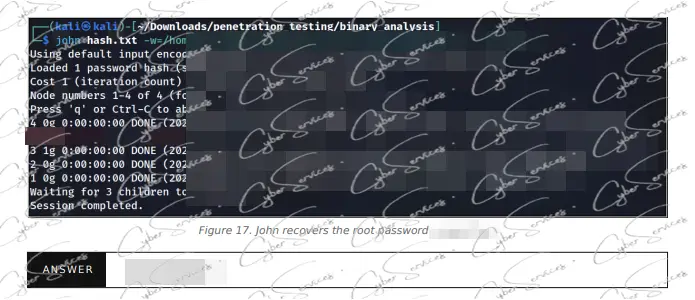
Password security is equally important. Even when a modern hash format is used, a weak or predictable password may still place the account at risk.
IoT Firmware Analysis Range
The IoT range contains 13 challenges, making firmware security one of the largest subject areas in the report.
The questions cover:
- Firmware image structure
- Image sizes and offsets
- Embedded Linux file systems
- SquashFS
- JFFS2
- Firmware headers
- CRC values
- Device configurations
- Hardware identifiers
- Embedded management protocols
- Password records
- Firmware signatures
- Product identification
These topics demonstrate that IoT security is not limited to scanning network ports. Firmware can contain an entire embedded operating system, management interface, update mechanism, startup scripts, and sensitive configuration data.
SquashFS and JFFS2
SquashFS and JFFS2 appear throughout the IoT section.
SquashFS is a compressed, read-only file system frequently used in embedded Linux products. It allows operating system files and application components to be stored efficiently inside a firmware image.
JFFS2 is designed for flash-based storage and is also commonly found in routers, cameras, access points, and other embedded devices.
Firmware file systems may contain:
- Web interface files
- Startup scripts
- Password records
- Network settings
- Certificates
- Private keys
- Update configurations
- Hardcoded secrets
- Third-party software versions
Manufacturers should ensure that reusable credentials, production secrets, and private signing material are never included inside publicly distributed firmware.
Firmware Headers and Integrity
The LPT Master Exam Report includes questions about firmware headers, image sizes, file-system addresses, checksums, and CRC values.
These fields help describe how firmware components are organized and may be involved in update validation.
A secure firmware update process should include:
- Cryptographic signature validation
- Protected signing keys
- Anti-rollback controls
- Secure boot integration
- Update authenticity checks
- Version verification
- Encrypted transport
- Safe failure recovery
Checksums are useful for detecting accidental corruption, but they do not necessarily prove that a firmware package came from a trusted manufacturer. Authenticity requires strong cryptographic validation.
Embedded Device Information LPT Master Exam Report
The report also represents topics such as device identifiers, product information, management protocols, configuration files, and embedded service credentials.
Firmware may unintentionally expose:
- Device models
- Hardware revisions
- Default usernames
- Management ports
- Telnet information
- Wireless settings
- Internal network addresses
- Debugging functions
- Update server details
- Product-specific scripts
Each device should receive unique credentials during manufacturing or first-time configuration. Shared default passwords can turn one disclosed secret into a risk across an entire product line.
Web Application Security Range
The web range includes six challenges across two applications. The main topics are information disclosure, broken access control, exposed database backups, password recovery, OTP security, unrestricted file uploads, local file inclusion, and server log exposure.
The report demonstrates how several web weaknesses can connect. A small information disclosure may reveal an administrative location, while an exposed backup may provide information that weakens an account recovery process.
Robots.txt and Information Disclosure
The robots.txt file is designed to guide search engine crawlers. It should never be treated as an access-control system.
Listing sensitive paths in this file can unintentionally reveal:
- Administrative panels
- Private directories
- Backup locations
- Staging pages
- Development endpoints
- Internal tools
Sensitive resources must use proper authentication and authorization. Preventing search engine indexing does not prevent direct access.
Broken Access Control
One of the web challenges represents an administrative page that lacks effective server-side authorization.
This is a classic broken access control issue. Hiding a link or relying on a client-side redirect does not protect privileged functionality.
Every sensitive request should verify:
- Whether the user is authenticated
- Whether the session is valid
- Whether the correct role is assigned
- Whether the requested resource belongs to the user
- Whether the requested action is permitted
Access controls should be enforced consistently on the server, not only through the application interface.
Exposed Database Backups LPT Master Exam Report
Database backup exposure is another important theme in the LPT Master Exam Report.
A database export may contain:
- Usernames
- Email addresses
- Password records
- Security questions
- Application roles
- Internal identifiers
- Historical account data
- Configuration information
Production web directories should never contain publicly accessible SQL exports, ZIP archives, old source code, configuration backups, or temporary files.
Backups should be encrypted, access-controlled, monitored, and stored outside the public web root.
Password Reset and OTP Security
The web section includes an account recovery workflow involving security questions, a one-time password, and a reset reference.
Password recovery systems can become an alternative route around the main login page when they are not properly protected.
A secure recovery process should use:
- Cryptographically secure tokens
- Short expiration periods
- Single-use reset references
- Strict rate limiting
- User and IP-based throttling
- Generic responses
- Account enumeration protection
- Multi-factor verification
- Monitoring for repeated failures
Short numeric OTP values require particularly strong rate limits because the number of possible combinations is limited.
Security questions are also a weak verification method when their answers can be guessed, researched, or obtained from exposed application data.
Unrestricted File Upload
The report includes an upload function that does not provide sufficient file validation.
Upload security should not depend only on the filename extension or MIME type supplied by the browser.
Recommended controls include:
- Extension allowlists
- MIME type verification
- File signature inspection
- Random server-generated filenames
- Storage outside the web root
- Disabled execution permissions
- Antivirus or sandbox scanning
- File size restrictions
- Authorization checks
Without these controls, a normal image or document feature may expose the underlying web server.
Local File Inclusion and Web Server Logs LPT Master Exam Report
Another application represented in the report contains a local file inclusion weakness involving user-controlled file paths and Apache logs.
Local file inclusion may expose:
- Application source code
- Configuration files
- System account information
- Environment files
- Session data
- Web server logs
- Stored credentials
Server logs may contain request paths, headers, user-agent strings, authentication events, and error messages. Some of this information originates from user-controlled requests, so log content should never be treated as trusted application code.
Applications should use fixed templates or strict server-side allowlists rather than directly processing arbitrary file paths.
CTF Range
The CTF range contains 13 challenges distributed across public and internal Linux systems.
The main themes include:
- Ticketing portal security
- SQL injection
- Database enumeration
- Weak credential encoding
- Upload validation
- SUID permissions
- SSH private key exposure
- Network pivoting
- Scheduled tasks
- Writable privileged scripts
- Command injection
- Linux privilege escalation
This range connects web application vulnerabilities with operating-system security and internal network access.
SQL Injection and Database Security
The ticketing portal represents database-related weaknesses caused by unsafe input handling.
SQL injection may result in:
- Authentication bypass
- User record disclosure
- Password exposure
- Database modification
- Administrative access
- Loss of application data
Prepared statements, parameterized queries, consistent input handling, and limited database permissions are essential defenses.
The report also reflects the difference between encoding and secure password storage. Encoding formats can be reversed and should never be used as a substitute for password hashing.
SUID Permission Risks LPT Master Exam Report
Linux SUID permissions allow an executable to run with the privileges of its owner. If the owner is root, an unnecessary or unsafe SUID file may create a serious security risk.
Organizations should regularly review:
- Unexpected SUID files
- Custom privileged binaries
- File ownership
- Writable executables
- Legacy administrative tools
- Unnecessary elevated permissions
Only programs that genuinely require elevated privileges should use SUID, and custom privileged applications should receive careful code review.
Scheduled Tasks and Writable Scripts
Scheduled tasks are another important Linux security topic represented in the CTF range.
Privileged automation can become dangerous when a script executed by root can be modified by a lower-privileged user.
Security teams should examine:
- Cron job ownership
- Script permissions
- Writable dependencies
- PATH configuration
- Temporary files
- Backup scripts
- Maintenance tasks
- Environment variables
Privileged automation should use fixed paths, protected files, restricted permissions, and detailed logging.
SSH Key Security and Network Pivoting
Private SSH keys appear as important authentication assets within the report.
SSH keys should be protected with the same care as passwords. Reusing a private key across multiple systems increases the impact of a single exposure.
Recommended controls include:
- Unique keys for different roles
- Encrypted private keys
- Strict file permissions
- Regular key rotation
- Source address restrictions
- Removal of obsolete keys
- Centralized key inventories
- Monitoring of SSH authentication
Network segmentation should also prevent a compromised public server from communicating freely with sensitive internal systems.
Command Injection
The CTF range includes an application function affected by unsafe handling of operating-system input.
Command injection can occur when application data reaches a system command without sufficient separation or validation.
Potential consequences include:
- Unauthorized file access
- Credential exposure
- Application takeover
- Internal reconnaissance
- Service disruption
- Complete server compromise
Applications should avoid invoking a system shell with user-controlled input. Safe libraries, fixed arguments, strict allowlists, and low-privileged service accounts reduce the risk.
Skills Evaluated in the LPT Master Exam
Based on the 53 challenges represented in the report, the assessment evaluates skills in:
- Windows and Linux enumeration
- Active Directory security
- SMB and NetBIOS
- Kerberos authentication
- Windows credential protection
- Binary debugging
- Reverse engineering
- Memory corruption awareness
- Linux privilege management
- IoT firmware analysis
- Embedded file systems
- Web access control
- Account recovery security
- File upload assessment
- Local file inclusion
- SQL injection
- SSH key security
- Network pivoting
- Evidence collection
- Professional penetration testing reporting
The diversity of these topics demonstrates why LPT Master requires more than familiarity with automated tools. Candidates must interpret evidence, identify relationships between findings, and communicate technical impact clearly.
Why Reporting Matters LPT Master Exam Report
A practical penetration testing assessment is not complete until the results are documented properly.
A professional report should clearly explain:
- Which systems were assessed
- What security issue was identified
- What evidence supports the finding
- What level of access was obtained
- How the issue affects the wider environment
- What remediation should be prioritized
Technical accuracy is essential, but presentation also matters. Findings should be understandable to technical teams while still providing enough context for decision-makers.
Frequently Asked Questions
What is covered in the LPT Master Exam Report?
The report covers Active Directory, SMB, Kerberos, binary analysis, reverse engineering, IoT firmware, web application security, SQL injection, SSH key exposure, network pivoting, and Linux privilege escalation.
How many challenges are included?
The reviewed LPT Master Exam Report contains 53 challenges worth a total of 2,500 points.
Does LPT Master include Active Directory?
Yes. The report includes Windows domain identification, SMB shares, NetBIOS, Kerberos concepts, LSASS security, domain groups, and administrative access.
Is IoT firmware analysis included?
Yes. The IoT range covers SquashFS, JFFS2, firmware headers, image offsets, checksums, device identification, management protocols, and embedded configuration data.
Which web vulnerabilities are represented?
The report includes information disclosure, broken access control, exposed backups, weak password recovery, insufficient OTP protection, unrestricted file uploads, local file inclusion, and unsafe log handling.
Does the exam include binary analysis?
Yes. Binary challenges cover runtime analysis, memory addresses, processor registers, program behavior, input handling, and Linux privilege boundaries.
Does the CTF range include privilege escalation?
Yes. The CTF section represents SUID permissions, scheduled tasks, writable privileged scripts, exposed SSH keys, command injection, and Linux privilege management.
Does this article contain exam solutions?
No. It explains the security domains and learning objectives without disclosing confidential answers, credentials, flags, hashes, IP addresses, payloads, commands, or step-by-step solutions.
Final Thoughts LPT Master Exam Report
The LPT Master Exam Report demonstrates how broad a professional penetration testing assessment can be.
The Active Directory range evaluates Windows identity, SMB, Kerberos, and credential security. Binary challenges focus on program behavior, runtime analysis, and memory safety. The IoT section introduces embedded Linux, firmware structures, device metadata, and file systems.
The web and CTF ranges connect application vulnerabilities with authentication, databases, operating systems, internal networks, SSH keys, and privilege escalation.
The central lesson is that vulnerabilities should not be assessed only as isolated findings. An exposed backup may weaken account recovery. A compromised account may reach an unsafe upload feature. A leaked SSH key may expose an internal system, while a writable scheduled script may increase the final impact.
Recognizing these relationships is what separates basic vulnerability discovery from professional penetration testing.
Disclaimer: This article is intended for general LPT Master exam awareness and authorized cybersecurity education. It does not disclose confidential answers, passwords, hashes, flags, IP addresses, payloads, commands, or complete examination solutions.
Buy this dump:
Vendor: https://www.eccouncil.org/train-certify/licensed-penetration-tester-lpt-master/
See other certs report: https://cyberservices.store/