
If you have typed “how to buy exam resources anonymously” into a search bar, you are really asking one of two questions. Either you want ordinary privacy around your training spend, or you want to obscure a purchase of leaked exam content and hope anonymity keeps you safe. Those are not the same decision, and only one of them survives contact with how modern certification providers actually work. The privacy version is easy and legitimate. The dump version fails at the exam, not at the checkout, because enforcement happens on the grading and proctoring side where a payment pseudonym has no reach.
At Cyber Services we build mentor-supported preparation for OSCP, OSWP, OSWE, CPTS and a broad range of HTB and OffSec-style exams, so we spend a lot of time helping people separate a smart privacy choice from a career-ending shortcut. This guide draws that line clearly and shows you how to buy exam resources in a way that protects both your data and your credential.
Table of contents
What the search really encodes
The phrase looks like a single request, but it splits along motivation. One group wants to keep study plans away from an employer, control what personal data a vendor holds, and understand how payment information is processed. That is normal consumer privacy, and it is fully compatible with every certification we support.
The other group hopes that alternate emails, pseudonyms, or indirect payment will make it safe to buy exam dumps, writeups, or walkthroughs that contain confidential exam content. This is where the plan collapses. OffSec’s Terms and Conditions and Academic Policy define exam reports, lab reports, walkthroughs, vulnerabilities, and “any other information that may help a student pass” as confidential material that must not be shared or used. Buying or using that material is classified as cheating under a zero-tolerance policy, and the enforcement is aimed at the behavior, not at your billing name.
So the honest reframing is this: your real choice is not how to stay anonymous, it is whether to stay inside the rules. If your plan depends on current exam content, anonymity does nothing to protect you from exam-side detection. If your plan is legitimate preparation, you never needed to hide in the first place. Our whole model at Cyber Services is built around the second path, and you can start with our OSCP exam support services to see what compliant, mentor-led help actually looks like.
Four concepts people keep confusing
Before you decide where to spend money, it helps to pull four ideas apart that usually get blurred into one.
Legitimate study resources are textbooks, practice labs, public writeups of retired or non-exam systems, official courseware, and methodology guides. Providers do not prohibit independent material as long as it does not contain current confidential exam content or breach an NDA.
Illicit dumps and walkthroughs are the confidential category. OffSec specifies that machine walkthroughs, exam and lab reports, and any information that could help someone pass are off limits, and buying or using them triggers enforcement regardless of source.
Ordinary purchasing privacy is about deciding what personal data you share with a training provider, how payment data is handled, and whether to keep purchases off your employer’s systems. This is compatible with exam rules when the resources themselves are clean.
Attempted anonymity to hide cheating is the trap. The policies and detection systems target cheating behavior, so consequences apply no matter how the material was obtained or paid for. Spending effort on anonymity here is optimizing the wrong variable.
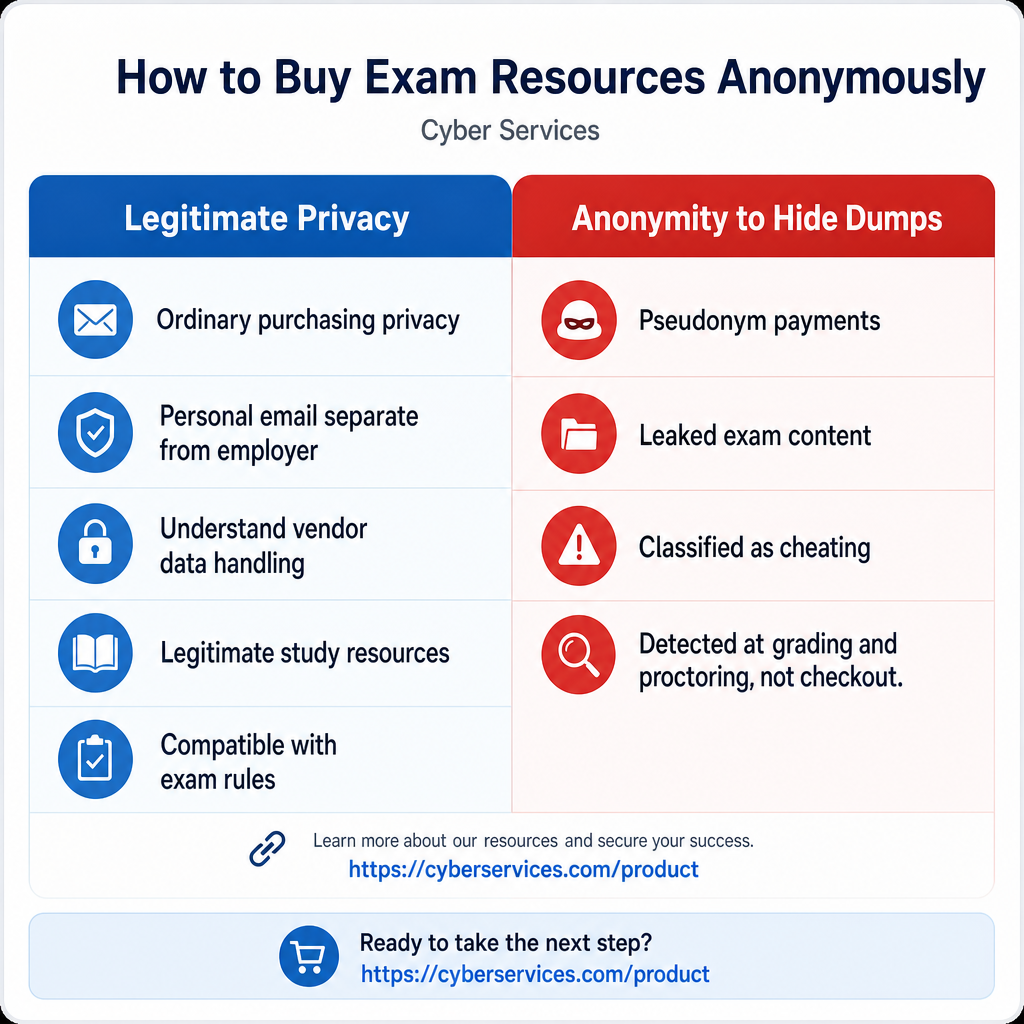
Once these four are separate, most of the confusion disappears. You can be fully private about buying legitimate resources. You cannot be safely anonymous while buying illicit ones, because the risk lives at the exam.
How exam providers protect integrity
Understanding the machinery is what makes the case obvious rather than preachy. Major certifying bodies invest heavily in exam integrity, and their defenses are designed precisely against the “anonymous dump” strategy.
Confidentiality comes first. OffSec’s legal terms and Academic Policy require candidates to treat exam and lab information as confidential and to avoid sharing reports, walkthroughs, or vulnerabilities. Critically, the Academic Policy also states you must not use exam-related information that others shared in breach of policy, even if it is already circulating online. The rule binds the later user, not only the original leaker.
Detection is layered. OffSec publicly describes a community culture that reports suspected cheaters and dump sellers, undisclosed anti-cheating analysis inside the grading process that looks for patterns of reused solutions, continuous modification of exam systems on a regular basis to invalidate static dumps, and online proctoring with in-house teams monitoring video and screen feeds. Their privacy policy confirms proctoring video and screen feeds, including ID images, are retained for months, while certification records are kept indefinitely to protect integrity.
The consequences are severe and retroactive. Learners caught cheating or sharing exam materials can have all certifications revoked and be permanently banned from future courses and exams, and serious cases can carry legal and employment fallout. OffSec can also look backward and revoke previously granted certifications when later evidence surfaces. That indefinite retention window is why a badge obtained through dumps is never truly settled.
Public commentary on OSCP cheating cases adds the career dimension: employers increasingly verify practical skills rather than trusting a badge, so a cert obtained without the underlying capability tends to unravel in a technical interview. Framed against all of this, “how to buy exam resources anonymously” is really a question about how much risk you are willing to carry, and any path involving current exam content puts your certs, future access, reputation, and job on the line.
Mentor-supported prep versus brain dumps
Third-party platforms sit in a real gray area: intense, exam-aligned preparation while the candidate stays bound by the provider’s policies. That is exactly the space Cyber Services occupies, and we are deliberate about which side of the line we operate on.
Our offering centers on mentor support and structured, exam-aligned preparation across OSCP, OSWP, OSWE, CPTS and a wide set of HTB and OffSec-style exams, with post-purchase support that guides how you plan, practice, and report. That model appeals to the people we serve most: aspiring penetration testers, red teamers, and time-constrained professionals who need efficient preparation without gambling their credential. If you want the bigger picture of how those exams stack, our overview of the OffSec certification path maps where each credential fits.
The ethical boundary is precise. Certification providers do not object to third-party study resources in principle; the problem starts when a resource contains confidential exam content or replaces training with answers. The Academic Policy is explicit that any walkthrough for a course or exam machine, and any vulnerabilities or exploits in the context of those labs, are confidential and must not be used to pass. If a resource reproduces live exam machines, solutions, or reporting in a way that enables direct reuse, treating it as a dump crosses into cheating no matter where you bought it.
That is why the defensible way to use a mentor-supported platform is as a skill-building and thinking tool: practicing exploitation techniques, methodology, and reporting on non-exam systems, and getting guidance on how to plan and execute within the rules. Our mentor support model is built to deepen capability, not hand you exam solutions, and that distinction is the entire difference between a resource that helps your career and one that destroys it.
Decision criteria that keep your certification safe
When you decide where and how to buy exam resources, run each option through a short filter before you spend anything.
| Criterion | Green flag | Red flag |
|---|---|---|
| Policy fit | Teaches independent skills, no confidential exam assets | Advertises “exam dump” for current exams or live-machine walkthroughs |
| Content type | Skills, workflows, reporting practice | “Guaranteed pass,” “instant success,” “no study needed” |
| Support model | Mentors guide your learning | Someone tells you what to submit in your report |
| Data handling | Clear privacy terms you can read | Anonymity pitched as protection against detection |
| Career effect | Real capability that survives interviews | A badge you cannot defend in a technical screen |
Start with policy fit. Read the certification’s terms and Academic Policy, focusing on the definitions of confidential information and prohibited assistance. Anything marketed as a dump for a current exam, or a walkthrough identical to live exam assets, is almost certainly incompatible.
Then check the nature of the content. Legitimate resources teach skills, workflows, and reporting; illicit ones supply answers. Promises of instant success or zero study are a direct signal that you are being offered material providers classify as cheating.
Weigh the support model and transparency. A platform that guides your learning is an asset; one that dictates exam submissions is a liability. On privacy, keep your concern where it belongs: how your personal data, payment information, and learning history are stored and used. That is a reasonable question to ask any vendor. Just do not confuse it with the false hope that obscuring your identity around illicit material prevents exam-side detection, because the retained proctoring and certification records show it does not.
Finally, think in career terms. The value of OSCP and advanced HTB or OffSec credentials is genuine skill and reputation, and the public cheating scandals prove employers now test real capability. If, after this filter, your plan still depends on live dumps or confidential writeups, the fix is to change the plan, not to refine the anonymity. When you are ready for preparation that survives that scrutiny, our OSCP exam support services are built exactly for it.
Frequently asked questions
Is it allowed to buy OffSec exam dumps if they already exist online?
No. OffSec defines exam reports, lab reports, walkthroughs, and vulnerabilities for course or exam machines as confidential, and prohibits using any other information that may help a student pass, even when it is already circulating. Using such material is cheating and can cost you your certification, a lifetime ban from future courses and exams, and in serious cases legal remedies.
Can OffSec detect exam-dump use if I paid under a pseudonym?
Yes. Detection relies on community reports, undisclosed anti-cheating checks during grading, regular changes to exam systems, and online proctoring. Proctoring video, screen feeds, and exam records are retained to protect integrity, and certifications can be revoked retroactively. A payment pseudonym does not touch any of those mechanisms.
Are mentor-supported third-party resources allowed for OSCP and similar exams?
Using general study resources and mentorship to build skills is acceptable; using confidential exam content or dumps is not. The Academic Policy states you must not use information that could help you pass, even if someone else shared it in breach of policy. Mentor-supported platforms should build capability, not copy exam solutions.
What does “buy exam resources anonymously” mean if I only care about privacy?
It means choosing resources that respect exam policies, teach skills rather than answers, and have clear data-protection practices, then deciding how much personal information to share. Using a personal email separate from your employer and reading a provider’s privacy terms are reasonable. Trying to hide the purchase of illicit dumps is not a workable strategy.
How can Cyber Services fit into my preparation?
We provide mentor support and post-purchase assistance across a wide range of OffSec and HTB-style certifications. Used well, that structure helps you deepen understanding, practice exploitation and reporting, and prepare efficiently, while keeping every part of your preparation free of live exam content and policy-violating dumps. Tell us your target exam and timeline and we will map a compliant plan to it.