
Anonymous online purchases explained comes down to one idea: separating your real identity from the way you pay, connect, and receive goods so that no single party in the chain can reliably tie a transaction back to you. For cybersecurity and red-team professionals buying legitimate training and exam preparation, that separation is a practical way to keep work, personal, and study identities compartmentalized. The catch is that “anonymous” is rarely absolute. Most methods still leave a record with at least one intermediary, so the real skill is matching the level of privacy you actually need to the method you choose.
At Cyber Services, we deliver mentor-supported certification resources across OffSec, HTB, and related tracks with instant digital access, which is exactly the kind of purchase where buyers often prefer not to leave a trail through corporate procurement or personal purchase history. This guide explains how anonymous purchasing works layer by layer, when it is worth the effort, and where its limits are.
Table of contents
It helps to start with three levels of privacy, because they define the whole decision. A fully anonymous purchase means neither the merchant nor any intermediary holds personally identifiable information (PII) that links back to you, as with cash-backed prepaid codes or privacy-focused cryptocurrencies used correctly. A partially anonymous purchase hides your real card and name from the merchant, but a payment provider or exchange still knows who you are. A standard non-anonymous purchase uses traditional cards, bank transfers, and verified accounts. Knowing which level your threat model requires is the entire point of anonymous online purchases explained.
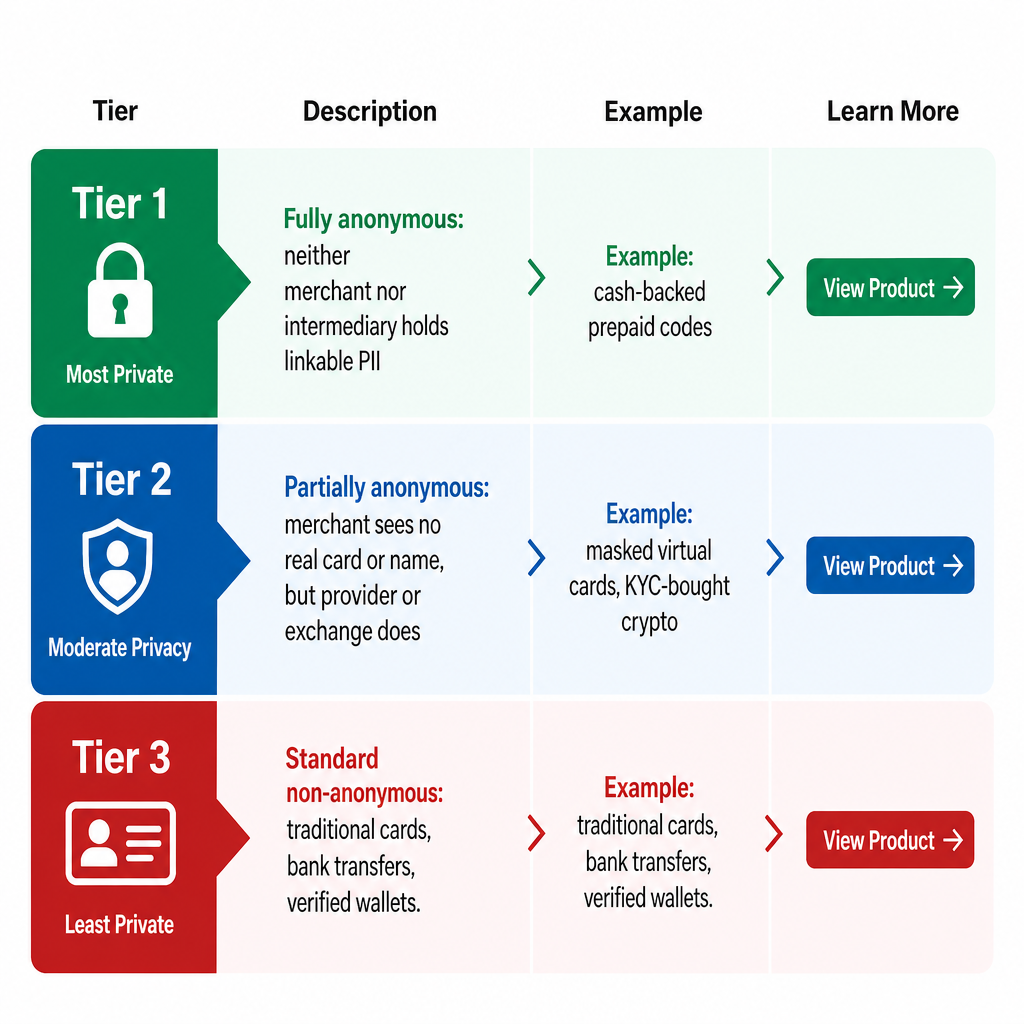
The decision: when do you actually need anonymity?
Before choosing methods, you are deciding why you want an anonymous purchase instead of a standard one. For cybersecurity professionals, the common and legitimate reasons cluster around commercial and social privacy rather than evading law enforcement or breaking certification rules. You might want to keep certification preparation out of employer-managed procurement systems and expense logs. You might prefer that training purchases not reveal current skill gaps or planned career moves to colleagues. Or you may simply want to avoid commercial profiling, where advertisers infer your interests from exam and tooling purchases.
That framing matters, because most “anonymous” methods still create some record with at least one party in the chain: a payment processor, an exchange, or a telecommunications provider. Anonymity here is about reducing exposure, not vanishing.
When the purchase is a digital exam resource, another sub-decision appears: do you need anonymity only at the merchant layer, or across payment, device, and network layers? Digital-only goods remove shipping concerns, but they raise the importance of account and device hygiene, because access typically runs through web portals or downloads. If you are researching how to structure this end to end, our companion guide on how to buy exam resources anonymously walks through the same principles applied to a full purchase.
Many candidates land on a middle path: separate identities while still benefiting from guided preparation. We publish exam-focused service lists and writeups, and if you want to move straight to a specific track, our OSCP exam support services show what mentor-backed, instant-delivery preparation looks like in practice.
Mechanisms: how anonymous purchases actually work
Anonymous purchases are built from mechanisms across three layers: payment, network and accounts, and delivery. Each offers several options with different guarantees and trade-offs.
Payment mechanisms
Contemporary payment guides group anonymous methods by whether PII is exposed and to whom.
Cash and cash-backed instruments remain the most anonymous option, especially when exchanged in person for online-capable instruments such as prepaid codes or vouchers. A voucher model like Paysafecard illustrates this: you buy a code with cash and use the PIN online without sharing bank or card details, achieving strong anonymity as long as you never link it to identifiable accounts.
Prepaid debit cards and gift cards bought with cash can often be used online without a printed name, particularly where a merchant only needs card number, expiry, and CVV. The anonymity weakens the moment you reload from a bank account or register the card with detailed personal data, because that creates an identifiable record with the issuer even if the merchant never sees it.
Cryptocurrencies such as Bitcoin and more privacy-oriented assets can be mostly anonymous when acquired and spent without KYC exchanges and without obvious links to personal wallets. In reality, many exchanges require full identity verification, and public blockchains are inherently traceable without additional privacy tooling, so practical anonymity depends heavily on operational discipline.
Virtual cards, masked cards, and digital wallets act as intermediaries, hiding your underlying card number behind tokens or temporary numbers. A masked card or a semi-anonymous business wallet can stop the merchant from seeing your real identity while the wallet provider still knows who you are. This is the classic “partially anonymous” tier: good against merchant profiling, weaker against legal or financial investigations. Since we support mainstream cards and popular wallets, this layer combines cleanly with a masked card or pseudonymous business name so the merchant sees only tokenized data.
Network and account mechanisms
Payment anonymity collapses if your network and account identity announce who you are. Three mechanisms recur across privacy guides.
Burner or compartmentalized email accounts created without a real name, recovery phone, or link to your primary inbox reduce the chance that merchants or providers tie purchases to your identity. The discipline is to avoid reusing a burner email across unrelated transactions.
VPNs and secure browsing practices mask your IP and encrypt traffic, limiting what ISPs and some sites can infer about your location. That only works alongside supporting hygiene: clearing cookies, using private windows, and not reusing logins that would link an anonymous purchase back to your everyday persona.
Fresh merchant accounts and device hygiene keep separation intact. Dedicated shopping accounts, generic names where permitted, skipping optional fields like phone numbers, and not mixing these accounts with your primary device profiles all preserve the boundary you built.
Because our exam dumps and writeups are delivered digitally through portals and downloads, these account and network habits do most of the work: keeping exam-prep accounts distinct from your main email and VPN profile keeps your preparation footprint separate from ordinary browsing.
Delivery and access mechanisms
For physical goods, delivery choices carry real weight. Guides commonly suggest neutral delivery points such as parcel lockers, pick-up locations, or P.O. boxes under permitted pseudonyms instead of home addresses, which limits how many parties know an item reached your residence. Postal rules vary by jurisdiction, so this is not universal.
For exam resources and writeups, delivery is instant and digital through downloadable reports, portals, or encrypted archives. “Delivery anonymity” is therefore mostly about account and network privacy rather than shipping at all.
Decision criteria: choosing the right anonymous method
Rather than chasing one “best” method, weigh a handful of criteria against your situation.
| Criterion | Lean partially anonymous | Lean fully anonymous |
|---|---|---|
| Required privacy level | Avoiding merchant profiling and ads | Sensitive, high-scrutiny context |
| Typical method | Masked cards, privacy wallets | Cash-backed vouchers, careful crypto |
| Reversibility | Provider can often mediate disputes | Effectively final payments |
| Friction | Lower, works with card-first merchants | Higher, more manual steps |
Required level of anonymity sets the baseline. To dodge profiling and targeted ads, partially anonymous masked cards or privacy-oriented wallets usually suffice. For more intensive scrutiny, cash-backed instruments or high-privacy cryptocurrencies used in non-KYC channels sit closer to full anonymity.
Regulatory environment and KYC obligations constrain your options. Prepaid cards or vouchers may require ID above certain thresholds, and crypto exchanges often enforce strict KYC. Choose methods that stay compliant with local law while still delivering the privacy you need, and verify the current rules for your own jurisdiction rather than assuming.
Merchant acceptance and friction is the practical filter. Many exam-resource platforms emphasize cards and mainstream wallets for speed. In that setting, pairing an accepted method with a privacy layer such as a virtual card or pseudonymous billing detail achieves practical anonymity without sacrificing instant delivery.
Risk tolerance and reversibility deserves honesty. High-privacy methods usually reduce your ability to dispute charges. Cash vouchers and certain crypto payments are effectively final, so if you value recourse, a semi-anonymous arrangement where a trusted provider can still mediate disputes may suit you better.
Ethical and contractual boundaries never disappear. Certification bodies and training vendors maintain terms of service about authorized materials and exam integrity, and anonymous purchasing does not change those obligations. In penetration testing and red teaming, where trust is the currency, you remain responsible for ensuring what you buy aligns with exam rules and professional ethics.
For time-constrained professionals who want mentor-backed resources without a standard, fully identified checkout, we curate service lists and writeups across OSCP, OSEP, OSWE, CPTS, PNPT, and HTB labs. If you are still comparing paths, our breakdown of PNPT versus OSCP helps you pick the track before you optimize how you buy.
Applying anonymous purchases to exam preparation
The practical question for certification candidates is direct: how do I acquire exam preparation resources without tying them to my personal or corporate identity, while staying inside legal and contractual boundaries?
A privacy-preserving pattern for digital exam resources layers three habits. First, a compartmentalized email used only for certification purchases and exam-related portals. Second, a VPN plus disciplined browser hygiene to reduce IP- and cookie-based tracking across study sessions. Third, a payment method that fully or partially hides your real card and address from the merchant, such as prepaid cards, cash-backed vouchers, or masked virtual cards, subject to local regulation and availability.
The common thread across anonymous shopping guidance is simple: anonymity is strongest when you never reconnect any single piece, email, payment, device, or delivery, to your everyday identity. One careless login undoes the rest.
Our materials are built for this workflow. We publish detailed writeups and resource bundles for tracks like CPTS and a broader OffSec and HTB portfolio, all delivered digitally with mentor support and instant access once payment clears. Because everything is digital-only, the layered privacy approach above fits naturally: there is no shipping address to expose, and access hinges on the account and network separation you control. When you are ready to secure your resources, browse the relevant service list and complete a private, instant-access purchase.
Risks, limitations, and realistic expectations
No mechanism in anonymous online purchases explained is a magic cloak, and treating it as one is the fastest way to get burned.
Traceability via intermediaries persists even when merchants cannot see you. Payment providers, ISPs, and VPNs often retain some logs or KYC data, and lawful requests or data breaches can erode the anonymity you assumed you had.
Configuration mistakes are the most common failure. Reusing burner emails across unrelated services, logging into personal accounts over the same VPN session, or linking a prepaid card to an identifiable bank account can deanonymize an otherwise careful setup in one step.
Irreversibility and fraud risk rise with privacy. Highly anonymous methods carry limited consumer protection, so if a merchant fails to deliver, recovering funds paid by cash voucher or certain cryptocurrencies can be difficult or impossible.
Legal and exam-policy constraints stand regardless of payment method. Anonymity does not override laws, intellectual property rights, or certification policies, and many exam providers enforce strict rules whose violation can mean revoked certifications, no matter how a resource was bought.
Being candid about these limits is what lets you choose methods that fit your risk tolerance and ethics while still gaining meaningful privacy over a default, fully identified card purchase. Throughout that process, our mentor-backed portfolio and instant digital delivery are designed to help aspiring penetration testers, red teamers, and web application security professionals reach certification outcomes quickly, whether you pay through standard channels or add privacy layers around the purchase.
Frequently Asked Questions
Is paying with a prepaid card really anonymous?
A prepaid card bought with cash and used without linking to a bank account can offer strong anonymity at the merchant level. Issuers or regulators may still track usage depending on local rules and how the card was loaded, so it is not absolute.
Are cryptocurrencies the best choice for anonymous exam resource purchases?
They can provide high privacy when acquired and spent outside KYC exchanges with careful operational hygiene. They also add volatility, irreversible payments, and compliance complexity, so they do not suit every buyer.
Does using a VPN make my purchase anonymous by itself?
No. A VPN hides your IP and encrypts traffic, but it does not anonymize your payment or account identity. Real anonymity requires aligning network privacy with a burner account and a suitable payment method.
Can I stay anonymous when using mainstream wallets or card payments on training sites?
To a degree, yes. Masked cards, business accounts, and tokenized payment solutions can keep the merchant from seeing your full card or legal name while still meeting provider KYC obligations, giving partial anonymity that is often enough for commercial privacy.
How does Cyber Services fit into anonymous exam preparation?
We deliver digital-only, mentor-supported certification resources across OffSec, HTB, and related paths with instant access after payment. That model works well with privacy-conscious setups where you separate exam-prep accounts, VPN sessions, and payment methods from your main identity while still receiving structured guidance.