
Linux privilege escalation is defined as the process of elevating access rights from a low-privileged user account to root or equivalent administrative control on a Linux system. For penetration testers and red teamers, mastering this discipline separates a shallow foothold from a complete system compromise. Techniques span SUID binary abuse, sudo misconfigurations, Linux capabilities exploitation, writable cron jobs, PATH hijacking, and kernel exploits. Frameworks like MITRE ATT&CK catalog these methods under T1548 and T1068, giving professionals a structured vocabulary for both offense and defense. This guide covers each vector with precision, including 2026 kernel vulnerabilities and enumeration methodology built for real engagements.
What is Linux privilege escalation and why does it matter?
Linux privilege escalation is the technical discipline of moving from a restricted shell to root access after initial compromise. The distinction matters because most real-world footholds land on low-privilege accounts. Without escalation, a tester cannot read sensitive files, pivot to other systems, or demonstrate the full blast radius of a vulnerability. Every serious engagement requires this skill.
The attack surface is wider than most candidates expect. SUID binary abuse remains the most common escalation vector and can often be exploited in under 10 seconds with the right misconfiguration in place. That speed reflects how frequently these misconfigurations appear in production environments, not just lab machines. Candidates preparing for certifications like OSCP, CPTS, or PJPT will encounter these vectors repeatedly.

MITRE ATT&CK maps privilege elevation techniques under T1548 (Abuse Elevation Control Mechanism) and T1068 (Exploitation for Privilege Escalation). Using this framework during an engagement gives testers a repeatable structure for documentation and helps defenders recognize attack patterns after the fact.
Key Linux privilege escalation vectors and techniques
Understanding the full catalog of escalation vectors is the foundation of effective methodology. Each vector exploits a different class of misconfiguration or design weakness in Linux access control.
SUID and SGID binary abuse
SUID binaries execute with the file owner’s privileges, typically root, regardless of who runs them. The classic example is find with the -exec flag: if find carries the SUID bit, a tester can execute arbitrary commands as root. Enumeration starts with find / -perm -4000 2>/dev/null to list every SUID binary on the system. GTFOBins documents exploitation paths for dozens of common binaries.
Sudo misconfigurations
Sudo NOPASSWD entries provide nearly instant privilege elevation opportunities. Running sudo -l reveals which commands the current user can execute as root without a password. A single misconfigured entry, such as (ALL) NOPASSWD: /usr/bin/vim, gives a tester a root shell within seconds using :!/bin/bash inside the editor.
Linux capabilities abuse
Linux capabilities divide root privileges into discrete units. When dangerous capabilities like cap_setuid or cap_dac_override are assigned to interpreters like Python or Perl, a tester can spawn a root shell without any SUID bit. Enumeration uses getcap -r / 2>/dev/null. A binary with cap_setuid+ep can call os.setuid(0) directly and drop into a root shell.
Writable cron jobs
Writable cron scripts executed by root create a persistent and often overlooked escalation path. If a cron job runs /opt/scripts/backup.sh as root every five minutes and that script is world-writable, injecting a reverse shell payload into it grants root access on the next execution cycle. Manual inspection of /etc/cron* and crontab -l catches these.
PATH hijacking
PATH hijacking works when a SUID binary or root-owned script calls another program by name without specifying its full path. A tester creates a malicious binary with the same name in a directory they control, then prepends that directory to $PATH. The SUID binary executes the malicious version as root.
Pro Tip: Before running any automated tool, manually check sudo -l, SUID binaries, and capabilities. These three checks take under two minutes and catch the majority of quick-win escalation paths in real engagements.
Kernel vulnerabilities as privilege escalation methods
Kernel exploits represent the highest-risk, highest-reward category of Linux privilege elevation. They bypass all user-space controls by attacking the operating system itself.
2026 kernel CVEs and their impact
Recent 2026 research confirms that kernel vulnerabilities like CVE-2026-43503 (“DirtyClone”) and CVE-2026-46215 allow local users to gain root by exploiting race conditions and use-after-free bugs. Fixes require kernel updates to versions like 7.1-rc5 or 6.18.32. Affected distributions include Debian, Fedora, and Ubuntu, making these vulnerabilities relevant across the majority of enterprise Linux deployments.
Race conditions occur when two processes access shared memory in an uncontrolled sequence, allowing an attacker to corrupt kernel state at precisely the right moment. Use-after-free bugs arise when the kernel accesses memory that has already been freed, enabling an attacker to place controlled data in that memory region and redirect execution. Both classes require precise timing and careful exploit construction.
Kernel exploits should always be tested with full awareness that a failed attempt may crash production systems, alert defenders, or permanently lose access. Matching the exploit to the exact kernel version and patch level is not optional. It is the minimum due diligence before execution.
Containerized and cloud environment considerations
Kernel exploits in container environments carry additional complexity. Kubernetes pods and Docker containers share the host kernel, meaning a successful kernel exploit inside a container can escalate to the host node. Standard privilege checks differ in these environments, and testers must verify whether they are operating inside a container before selecting an exploit. Tools like amicontained and inspection of /proc/1/cgroup confirm container context.
Patch-level enumeration is the prerequisite for any kernel exploit attempt. Running uname -r and cross-referencing the output against public CVE databases narrows the candidate exploit list significantly. Automated scanners often miss race conditions and memory corruption patterns that require human analysis and kernel internals knowledge.
Effective enumeration methodology for privilege escalation
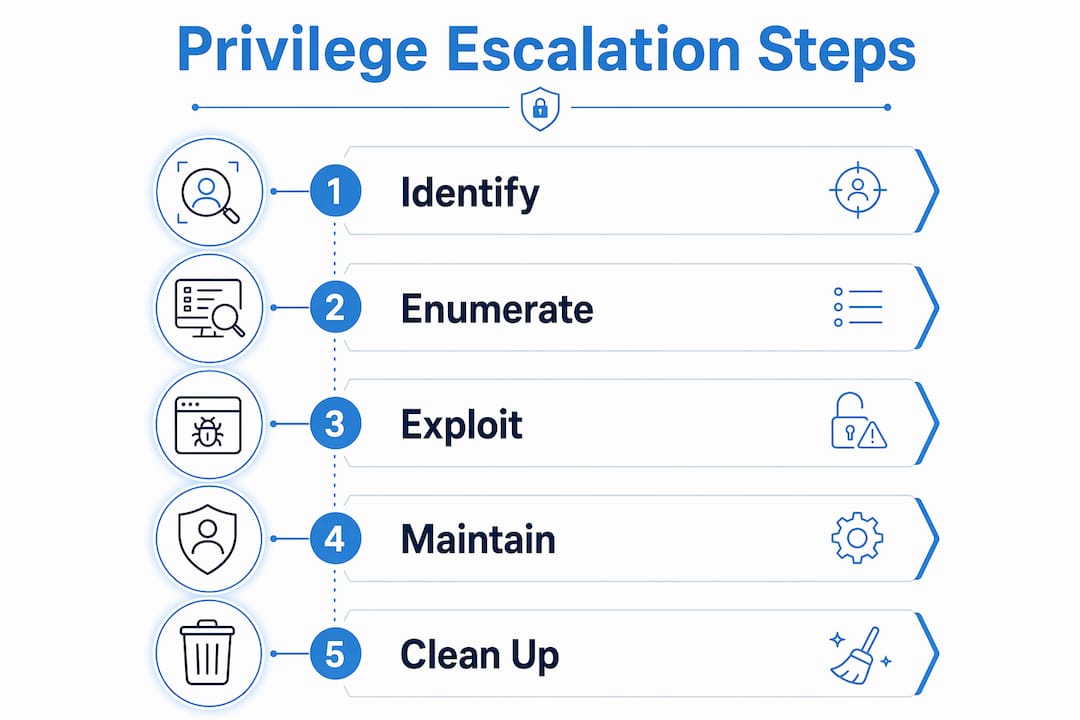
Enumeration is the detective work of privilege escalation. A structured, ordered approach produces results faster and with less noise than running automated tools blindly.
The recommended sequence for any engagement follows this order:
- Run
sudo -lto identify NOPASSWD entries and exploitable sudo rules immediately. - Enumerate SUID binaries with
find / -perm -4000 2>/dev/nulland cross-reference against GTFOBins. - Check capabilities using
getcap -r / 2>/dev/nulland flag any dangerous assignments likecap_setuidorcap_dac_override. - Inspect cron jobs by reviewing
/etc/cron*,/var/spool/cron, and checking for writable scripts called by root-owned jobs. - Hunt credentials in
.bash_history, configuration files, SSH private keys, and environment variables. - Run LinPEAS after manual checks are complete, using it to surface less obvious findings rather than as the first step.
- Consider kernel exploits only after all other vectors are exhausted and the kernel version confirms a matching CVE.
Mapping findings to MITRE ATT&CK during enumeration keeps documentation structured and directly useful for remediation reports. Aligning each finding to T1548 or T1068 also helps defenders prioritize patching.
| Enumeration step | Command | Risk level |
|---|---|---|
| Sudo rules | sudo -l |
None |
| SUID binaries | find / -perm -4000 |
Low |
| Capabilities | getcap -r / |
Low |
| Cron jobs | cat /etc/cron* |
Low |
| Kernel version | uname -r |
None |
| Automated scan | ./linpeas.sh |
Medium |
Automated tools like LinPEAS are valuable but must be supplemented with manual checks. On production systems, automated scripts can generate excessive noise, trigger security alerts, or destabilize services. Starting with surgical manual enumeration and using automation to fill gaps is the professional standard.
Pro Tip: Save LinPEAS output to a file with ./linpeas.sh | tee linpeas_output.txt rather than reading it in real time. Reviewing the output offline lets you prioritize findings without missing critical entries that scroll past.
Challenges, nuances, and pitfalls in privilege escalation
Privilege escalation is not a mechanical process. Misreading a single capability flag or misunderstanding an environment’s restrictions can waste hours or crash a target system.
The most common pitfalls professionals encounter include:
- Capability flag confusion: The difference between
+ep(effective and permitted) and+p(permitted only) is critical. A binary with only+pcannot use the capability until it explicitly activates it in code. Misinterpreting this flag leads to failed exploits and wasted time. Capability flag misreading is one of the most frequent errors in capability-based escalation attempts. - Noexec
/tmprestrictions: Many hardened systems mount/tmpwith thenoexecflag, preventing execution of binaries dropped there. Testers must identify alternative writable directories like/dev/shmor/var/tmpbefore staging payloads. - Restricted shell escapes: Some environments drop users into
rbashor similar restricted shells. Standard escalation commands fail silently. Escaping requires techniques like invoking editors, usingawk, or abusingsshwith command execution flags. - Automated script instability: LinPEAS and similar tools can crash unstable services or trigger host-based intrusion detection systems. Running them on fragile or production systems without client authorization carries real operational risk.
- Hardened binary environments: In locked-down systems, standard binaries may be stripped or restricted, requiring testers to locate writable custom binaries or shared libraries for escalation paths.
Defensive measures increasingly target these exact techniques. Auditd rules, SELinux policies, and AppArmor profiles can detect or block SUID abuse, capability misuse, and suspicious cron modifications. Understanding how defenders detect these actions helps testers operate with appropriate stealth and document realistic risk for clients.
Key Takeaways
Effective Linux privilege elevation requires ordered enumeration, precise technique selection, and disciplined documentation aligned with frameworks like MITRE ATT&CK.
| Point | Details |
|---|---|
| Start with manual checks | Run sudo -l, SUID enumeration, and getcap before any automated tool. |
| Capabilities require precision | Distinguish between +ep and +p flags to avoid failed exploits and wasted time. |
| Kernel exploits are last resort | Match CVE to exact kernel version and test only after all other vectors are exhausted. |
| Automation supplements, not replaces | LinPEAS surfaces hidden findings but can crash systems and trigger alerts if used first. |
| Framework alignment matters | Map every finding to MITRE ATT&CK T1548 or T1068 for structured, defensible reporting. |
The discipline that separates testers from operators
The professionals who consistently achieve root in real engagements are not the ones with the largest exploit collection. They are the ones who read the environment before they touch it. I have watched candidates burn through a dozen kernel exploits on a box that had a world-writable cron script running as root every three minutes. The answer was sitting in plain sight. The habit of reaching for automation before finishing manual enumeration is the single most common failure mode I observe.
Clean documentation of escalation chains is not a bureaucratic afterthought. It is what makes a finding reproducible, defensible, and actionable for the client. An undocumented root shell is a liability, not a deliverable. Every escalation path should be recorded with the exact commands, the misconfiguration identified, and the MITRE ATT&CK technique it maps to.
The OSCP and PJPT exam environments reward exactly this mindset: methodical enumeration, precise exploitation, and clear reporting. Candidates who treat privilege escalation as a checklist rather than a discipline consistently underperform. The goal is not to run every trick in the book. The goal is to run the right trick, once, cleanly.
— kr4k1
Cyberservices resources for advanced privilege escalation training
Candidates preparing for certifications where Linux privilege elevation is a core exam domain need more than theory. They need structured, scenario-based resources that mirror the pressure and complexity of real engagements.
Cyberservices provides premium exam dumps, lab guides, and step-by-step methodology resources for certifications including OSCP, CPTS, PJPT, OSWA, and OSEP. Each resource is built around real-world scenarios, not abstract concepts. The OSWA service list covers practical penetration testing preparation with materials that align directly to the enumeration and exploitation methodology covered in this guide. Candidates who want structured, exam-ready training built for professionals can find the full catalog at Cyberservices.
FAQ
What is the fastest Linux privilege escalation method?
Sudo NOPASSWD misconfigurations provide root access in seconds. Running sudo -l immediately after gaining a foothold is the fastest first check in any engagement.
What does LinPEAS do in privilege escalation?
LinPEAS automates enumeration of SUID binaries, capabilities, cron jobs, credentials, and kernel version. It supplements manual checks but should not replace them, especially on production or fragile systems.
How dangerous are kernel exploits for privilege escalation?
Kernel exploits can cause system crashes (kernel panic) if mismatched to the target version. They should only be attempted after all other escalation vectors are exhausted and the CVE is confirmed against the exact kernel version.
What is the difference between cap_setuid+ep and cap_setuid+p?
The +ep flag makes a capability both effective and permitted immediately, allowing direct exploitation. The +p flag marks it as permitted only, requiring the binary to activate it explicitly in code before it can be used.
How does MITRE ATT&CK apply to Linux privilege escalation?
MITRE ATT&CK maps escalation techniques under T1548 and T1068, providing a standard taxonomy for documenting findings, communicating risk to clients, and helping defenders build detection rules.