

The CAPE certification guide you need starts with one direct answer: CAPE (Certified Advanced Penetration Tester Expert in malware analysis, issued by HackTheBox) is a specialist-level credential that validates your ability to analyze, reverse-engineer, and respond to real-world malware threats in enterprise environments. If you are a SOC analyst, blue teamer, or incident responder looking to formalize your malware analysis skills in 2026, CAPE is one of the most technically demanding and market-relevant badges you can earn.
- What Is the CAPE Certification Guide?
- CAPE Exam Structure and Format
- CAPE vs. CDSA: Which Should You Choose?
- Best Study Resources for the CAPE Exam
- Practical Study Tips for Malware Analysis
- Decision Flow: Is CAPE Right for You?
- CAPE Exam Prep Checklist
- How Cyber Services Helps You Pass CAPE
- Frequently Asked Questions
What Is the CAPE Certification Guide?
CAPE is a HackTheBox-issued certification focused on malware analysis and advanced threat emulation, designed for security professionals who need to understand attacker tooling at a binary level. Unlike certifications that test network reconnaissance or web exploitation, CAPE digs into static and dynamic analysis of malicious code, unpacking, deobfuscation, and behavioral profiling of malware samples.
The credential sits at an advanced level on the HTB learning path, making it unsuitable as a first certification. Candidates are expected to already understand operating system internals, common attack techniques (MITRE ATT&CK), and basic reverse engineering concepts before sitting the exam. CAPE targets malware analysts, incident responders, and blue teamers who want to move beyond detecting threats to truly understanding how they work.
“Understanding malware at a binary level is the difference between reacting to alerts and actually stopping attackers. CAPE is built around that gap.” – Cyber Services editorial team
CAPE Exam Structure and Format
The CAPE exam is a fully practical, lab-based assessment with no multiple-choice questions, meaning you prove competence by doing, not by selecting answers. Candidates are given a controlled environment and must analyze and document malware samples within a set time window, producing written findings that demonstrate depth of understanding.
Key points about the exam format:
- Fully hands-on, lab-based environment
- Requires written analysis and behavioral documentation
- Covers static analysis, dynamic analysis, unpacking, and evasion detection
- No partial credit for guessing – findings must be justified
- Results typically returned within a few business days of submission
One factual benchmark: the CAPE exam is widely regarded as one of the hardest blue-team certifications offered on the HTB platform, comparable in rigor to OSCP on the offensive side. Preparation time for candidates with some RE background typically ranges from 3 to 6 months of dedicated study.
CAPE vs. CDSA: Which Should You Choose?
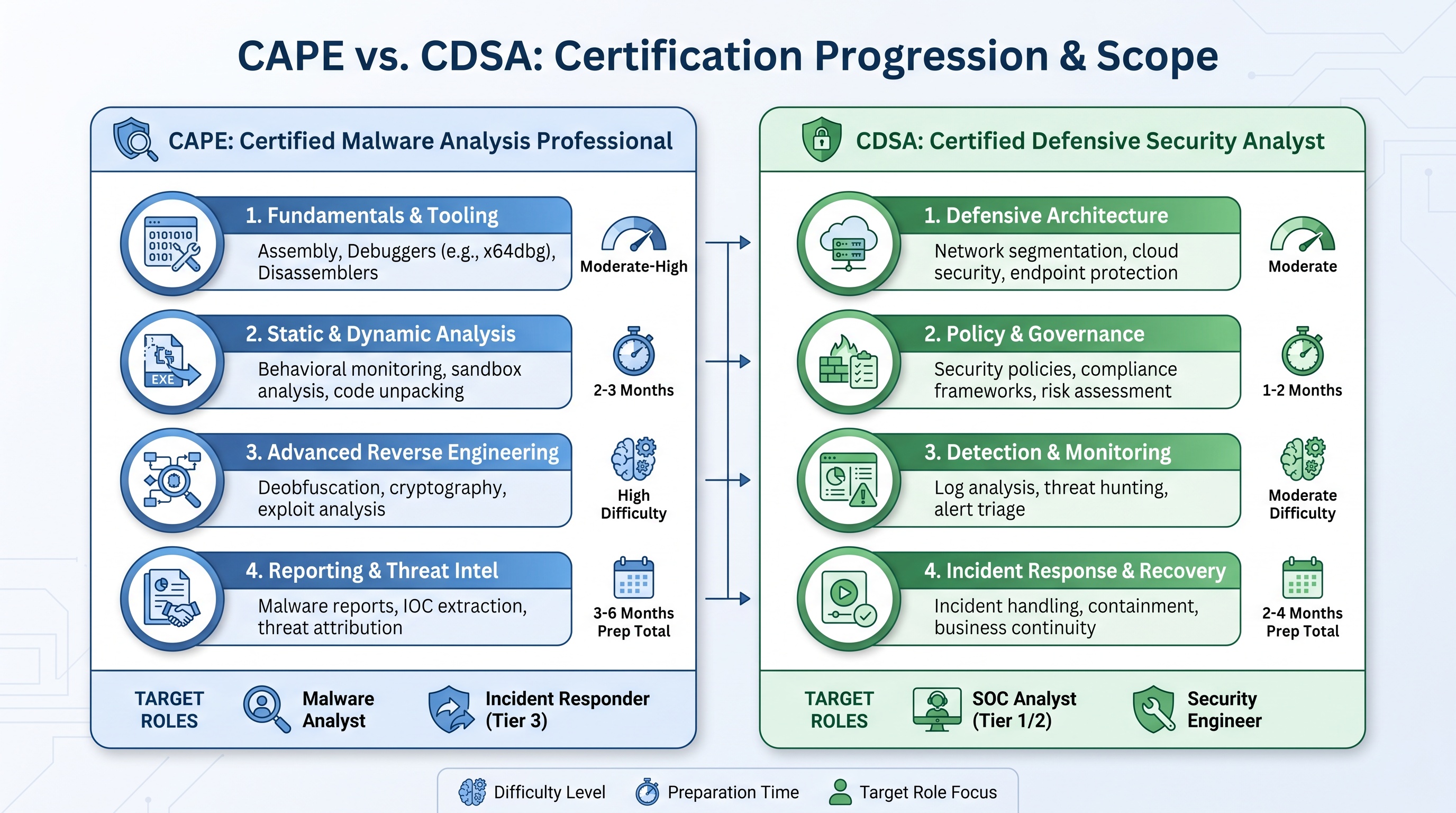
CAPE and CDSA (Certified Defensive Security Analyst) are both HackTheBox defensive certifications, but they serve different career stages and job functions. CDSA is the better starting point for analysts focused on threat detection, log analysis, and SIEM workflows, while CAPE is the right next step for those who need to analyze the malware itself rather than simply detect it.
| Criterion | CAPE | CDSA |
|---|---|---|
| Primary focus | Malware reverse engineering and analysis | Threat detection, SIEM, incident response |
| Difficulty level | Advanced | Intermediate |
| Exam format | Fully practical lab | Fully practical lab |
| Ideal candidate | Malware analyst, threat intel engineer | SOC analyst, blue teamer (L1-L2) |
| Recommended prior cert | CDSA or equivalent RE experience | eJPT or basic networking knowledge |
| Market demand (2026) | High (specialist niche) | Very high (broad SOC roles) |
If you are unsure where to start, consider the CDSA exam resources on Cyber Services to gauge whether you are ready for that stepping-stone level before targeting CAPE.
Best Study Resources for the CAPE Exam
Quality study material is the single most important factor in passing a fully practical exam like CAPE, because memorization alone will not get you through a hands-on lab. The best resources combine theory with applied exercises on real malware samples.
| Resource Type | Examples | Best For |
|---|---|---|
| Official HTB Academy path | Malware Analysis module, RE fundamentals | Structured foundational learning |
| Disassemblers / debuggers | Ghidra, x64dbg, IDA Free | Static and dynamic hands-on practice |
| Sandboxing platforms | Any.run, Cuckoo sandbox (self-hosted) | Dynamic behavioral analysis |
| Exam writeups and reports | Cyber Services CAPE exam writeup | Understanding reporting expectations |
| Community forums | HTB Discord, Reddit r/ReverseEngineering | Peer tips and unofficial hints |
The SANS Institute publishes openly accessible reading material on malware analysis tradecraft that aligns closely with the analytical thinking CAPE rewards. It is worth browsing their public resources as supplemental reading.
For candidates who want to see what a passing-quality analysis report looks like, the CAPE exam writeup available on Cyber Services provides a transparent, premium-quality walkthrough prepared from real exam experience. Cyber Services has supported over 500 clients worldwide with continuously updated materials, so the content reflects the current exam version, not an outdated format.
Practical Study Tips for Malware Analysis
Passing CAPE requires building genuine analytical instincts, not just tool familiarity. Candidates who fail often know the tools but cannot structure their findings into a coherent, evidence-backed narrative.
Tip 1: Build a Safe Malware Analysis Lab
Set up an isolated VM environment (no bridged networking) with Windows and Linux VMs. Practice with known malware families from public repositories like MalwareBazaar or VirusTotal’s free samples. Never run malware outside a sandboxed environment.
Tip 2: Focus on the Analysis Process, Not Just the Output
CAPE graders want to see your reasoning. Document every step: what you observed in static analysis, what changed at runtime, and why you drew each conclusion. The process matters as much as identifying the malware family.
Tip 3: Learn x86/x64 Assembly to a Practical Level
You do not need to be an assembly expert, but you must read disassembly comfortably. Focus on function calls, string operations, and API calls that indicate malicious behavior (e.g., VirtualAlloc, CreateRemoteThread, WriteProcessMemory).
Tip 4: Practice Structured Reporting Under Time Pressure
Use a timer when practicing. The exam has a fixed window, so write analysis reports during timed practice sessions to simulate real conditions. Review your writeups afterward for clarity and technical accuracy.
“The candidates who struggle with CAPE are not always the ones with weak technical skills – they are the ones who cannot translate what they see in a debugger into a clear, professional report.” – Cyber Services editorial team
Decision Flow: Is CAPE Right for You?
Use this decision flow to determine whether CAPE is the right certification target for your current career stage and technical background.
- Do you have at least 1 year of hands-on security experience? If no, start with eJPT or CDSA first.
- Are you comfortable with basic reverse engineering concepts? If no, complete an RE fundamentals course (e.g., HTB Academy RE module) before registering.
- Is your primary career path blue team, SOC, or threat intelligence? If yes, CAPE is directly aligned with your progression.
- Do you already hold CDSA or a comparable defensive cert? If yes, CAPE is the logical next step.
- Are you an offensive pentester looking to understand malware staging? If yes, CAPE adds strong value but is not your primary path – consider OSEP or CRTO first.
- Do you have 3 to 6 months available for focused preparation? If no, delay registration until you can commit the time needed.
| Profile | Recommended Cert | CAPE Priority |
|---|---|---|
| Junior SOC analyst (0-1 yr) | eJPT, CDSA | Low – build foundation first |
| Mid-level blue teamer | CDSA then CAPE | High – natural progression |
| Malware / threat intel analyst | CAPE | Very high – direct match |
| Red teamer / pentester | CRTO, OSEP | Medium – supplemental value |
| Incident responder | CAPE, CDSA | High – directly applicable |
CAPE Exam Prep Checklist
Work through this checklist before booking your CAPE exam slot to make sure you are genuinely ready for the practical assessment.
- Complete the HTB Academy Malware Analysis path in full, including all practical exercises.
- Set up a personal malware lab with at least one Windows VM and one Linux REMnux/FlareVM instance.
- Practice with at least 15 to 20 real malware samples, covering different families (stealers, RATs, droppers, ransomware loaders).
- Master at least two disassemblers (e.g., Ghidra for static, x64dbg for dynamic) at a comfortable operational level.
- Write and review five full malware analysis reports from scratch, timed under exam conditions.
- Study common packing/obfuscation techniques and practice unpacking UPX, custom packers, and XOR-encoded payloads.
- Review CAPE exam writeups to calibrate your report quality against passing-standard submissions.
- Test your lab environment to confirm network isolation, snapshot functionality, and tool availability before exam day.
How Cyber Services Helps You Pass CAPE
Cyber Services is a privacy-focused platform with six years of experience helping cybersecurity professionals pass demanding certifications efficiently. The platform provides exam writeups, walkthrough reports, and direct support for CAPE candidates who want to understand what a high-quality submission looks like before they attempt the real thing.
The CAPE exam writeup on Cyber Services is continuously updated to reflect the current exam environment, not archived from a previous version. Every resource is prepared with transparency: you see exactly what analysis steps were taken, how findings were documented, and what level of technical detail the exam expects.
For candidates who need more than a written report, Cyber Services also offers full-support and remote-pass services for supported certifications. The best-price guarantee and worldwide track record (over 500 satisfied clients) make it a practical first stop when building your exam preparation plan.
“A well-structured exam writeup does not just show you the answer – it teaches you the analytical thinking pattern you need to replicate independently.” – Cyber Services editorial team
Frequently Asked Questions
Is CAPE harder than CDSA?
Yes, CAPE is significantly harder than CDSA. CDSA tests detection, triage, and investigation skills at an intermediate level, while CAPE requires deep malware reverse engineering, unpacking, and structured analysis at an advanced level. Most candidates complete CDSA before attempting CAPE.
How long does it take to prepare for the CAPE exam?
Candidates with some prior experience in reverse engineering typically need 3 to 6 months of focused preparation. Those starting from a detection-only background (SOC L1/L2) should expect 6 months or more, especially if they need to build assembly reading skills from scratch.
What tools should I know for the CAPE exam?
You should be comfortable with at least one disassembler (Ghidra or IDA Free), one dynamic debugger (x64dbg), and a sandboxing environment. Familiarity with Python scripting for automating analysis tasks is also helpful, though not always required.
Can exam writeups from Cyber Services help me pass CAPE?
Yes. The CAPE exam writeup on Cyber Services provides a detailed, transparent walkthrough of the analysis process and reporting format expected by graders. Reviewing a passing-quality report helps you calibrate your own work and avoid the structural mistakes that cause many technically capable candidates to fail.
Did you like this article?
Everything you just read is available on our site – tools, resources, and updates are delivered directly to you. Click the “Buy Now” button on the homepage to get full access today.
{“@context”:”https://schema.org”,”@type”:”Article”,”headline”:”CAPE Certification Guide: Malware Analysis Exam Resources and Study Tips”,”author”:{“@type”:”Organization”,”name”:”Cyber Services”},”publisher”:{“@type”:”Organization”,”name”:”Cyber Services”,”logo”:{“@type”:”ImageObject”,”url”:”https://xhdswqyfzrihqsonlzcp.supabase.co/storage/v1/object/public/logos/17f6a2f4-f796-4940-b1e6-6bfd4e9d1c2a.png?v=1786023724192″}},”image”:[“https://xhdswqyfzrihqsonlzcp.supabase.co/storage/v1/object/public/article-images/17f6a2f4-f796-4940-b1e6-6bfd4e9d1c2a/7861b160-b19e-4aea-8553-f2ea5ba1d6bb/a4b4f87d-60fe-45db-b227-cf2e7de61817.jpg”],”url”:”https://cyberservices.store/cape-certification-guide/”,”mainEntityOfPage”:{“@type”:”WebPage”,”@id”:”https://cyberservices.store/cape-certification-guide/”},”datePublished”:”2026-08-15″,”dateModified”:”2026-08-15″}
{“@context”:”https://schema.org”,”@type”:”FAQPage”,”mainEntity”:[{“@type”:”Question”,”name”:”Is CAPE harder than CDSA?”,”acceptedAnswer”:{“@type”:”Answer”,”text”:”Yes, CAPE is significantly harder than CDSA. CDSA tests detection, triage, and investigation skills at an intermediate level, while CAPE requires deep malware reverse engineering, unpacking, and structured analysis at an advanced level. Most candidates complete CDSA before attempting CAPE.”}},{“@type”:”Question”,”name”:”How long does it take to prepare for the CAPE exam?”,”acceptedAnswer”:{“@type”:”Answer”,”text”:”Candidates with some prior experience in reverse engineering typically need 3 to 6 months of focused preparation. Those starting from a detection-only background (SOC L1/L2) should expect 6 months or more, especially if they need to build assembly reading skills from scratch.”}},{“@type”:”Question”,”name”:”What tools should I know for the CAPE exam?”,”acceptedAnswer”:{“@type”:”Answer”,”text”:”You should be comfortable with at least one disassembler (Ghidra or IDA Free), one dynamic debugger (x64dbg), and a sandboxing environment. Familiarity with Python scripting for automating analysis tasks is also helpful, though not always required.”}},{“@type”:”Question”,”name”:”Can exam writeups from Cyber Services help me pass CAPE?”,”acceptedAnswer”:{“@type”:”Answer”,”text”:”Yes. The CAPE exam writeup on Cyber Services provides a detailed, transparent walkthrough of the analysis process and reporting format expected by graders. Reviewing a passing-quality report helps you calibrate your own work and avoid the structural mistakes that cause many technically capable candidates to fail.”}}]}