

CPENT vs OSCP is one of the most debated certification comparisons in offensive security, and the direct answer is this: OSCP carries stronger name recognition with most enterprise employers in 2026, while CPENT offers broader topic coverage at a lower entry cost. Which one proves more to your specific employer depends on the role, the industry, and how you position your credential.
- What Are CPENT and OSCP?
- Exam Structure and Format Compared
- Which Certification Is Harder to Pass?
- CPENT vs OSCP Employer Value and Market Recognition
- Cost and Prerequisites Side by Side
- Who Should Choose CPENT and Who Should Choose OSCP?
- How to Prepare Effectively for Either Exam
- Frequently Asked Questions
What Are CPENT and OSCP?
CPENT (Certified Penetration Testing Professional) is issued by EC-Council, covering a wide range of penetration testing domains including network, IoT, OT, and binary exploitation basics. OSCP (Offensive Security Certified Professional) is issued by Offensive Security and focuses on practical, hands-on exploitation across a live 24-hour exam environment. Both target intermediate-level pentesters, but their philosophies differ significantly: CPENT leans on structured knowledge breadth, while OSCP demands demonstrated exploitation skill under pressure.
Exam Structure and Format Compared
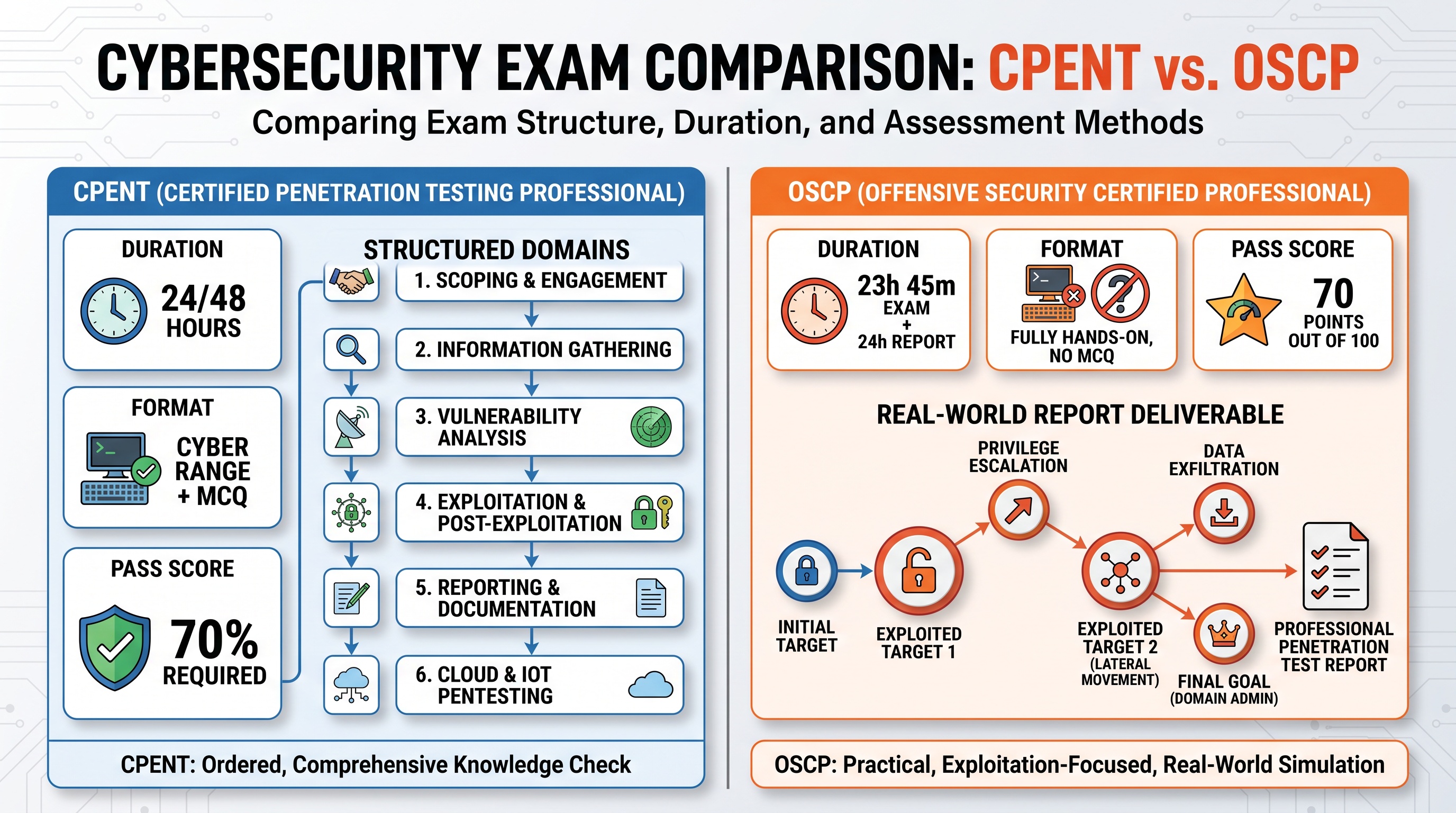
The exam format is where CPENT and OSCP diverge most clearly, and understanding those differences helps candidates choose the path that matches their learning style.
| Feature | CPENT | OSCP |
|---|---|---|
| Issuing Body | EC-Council | Offensive Security |
| Exam Duration | 24 hours (two 12-hour slots) or 48 hours | 23 hours 45 minutes (+ 24 hrs report) |
| Format | Live cyber range + MCQ elements | Fully hands-on live lab, no MCQ |
| Passing Score | 70% for CPENT; 90%+ unlocks LPT Master | 70 points out of 100 |
| Proctored | Yes | Yes |
| Report Required | Yes (optional for LPT Master upgrade) | Yes, mandatory professional report |
A key structural fact: OSCP requires candidates to submit a professional penetration testing report as part of the exam, training a real-world deliverable skill. CPENT’s range-based evaluation gives more guided structure, which some candidates find less intimidating as a starting point.
Which Certification Is Harder to Pass?
OSCP is widely regarded as the more technically demanding certification because it requires active exploitation with no multiple-choice safety net, relying entirely on hands-on performance. CPENT includes a structured cyber range but also incorporates theoretical question elements, giving candidates more ways to accumulate score. The OSCP environment is intentionally restrictive: no automated exploitation tools like Metasploit on most targets, forcing candidates to understand every step of their attack chain.
OSCP’s 24-hour hands-on exam with a mandatory professional report is designed to mirror a real-world engagement, making technical depth non-negotiable for every candidate who passes.
CPENT’s 48-hour option makes the timeline less brutal, but the breadth of domains (IoT, OT, binary analysis, mobile) means preparation time can actually be longer overall. For candidates coming from a pure network pentesting background, CPENT’s topic spread can be a genuine surprise.
CPENT vs OSCP Employer Value and Market Recognition
In terms of employer recognition, OSCP consistently appears in more penetration tester job postings than CPENT across major hiring platforms in 2026. Enterprise security teams, government contractors, and Big-4 consulting firms list OSCP as a preferred or required credential far more frequently than CPENT. That said, CPENT holds solid recognition in organizations that already work within the EC-Council ecosystem, particularly those that require CEH as a baseline.
| Dimension | CPENT | OSCP |
|---|---|---|
| Job Posting Frequency | Moderate | High (frequently listed as preferred) |
| Government / DoD Relevance | Moderate (EC-Council recognition) | High (common DoD 8570 context) |
| Consulting Firm Recognition | Moderate | Strong |
| Community Respect (technical peers) | Moderate | Very High |
| LPT Master Upgrade Path | Yes (at 90%+ score) | No direct equivalent |
SANS Institute, a leading institution for cybersecurity training and research, notes the growing importance of practical, hands-on credentials in the hiring process. For more context on industry-recognized training frameworks, visit SANS Institute.
Cost and Prerequisites Side by Side
Cost is a real factor for many self-funded candidates, and CPENT has a meaningful price advantage over OSCP when comparing the base exam bundle.
- CPENT: Typically bundled with EC-Council iLearn or official training; exam voucher is commonly available around $999 USD as part of a training package.
- OSCP: Requires a PEN-200 course subscription from Offensive Security; the 90-day lab package with one exam attempt starts at $1,499 USD.
- Prerequisites: Neither certification has a mandatory formal prerequisite, but both strongly recommend networking fundamentals and hands-on Linux experience.
- Renewal: CPENT requires EC-Council Continuing Education credits every three years. OSCP does not expire once earned.
The fact that OSCP does not expire is a long-term cost advantage many candidates overlook when calculating total investment.
Who Should Choose CPENT and Who Should Choose OSCP?
Your target role and current skill level should drive this decision, not certification prestige alone. Use the checklist below to orient your choice.
- Are most job postings in your target market listing OSCP specifically? If yes, prioritize OSCP.
- Do you already hold CEH and want to stay in the EC-Council certification track? CPENT is the natural next step.
- Are you aiming for a consulting or red team role at a large enterprise or government contractor? OSCP is the stronger signal.
- Do you need coverage of IoT, OT, or mobile pentesting topics for your current role? CPENT’s breadth may serve you better.
- Is budget a hard constraint right now? CPENT’s entry cost is generally lower.
- Do you want a credential that never expires and is universally recognized in technical communities? Choose OSCP.
- Are you comfortable with extended self-study and unguided lab environments? OSCP’s PEN-200 labs are designed for that approach.
For candidates whose goal is a red team or penetration testing role at a high-scrutiny employer, OSCP’s hands-on exam format is a more credible proof of skill than any multiple-choice component can provide.
How to Prepare Effectively for Either Exam
Effective preparation for both certifications requires consistent hands-on practice, not just reading or watching tutorials. For OSCP, the PEN-200 course is the official and most direct path; supplement it with platforms like HackTheBox and TryHackMe to build enumeration speed. For CPENT, EC-Council’s official courseware covers the domain list, but candidates should pay extra attention to the binary exploitation and IoT modules, which catch many test-takers off guard.
Cyber Services has supported over 500 clients worldwide across both certifications over six years, offering CPENT exam preparation resources that are continuously updated to reflect the latest exam content. For OSCP, the full OSCP service list covers everything from walkthrough reports to full-support options, all with a best-price guarantee and a strong focus on candidate privacy.
Regardless of which certification you pursue, structured exam intelligence combined with active lab practice is the most reliable preparation path in 2026.
Frequently Asked Questions
Is OSCP harder than CPENT?
Yes, most candidates and hiring managers consider OSCP harder because it is entirely hands-on with no multiple-choice component and requires a professional report submission. CPENT includes structured range elements and theoretical questions that provide additional scoring opportunities, making it somewhat more approachable for candidates transitioning from an exam-based background.
Does CPENT or OSCP look better on a resume?
OSCP generally carries stronger resume weight in penetration testing and red team roles, particularly at enterprise employers, government contractors, and consulting firms. CPENT is well-recognized within the EC-Council ecosystem and in organizations that value broad domain coverage, but OSCP appears more frequently in job posting requirements across major markets in 2026.
Can I pursue both CPENT and OSCP?
Yes, and many professionals do. A common path is to pass CPENT first for broader domain coverage and then pursue OSCP to demonstrate hands-on exploitation depth. Holding both signals both breadth and practical skill to employers, which can be a strong differentiator in competitive hiring situations.
Which certification is better value for money?
CPENT typically has a lower upfront cost and covers more domains, which can feel like better value for candidates who want broad knowledge. However, OSCP does not expire and commands higher employer recognition, which often translates to better salary outcomes and more job opportunities over a career, making its higher initial cost a reasonable long-term investment.
Did you like this article?
Everything you just read is available on our site – tools, resources, and updates are delivered directly to you. Click the “Buy Now” button on the homepage to get full access today.
{“@context”:”https://schema.org”,”@type”:”Article”,”headline”:”CPENT vs OSCP: Which Certification Proves More to Employers?”,”author”:{“@type”:”Organization”,”name”:”Cyber Services”},”publisher”:{“@type”:”Organization”,”name”:”Cyber Services”,”logo”:{“@type”:”ImageObject”,”url”:”https://xhdswqyfzrihqsonlzcp.supabase.co/storage/v1/object/public/logos/17f6a2f4-f796-4940-b1e6-6bfd4e9d1c2a.png?v=1786023724192″}},”image”:[“https://xhdswqyfzrihqsonlzcp.supabase.co/storage/v1/object/public/article-images/17f6a2f4-f796-4940-b1e6-6bfd4e9d1c2a/626681af-1a71-4bb4-8c89-b2e83ae2c796/c9bc1305-22b8-4b38-8088-38160145650e.jpg”],”url”:”https://cyberservices.store/cpent-vs-oscp/”,”mainEntityOfPage”:{“@type”:”WebPage”,”@id”:”https://cyberservices.store/cpent-vs-oscp/”},”datePublished”:”2026-08-20″,”dateModified”:”2026-08-20″}
{“@context”:”https://schema.org”,”@type”:”FAQPage”,”mainEntity”:[{“@type”:”Question”,”name”:”Is OSCP harder than CPENT?”,”acceptedAnswer”:{“@type”:”Answer”,”text”:”Yes, most candidates and hiring managers consider OSCP harder because it is entirely hands-on with no multiple-choice component and requires a professional report submission. CPENT includes structured range elements and theoretical questions that provide additional scoring opportunities, making it somewhat more approachable for candidates transitioning from an exam-based background.”}},{“@type”:”Question”,”name”:”Does CPENT or OSCP look better on a resume?”,”acceptedAnswer”:{“@type”:”Answer”,”text”:”OSCP generally carries stronger resume weight in penetration testing and red team roles, particularly at enterprise employers, government contractors, and consulting firms. CPENT is well-recognized within the EC-Council ecosystem and in organizations that value broad domain coverage, but OSCP appears more frequently in job posting requirements across major markets in 2026.”}},{“@type”:”Question”,”name”:”Can I pursue both CPENT and OSCP?”,”acceptedAnswer”:{“@type”:”Answer”,”text”:”Yes, and many professionals do. A common path is to pass CPENT first for broader domain coverage and then pursue OSCP to demonstrate hands-on exploitation depth. Holding both signals both breadth and practical skill to employers, which can be a strong differentiator in competitive hiring situations.”}},{“@type”:”Question”,”name”:”Which certification is better value for money?”,”acceptedAnswer”:{“@type”:”Answer”,”text”:”CPENT typically has a lower upfront cost and covers more domains, which can feel like better value for candidates who want broad knowledge. However, OSCP does not expire and commands higher employer recognition, which often translates to better salary outcomes and more job opportunities over a career, making its higher initial cost a reasonable long-term investment.”}}]}