
Deciding between PNPT and OSCP rarely comes down to which certificate is “harder” or more prestigious. When you weigh pnpt vs oscp honestly, you are really choosing between two different pictures of what a penetration tester does: one mirrors a full client engagement from reconnaissance to a live debrief, the other proves you can break into hosts and escalate privileges under a tight, scored clock. Both are practical, hands-on exams with no multiple-choice shortcuts. The right pick depends on your experience, the roles you want, and how much uninterrupted time you can actually commit.
This comparison lays out what each exam tests, where they diverge on realism, skill coverage, proctoring, and hiring signal, and when a smaller stepping-stone certificate is the smarter first move. We work with candidates on both tracks every week, so we will also be direct about where mentor-supported preparation changes the equation for time-constrained professionals.
Table of contents
PNPT and OSCP defined without ranking
The Practical Network Penetration Tester (PNPT) from TCM Security is designed to mirror a real penetration test from reconnaissance through reporting and client debrief. You get five full days to assess an external and internal network, two days to produce a professional report, and the exam finishes with a live 15-minute presentation of your findings to senior penetration testers. Across that week you perform OSINT, breach the perimeter, move laterally and vertically through Active Directory, bypass defenses, compromise the domain controller, and deliver actionable remediation advice. It is a full engagement compressed into a single timeline.
The Offensive Security Certified Professional (OSCP) is a 24-hour, proctored practical exam against a private lab that includes three standalone machines and one Active Directory set, followed by a 24-hour window to submit a professional report. To pass you must reach at least 70 of 100 points by compromising the targets through foothold plus privilege escalation, with 60 points available from the standalone hosts and 40 from the AD set. There are no multiple-choice questions; points come only from actually exploiting systems and documenting the work. Every OffSec exam, OSCP included, is proctored over a private VPN by an OffSec employee.
Stripped to essentials, PNPT asks you to run and narrate an entire engagement, while OSCP asks you to demonstrate exploitation and escalation under strict scoring and monitoring. Neither definition contains a verdict. They measure overlapping but genuinely different competencies.
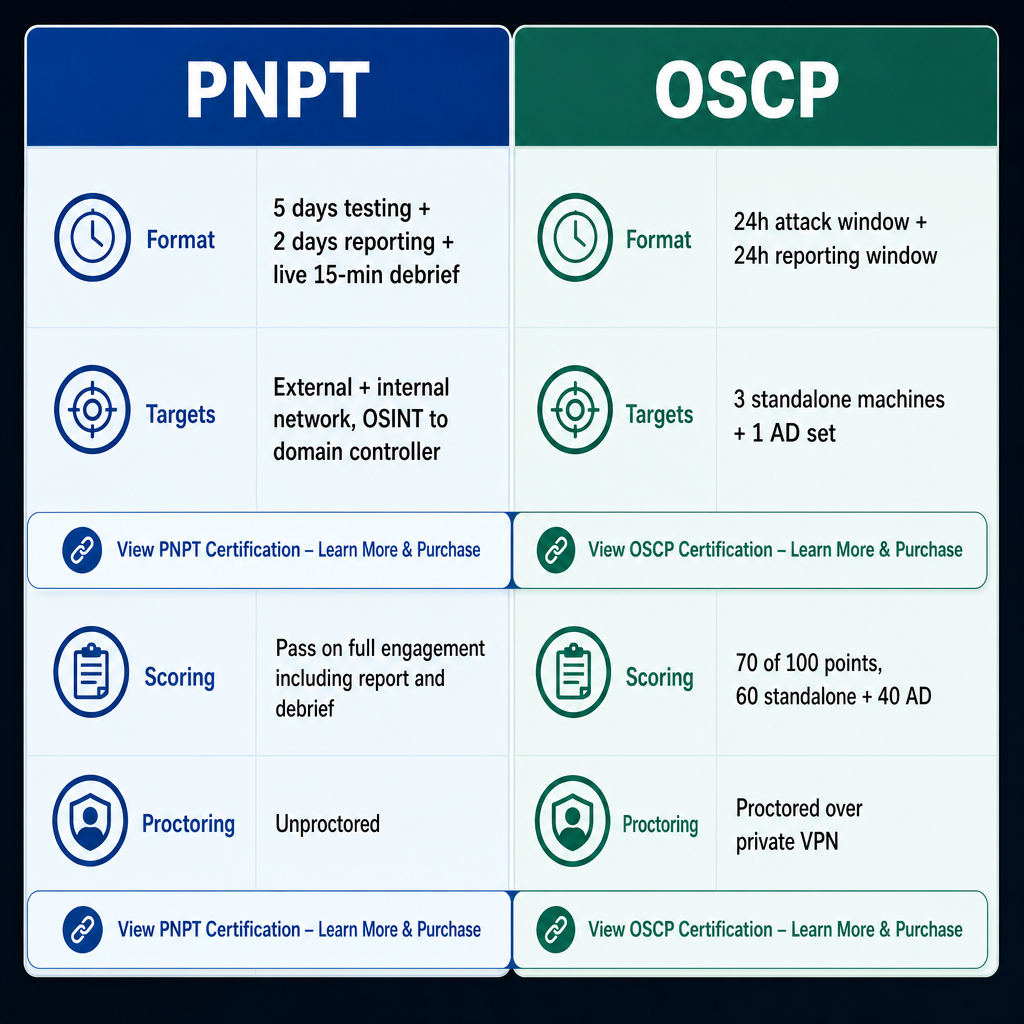
The alternatives sitting beside PNPT vs OSCP
Even when your core question is pnpt vs oscp, there are real alternatives that sit beside or between them. They do not replace either exam, but they change the sequence you should follow.
Hands-on stepping stones such as eJPT, PJPT, or CJCA validate foundational penetration testing or Active Directory skills before you commit to a multi-day exam. Broader pentest tracks like CPTS or CPENT lean into Hack The Box-style labs and mixed infrastructure engagements. Specialized paths such as OSWE, OSWA, BSCP, or CWEE serve candidates focused on web application and code-level security. Advanced red-team and AD certificates like CRTP, CRTE, CRTM, CARTP, and CRTO target operators aiming at post-OSCP lateral movement and Kerberos-heavy campaigns.
The practical consequence is timing. Some candidates use these to build confidence before OSCP; others stack them around PNPT to signal broader capability. If you are early in your career, a shorter certificate first can turn PNPT or OSCP from a gamble into a test of polish rather than fundamentals. If you already run engagements, these become complements rather than prerequisites. We prepare candidates for many of these adjacent exams, so the entry point can match your actual skill level instead of forcing you into the deepest end first. Our eJPT exam writeup and PJPT exam writeup show how those foundational tracks map onto the harder exams above.
Criteria-by-criteria: how the two exams diverge
Exam realism and engagement style
PNPT is built to feel like a client engagement: OSINT, perimeter breach, internal AD movement, a professional report, and a live presentation. OSCP is a tightly time-boxed lab exam with defined per-host scoring and explicit point thresholds. The difference is not depth versus shallowness; it is narrative versus checkpoint.
| Criterion | PNPT | OSCP |
|---|---|---|
| Engagement style | Full external + internal pentest, OSINT to AD compromise, report and live debrief | 24-hour lab against 3 standalone machines + 1 AD set, scored out of 100 |
| Time allocation | 5 days testing + 2 days reporting + live presentation | 24h attack window + 24h reporting window |
| Reporting focus | Professional report plus live debrief, both mandatory to pass | Professional report required, no live presentation |
Skill coverage
PNPT requires you to combine OSINT, perimeter exploitation, internal lateral movement, AV and egress bypass, and AD compromise inside one continuous story. OSCP concentrates on host-level exploitation and privilege escalation, with a strong Active Directory attack chain, Linux and Windows local escalation, and web exploitation.
| Criterion | PNPT | OSCP |
|---|---|---|
| External attack surface | Strong OSINT and perimeter exploitation component | Present, but weighted below host exploitation and escalation |
| Active Directory skills | AD exploitation, lateral and vertical movement, AV/egress bypass, DC compromise | AD attack path across a 3-machine set worth 40 points |
| Exploit types | Network, web, AD, and evasion integrated into one engagement | Enumeration, exploitation, Linux/Windows privilege escalation, web attacks |
Proctoring, tools, and exam experience
PNPT is unproctored and allows any tools, including Metasploit and custom automation, with voucher terms that include at least one free retake and long validity, and the certification listed as lifetime once achieved. OSCP is proctored over a private VPN, requires practical exploitation rather than automated scoring, and manages retake and voucher policies through OffSec, with bonus points available through PEN-200 labs and exercises.
| Criterion | PNPT | OSCP |
|---|---|---|
| Proctoring | Unproctored, no monitoring software | Proctored by OffSec over a private VPN |
| Tool restrictions | All tools allowed, including automation | Governed by OffSec exam rules; hands-on exploitation required |
| Retakes & validity | Free retake, long validity, lifetime certification once earned | Retake and voucher policies managed by OffSec; PEN-200 bonus points |
Brand recognition and hiring signal
OSCP is one of the longest-standing, widely recognized practical pentest certificates, and it is frequently named directly in job postings. PNPT is newer but has earned a reputation for realistic exam design and its emphasis on reporting and full AD compromise. In signaling terms, OSCP reads as “prove you can hack and escalate,” while PNPT reads as “prove you can run the whole engagement and brief a client.” Neither cancels the other on a resume.
How mentor support changes the preparation equation
Both exams are time-intensive and high-stress by design. That is precisely where preparation strategy, not just raw skill, decides outcomes for working professionals. We built our service around the candidate who cannot spend months reverse-engineering what an exam will feel like. Instead of assembling every practice lab and report template alone, you get mentor-supported, exam-focused resources with instant delivery, so your limited evenings go toward replicating what actually appears in real assessments.
This does not alter official scoring or proctoring rules, and we are careful never to imply it does. What it changes is wasted time: structured guidance mapped to each exam’s structure and scoring means your practice stays aligned with the real thing. If you want to see how we scope this per exam, our PNPT exam writeup and OSCP exam support services lay out exactly what each package targets. Reach out and tell us your timeline and current level, and we will point you to the right starting resource.
When PNPT, when OSCP, and when neither
When PNPT makes more sense
Lean toward PNPT when your goal is end-to-end engagement ability: OSINT and external breach through to AD compromise, report writing, and a live debrief. It fits candidates who value client-facing skills such as communicating risk, remediation, and prioritisation in both writing and speech, not just exploitation. The unproctored, tool-friendly environment suits practitioners who want to use their normal workflow, including automation and offensive frameworks, across a realistic timeline. If your current or target role involves full network pentests, internal assessments, and executive read-outs, PNPT maps closely to the actual work. For candidates already in IT or security who lack time to experiment blindly in a fresh lab for five days, our PNPT-oriented resources compress the research phase without touching exam integrity.
When OSCP makes more sense
Choose OSCP when you need a widely recognised baseline that recruiters and hiring managers search for by name. It is the right proof when you want to show host-level exploitation and privilege escalation under strict time pressure and proctoring, and when you are ready to handle AD attack paths, Linux and Windows local escalation, and web exploitation inside one scored exam. It is also the pragmatic choice when your target organisations explicitly list OSCP or “equivalent” as a requirement. Our OSCP-focused support helps you avoid burning limited evenings on custom practice-lab construction so you can concentrate on exam-relevant techniques and report structure with mentor feedback.
When neither should be your first move
Hold off on both if you are still learning basic Linux, networking, and scripting and have never finished a CTF-style box on your own. The same applies if you have no Active Directory exposure and still struggle with scanning, enumeration, and manual exploitation, or if your available time is only a few hours per week, which makes a multi-day exam under pressure unrealistic. In these cases, stack more accessible hands-on certifications such as eJPT, PJPT, or CPTS first, then step into PNPT or OSCP once your fundamentals and schedule can support them. We already support many of these stepping-stone exams, so you can build a progression that respects your time and stress tolerance before committing to the harder tracks.
Connect your exam choice to a certification path
Once you know roughly where you sit on the PNPT vs OSCP spectrum, place that choice inside a wider certification path rather than treating it as an isolated decision. If OffSec progression is your goal, look at how OSCP fits among OSWP, OSWE, OSEP, and OSED across the OffSec certification path. If you are more AD- and red-team-focused, plan how PNPT or OSCP feed into CRTP, CRTE, CRTM, and CRTO. For candidates weighing the Hack The Box side of the ecosystem, our complete guide to HTB certifications shows where CPTS and its siblings fit.
We curate exam-oriented support across OffSec and Hack The Box certifications, so PNPT or OSCP becomes one rung on a coherent ladder. When you have settled on a target, tell us your exam, deadline, and current skill level, and we will match you to mentor-supported, instant-delivery resources built for that specific assessment so your limited study time goes as far as possible on your first serious attempt.
Frequently asked questions
Is PNPT easier than OSCP?
PNPT is not simply easier; it tests different strengths. Its longer timeline and unproctored setting reduce immediate time pressure but demand deeper reporting and communication skills, including a live debrief. OSCP is shorter and more intense, with proctoring, strict scoring, and tight attack and reporting windows.
Do employers value PNPT and OSCP differently?
OSCP currently enjoys broader name recognition in job postings and remains a common baseline requirement for penetration testing roles. PNPT is gaining respect among practitioners who value realistic engagements and reporting, but it is still newer inside mainstream HR filters.
Can PNPT replace OSCP on my resume?
For employers focused on practical skills and reporting, PNPT is viewed very positively. Organisations with rigid requirements or automated filters may still specifically look for OSCP, so PNPT is best treated as a strong complement rather than a universal replacement.
Should beginners jump straight into PNPT or OSCP?
Most beginners benefit from smaller, focused certificates such as eJPT, PJPT, or CPTS first. These solidify enumeration and exploitation fundamentals, so the larger exams test polish instead of basics.
Can any provider guarantee I will pass PNPT or OSCP?
We offer mentor-supported, instant-delivery resources, but no provider can change official scoring or proctoring. Your outcome still depends on your skill and effort. What targeted, exam-aligned preparation does is cut wasted study time and guesswork.