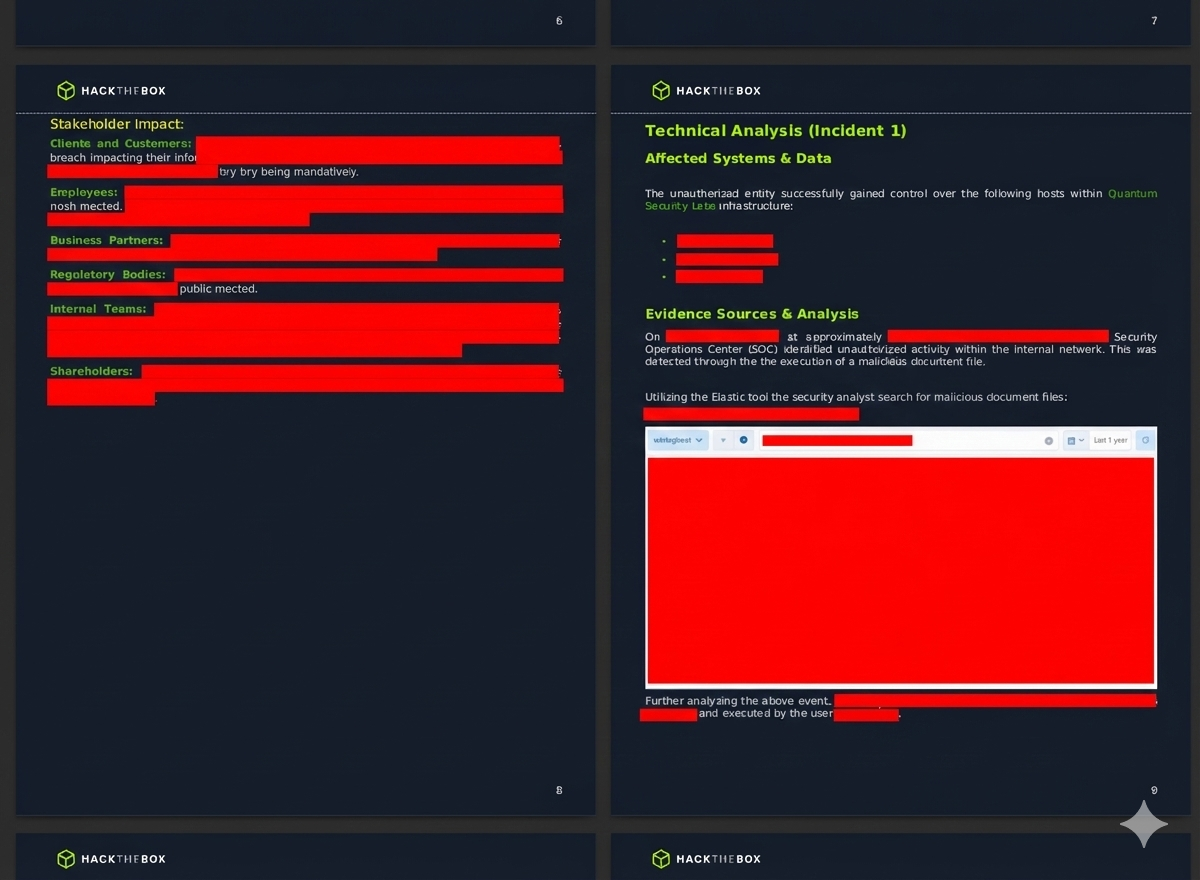
CDSA exam writeup resources help cybersecurity students and security analysts understand how to investigate incidents, correlate security logs, build evidence-based timelines, and document findings for the Hack The Box Certified Defensive Security Analyst (HTB CDSA) certification.
The HTB CDSA certification focuses on practical security operations, threat detection, incident handling, digital forensics, and professional reporting. Candidates must investigate suspicious activity across different data sources and communicate their conclusions in a commercial-grade security incident report.
This guide explains what a useful CDSA exam writeup should contain, how to structure an incident investigation, which technical skills matter most, and how to choose supplementary study materials.
What Is a CDSA Exam Writeup?
A CDSA exam writeup is a technical document explaining the investigation methodology, evidence, findings, and conclusions associated with a security incident analysis.
In the context of HTB CDSA preparation, the term may refer to independently created laboratory reports, SOC investigation notes, defensive security walkthroughs, or professional incident report examples.
A strong writeup does more than identify suspicious activity.
It explains how the activity was discovered, what the supporting evidence establishes, which systems were affected, and how the organization could improve its security.
| Report component | Primary purpose |
|---|---|
| Executive summary | Explain the incident and business impact |
| Scope and methodology | Define the investigation boundaries |
| Evidence sources | Identify relevant logs and artifacts |
| Incident timeline | Reconstruct the sequence of activity |
| Technical findings | Explain observed attacker behavior |
| Impact assessment | Identify affected systems and security risks |
| Detection opportunities | Recommend improved monitoring |
| Remediation | Explain containment and corrective measures |
A legitimate study writeup should help candidates develop independent analytical skills. It should not be presented as a guaranteed solution to a confidential certification examination.
HTB CDSA Certification and Exam Overview
The Hack The Box Certified Defensive Security Analyst certification validates practical defensive security skills.
Candidates are assessed on their ability to investigate incidents, correlate evidence, identify attacker behavior, and prepare professional security documentation.
Unlike penetration testing certifications, CDSA primarily evaluates the ability to detect and understand security incidents rather than exploit systems.
CDSA Certification at a Glance
| Category | HTB CDSA |
|---|---|
| Certification | Certified Defensive Security Analyst |
| Provider | Hack The Box |
| Main focus | SOC operations and incident investigation |
| Training path | SOC Analyst Job Role Path |
| Eligibility | Complete all required path modules |
| Assessment | Hands-on security analysis |
| Examination window | Seven days |
| Reporting | Commercial-grade security incident report |
| Report language | English |
| Accepted submission | Unencrypted PDF or ZIP |
| Maximum report upload | 20 MB |
The examination is based on realistic security investigations rather than multiple-choice questions.
Candidates must correlate information from different sources, interpret suspicious activity, and document the conclusions supported by their findings.
The official examination interface provides the applicable objectives, deadlines, and submission instructions.
For current certification details, consult the official HTB CDSA certification page.
Explore CDSA Exam Writeup Study Materials
CyberServices.Store provides a collection of CDSA-related digital resources for candidates interested in SOC investigation reports, defensive security analysis, and incident documentation.
When evaluating a CDSA exam writeup resource, review its technical scope, file format, revision information, and intended educational use.
Relevant resources may address log analysis, SIEM investigations, threat hunting, incident timelines, Windows authentication activity, network evidence, and reporting methodology.
The value of a technical report comes from its explanations and supporting evidence, not simply from the number of screenshots or pages.
Explore HTB CDSA Exam Writeup Resources
Review the individual product descriptions to determine which materials match your preparation needs.
CDSA Exam Writeup Methodology: Investigating Security Incidents
The foundation of a professional CDSA exam writeup is a repeatable investigation methodology.
Security analysts rarely receive a complete chronological explanation of an incident. Instead, they work with fragmented records collected from endpoints, network devices, authentication systems, and security monitoring platforms.
The analyst must determine which events are relevant, establish their relationships, and explain what the evidence supports.
Establish the Investigation Scope
Begin by identifying the authorized environment, available data sources, relevant systems, and investigation objectives.
Determine whether the analysis concerns a particular host, user account, network segment, or suspected attack campaign.
The scope should also identify limitations, including missing telemetry or systems that were not available for investigation.
Identify Relevant Evidence Sources
Security incidents can produce evidence across multiple technologies.
Common sources include Windows Event Logs, Sysmon telemetry, network traffic, DNS records, web server logs, endpoint alerts, and SIEM event collections.
Different sources answer different questions.
Authentication records may reveal account activity, while network telemetry can provide information about communication between systems.
Build an Evidence-Based Timeline
A timeline organizes relevant observations chronologically.
It should identify timestamps, affected systems, event types, and the evidence supporting each entry.
Analysts must account for time-zone differences and avoid assuming that events are related solely because they occurred close together.
A useful timeline separates confirmed observations from hypotheses.
Determine the Security Impact
After identifying suspicious behavior, evaluate what the available evidence establishes.
An attempted login does not necessarily mean an account was compromised.
A network connection does not automatically prove successful data transfer.
A process execution event may be relevant without being malicious.
Professional incident analysis requires conclusions that match the strength of the supporting evidence.
Splunk and Elastic SIEM in CDSA Preparation
SIEM analysis is one of the most important technical areas for CDSA exam writeup preparation.
The official SOC Analyst curriculum includes both Splunk and Elastic-related training.
Candidates should be comfortable searching events, interpreting fields, correlating data, and validating potential detections.
Splunk Security Investigations
Splunk enables analysts to search and correlate security telemetry.
Relevant learning areas include field extraction, time filtering, aggregation, authentication analysis, and the investigation of Windows security events.
For example, an analyst may investigate repeated authentication failures followed by a successful login.
The important task is to determine whether the complete pattern supports a security finding.
Elastic Security and Threat Hunting
Elastic-based investigation helps analysts explore indexed events and identify unusual activity across different systems.
Candidates should understand event timestamps, field relationships, filtering, and the importance of selecting relevant datasets.
A query result is only the beginning of an investigation.
The analyst must explain why the returned events matter and what additional evidence supports the interpretation.
Correlating Multiple Data Sources
A strong incident report may combine authentication logs, endpoint process events, and network observations.
Each source contributes a different perspective.
| Evidence source | Investigation value |
|---|---|
| Windows Security Logs | Authentication and account activity |
| Sysmon | Process, network, and endpoint behavior |
| DNS logs | Domain resolution activity |
| Web server logs | HTTP requests and application access |
| Zeek | Network protocol metadata |
| PCAP | Packet-level communication evidence |
| Endpoint security alerts | Detection and response context |
| SIEM correlations | Relationships across event sources |
The objective is not to collect every possible log but to identify the evidence necessary to support an accurate conclusion.
Windows Event Logs and Active Directory Attack Analysis
Windows and Active Directory investigations are important parts of HTB CDSA preparation.
A CDSA exam writeup should explain how account activity, authentication mechanisms, and system events contribute to the incident narrative.
Authentication and Account Activity
Windows environments generate events associated with authentication attempts, account changes, privilege use, and security policy activity.
Analysts should understand how to distinguish routine administrative operations from behavior that warrants investigation.
Relevant context includes the account involved, originating system, destination, timestamp, and surrounding activity.
Kerberos and NTLM Security
Kerberos and NTLM are authentication technologies commonly encountered in Windows enterprise environments.
Defensive analysts should understand their basic behavior and how suspicious authentication patterns may appear in available telemetry.
A reliable report does not label every unusual ticket request or authentication failure as an attack.
It explains which characteristics support the interpretation and which alternative explanations were considered.
Endpoint Process Activity
Endpoint telemetry can help analysts identify suspicious process relationships, execution patterns, and system changes.
Process names alone are not sufficient evidence.
The parent process, command-line context, execution time, user identity, and related network activity may all influence the analysis.
Network Traffic Analysis and Digital Forensics
The CDSA exam writeup process may involve network traffic and forensic artifacts in addition to SIEM records.
Network analysis helps establish communication patterns, while digital forensics provides context about activity on affected systems.
PCAP and Network Evidence
Packet captures can reveal protocol interactions and other observable network behavior.
Tools such as Wireshark help analysts inspect authorized traffic captures.
Candidates should understand common protocols, client-server communication, DNS activity, and the limitations of encrypted traffic visibility.
IDS and Network Alerts
Intrusion detection systems identify traffic patterns that match configured rules or behavioral conditions.
An alert is a useful starting point, but it should be validated against the underlying network evidence.
False positives and incomplete telemetry must be considered.
Forensic Artifacts
Disk and memory artifacts can provide additional context about processes, files, execution history, and system activity.
A professional report should identify which artifacts were examined and how they support the findings.
Forensic evidence should be handled carefully to preserve integrity and maintain a clear record of analytical actions.
Threat Hunting and MITRE ATT&CK Mapping
Threat hunting is another important part of CDSA preparation.
Rather than relying entirely on alerts, analysts develop hypotheses and search for evidence of suspicious behavior.
A hypothesis might concern unusual account activity, unexpected process execution, or communication with an unfamiliar service.
The analyst then determines whether the available telemetry supports or contradicts the hypothesis.
Mapping Observed Behavior
The MITRE ATT&CK framework provides a common vocabulary for describing adversary tactics and techniques.
It can help analysts communicate the significance of observed behavior.
However, ATT&CK mapping should reflect actual evidence.
A technique should not be assigned merely because a tool name or process appears in a log.
Detection Opportunities
A professional investigation should also identify where monitoring could be improved.
Useful recommendations may include additional endpoint telemetry, better authentication auditing, improved SIEM correlations, or stronger alert validation.
Detection recommendations should be specific to the observed weaknesses.
How to Write a Professional CDSA Incident Report
A professional CDSA exam writeup should be understandable to both technical reviewers and security decision-makers.
Hack The Box requires a commercial-grade incident report as part of the certification assessment.
The report should describe what happened, how it was detected, which evidence supports the findings, and what actions would reduce future risk.
1. Executive Summary
Provide a concise overview of the investigation.
Explain the nature of the suspected or confirmed incident, affected assets, major findings, and security impact.
Avoid filling this section with raw logs or tool output.
2. Scope and Investigation Methodology
Identify the systems and data sources included in the assessment.
Describe the analytical approach and any limitations affecting the conclusions.
3. Incident Timeline
Present the relevant events in chronological order.
Each entry should include the timestamp, system or identity involved, observation, and evidence reference.
4. Technical Findings
Explain each significant finding clearly.
Include the relevant event sources, observed behavior, analytical reasoning, and supporting evidence.
Separate confirmed findings from uncertain interpretations.
5. Impact Assessment
Describe the consequences supported by the evidence.
Distinguish attempted activity from confirmed compromise, and identify which assets or security boundaries were affected.
6. Containment and Remediation
Recommend appropriate actions based on the findings.
These may include credential rotation after confirmed exposure, endpoint isolation where warranted, access-control changes, monitoring improvements, and configuration hardening.
7. Conclusion
Summarize the investigation outcome and remaining uncertainty.
The conclusion should not introduce unsupported claims or new findings that were not explained earlier.
Example CDSA Exam Writeup Finding
The following fictional example demonstrates professional incident documentation without reproducing confidential HTB examination content.
Finding: Suspicious Authentication Activity Involving a Privileged Account
Summary: Security logs show a concentrated sequence of unsuccessful authentication attempts associated with a privileged identity, followed by a successful authentication event.
Evidence: Authentication telemetry identifies the account, event timestamps, originating system, and destination service. Related endpoint and network records are reviewed to establish context.
Analysis: The observed sequence warrants further investigation. The analyst must determine whether the successful authentication represents authorized activity or an account compromise.
Impact: If unauthorized access is confirmed, the privileges associated with the identity may increase the severity of the incident.
Recommended actions: Validate the account activity with the responsible administrator, review related sessions, assess credential exposure, and improve monitoring for suspicious authentication patterns.
This example illustrates an important principle: an investigation should not claim confirmed compromise solely because authentication failures and a later success occurred.
CDSA Exam Writeup vs. CDSA SOC Walkthrough
A CDSA exam writeup and a SOC walkthrough are closely related, but their purposes differ.
A walkthrough typically explains how to investigate a technical scenario.
A professional writeup documents the investigation outcome, evidence, conclusions, impact, and recommendations.
| Area | CDSA exam writeup | CDSA SOC walkthrough |
|---|---|---|
| Main purpose | Professional incident reporting | Investigation learning |
| Primary focus | Evidence and conclusions | Analytical methodology |
| Audience | Reviewers and security stakeholders | Students and analysts |
| Timeline | Formal incident reconstruction | Learning-oriented event sequence |
| Business impact | Essential | May be secondary |
| Remediation | Required for actionable reporting | Supporting explanation |
For an additional example of multi-host SOC investigation concepts, read the HTB CDSA SOC Analysis Guide: DC01, IIS, PURPLE and Endpoint Investigation.
Common CDSA Exam Writeup Mistakes
Candidates can understand security tools yet still produce weak reports.
Common problems include presenting screenshots without explanations, relying on single events, confusing suspicious activity with confirmed compromise, and failing to correlate evidence across systems.
Another frequent issue is postponing documentation until the end of an investigation.
When analysts wait too long, they may lose the context behind important observations.
Avoid Unsupported Conclusions
Every major finding should be supported by evidence.
If the available data does not establish a conclusion, the report should explain the uncertainty.
Preserve Relevant Context
Include meaningful timestamps, affected identities, system names, and evidence references.
Avoid overwhelming the reader with unrelated logs.
Separate Technical Detail From Business Impact
Technical reviewers need sufficient detail to validate the findings.
Decision-makers need to understand the consequences and recommended actions.
A professional report serves both audiences.
How to Prepare for HTB CDSA in 2026
The most effective CDSA preparation combines official training, independent investigation practice, and clear technical reporting.
Complete the SOC Analyst Job Role Path. HTB requires candidates to finish the associated training path before becoming eligible for the examination.
Practice SIEM analysis. Develop confidence using Splunk and Elastic to search, filter, and correlate security events.
Understand Windows and Active Directory telemetry. Review authentication events, endpoint activity, and common enterprise attack patterns.
Study network and forensic evidence. Learn how packet captures, network metadata, and host artifacts contribute to incident reconstruction.
Develop a reporting workflow. Record findings, evidence references, timestamps, and analytical conclusions throughout practice investigations.
Review the official examination instructions. Confirm the current deadlines, reporting requirements, submission procedure, and academic integrity rules before starting.
HTB’s official certification guidance states that candidates must prepare their own examination reports.
AI tools must not be used to solve examination tasks or generate the candidate’s full report. HTB separately describes limited permitted reference and debugging uses.
Choosing CDSA Exam Writeup Study Resources
Before purchasing a CDSA exam writeup resource, consider what the material actually teaches.
A useful resource should explain its investigation methodology, identify the types of evidence discussed, and distinguish educational examples from official certification content.
Look for clear descriptions of included files, technical topics, report formats, and revision history.
Avoid treating claims of guaranteed examination success or access to confidential answers as evidence of quality.
The strongest preparation materials help candidates analyze unfamiliar incidents independently.
Browse CDSA Exam Writeup and Study Resources
CDSA Exam Writeup FAQ
What is a CDSA exam writeup?
A CDSA exam writeup is a technical incident investigation report or study document explaining security evidence, analytical methodology, findings, impact, and remediation in the context of HTB CDSA preparation.
What does CDSA stand for?
CDSA stands for Certified Defensive Security Analyst.
Is HTB CDSA a blue team certification?
Yes. HTB CDSA focuses on defensive security, SOC operations, threat detection, incident analysis, and professional reporting.
Does CDSA require a professional report?
Yes. Hack The Box requires candidates to submit a commercial-grade security incident report.
How long is the CDSA exam?
HTB describes a seven-day examination window. Candidates should follow the deadlines displayed in their official exam dashboard.
Does CDSA use Splunk and Elastic?
Both technologies are covered in the official SOC Analyst training curriculum, alongside log analysis, threat hunting, and incident response.
Does CDSA include Active Directory attack analysis?
Yes. The certification’s knowledge domains include Windows and Active Directory security investigations.
Does CDSA include digital forensics?
Yes. Digital forensics and incident response are important parts of the training and assessment domains.
What format should the CDSA report use?
Current HTB guidance requires an English-language report submitted as an unencrypted PDF or ZIP archive, with a maximum upload size of 20 MB.
Can I submit a purchased CDSA exam writeup as my own report?
No. Candidates must submit their own independent examination work and comply with HTB’s certification terms.
Can AI generate my CDSA examination report?
No. HTB prohibits using AI to generate the candidate’s entire examination report or directly solve examination tasks.
Where can I find CDSA study materials?
Visit the CyberServices.Store CDSA resource collection and consult the official Hack The Box Academy certification materials.
Final Thoughts: CDSA Exam Writeup 2026
A CDSA exam writeup is most valuable when it demonstrates how security analysts transform fragmented evidence into accurate, actionable incident findings.
Effective preparation requires practical experience with SIEM platforms, Windows event analysis, network telemetry, threat hunting, digital forensics, and professional reporting.
Candidates should prioritize official SOC Analyst training and independent laboratory investigations.
Supplementary study resources can reinforce reporting methodology and analytical concepts, but they cannot replace original examination work.
Explore HTB CDSA Exam Writeup Resources