The eLearnSecurity Certified Professional Penetration Tester (eCPPT v3) ecppt exam dump is designed to simulate a real-world internal penetration testing engagement. Instead of relying on Capture The Flag mechanics or isolated vulnerable machines, the assessment challenges you to think like a consultant performing an enterprise security assessment.
This writeup documents my experience during the Vanguard Trust Bank Internal Assessment. Rather than revealing protected exam content or step-by-step solutions, I’ll focus on the methodology, attack strategy, and lessons learned throughout the engagement.
Last Updated: August 2026
Understanding the Target Environment
The assessment began with access to the Vanguard Trust Bank internal network, where the primary objective was to identify vulnerabilities, compromise systems, escalate privileges, and document every finding professionally.
One of the first systems identified during reconnaissance was:
vanguardtrust.bank
along with the primary network range:
172.30.37.83
From the beginning, it was clear this wasn’t a simple web assessment. The environment resembled a realistic enterprise Windows domain with multiple servers, workstations, and interconnected services.
Internal Reconnaissance ecppt exam dump
Before attempting exploitation, I focused on building a complete picture of the network.
Host discovery, service enumeration, SMB analysis, Active Directory reconnaissance, and DNS mapping quickly revealed several critical assets, including:
- WS01
- DC01
- DC02
- FILESRV01
Understanding how these systems interacted became far more valuable than immediately searching for exploits.
The faster I understood the environment, the easier it became to identify potential attack paths.
Web Application Enumeration
The internal assessment wasn’t limited to Windows infrastructure.
Several web services were exposed that required careful manual testing.
One particularly interesting discovery involved Webmin, which immediately became a priority during enumeration.
Instead of assuming a known vulnerability existed, I inspected authentication behavior, service configuration, version information, and accessible functionality before deciding how to proceed.
This methodology prevented unnecessary rabbit holes and kept the engagement focused.
Credential Collection
As with many enterprise penetration tests, credentials played a central role throughout the assessment.
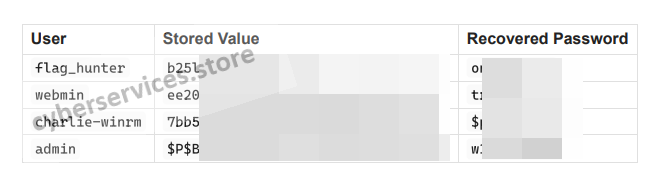
Several user accounts appeared during enumeration and post-exploitation activities, including:
- flag_hunter
- charlie-winrm
- robert
- dave
- david
- steve
- thomas
- mark
- richard
- brian
- jack
- jsmith
Rather than treating each account independently, I analyzed group memberships, permissions, shared credentials, and privilege inheritance to determine which users could provide additional access inside the domain.
Active Directory Enumeration ecppt exam dump
Once inside the Windows environment, Active Directory became the primary focus.
At this stage, understanding trust relationships, delegated permissions, group memberships, and administrative boundaries proved significantly more valuable than automated exploitation.
Native Windows utilities, PowerShell, BloodHound, and manual enumeration all contributed to identifying realistic privilege escalation opportunities.
One lesson became obvious throughout the assessment:
Small pieces of information often combine to create complete attack chains.
Privilege Escalation
Privilege escalation was less about finding a single critical vulnerability and more about chaining together multiple weaknesses discovered during enumeration.
Misconfigurations, credential exposure, permission abuse, and Active Directory relationships all contributed to progressing through the environment.
This closely reflects real internal penetration testing engagements, where methodology consistently outperforms automation.
Lateral Movement ecppt exam dump
With elevated privileges established, lateral movement became the next logical step.
Compromising additional hosts such as WS01, FILESRV01, DC01, and eventually DC02 required careful planning and validation.
Rather than moving aggressively through the environment, I verified every action to maintain an organized attack path while documenting evidence for the final report.
Professional reporting is just as important as successful exploitation.
Reporting the Assessment
One aspect that makes the eCPPT certification valuable is its emphasis on documentation.
Throughout the engagement, I recorded:
- Host discoveries
- Credentials
- Commands executed
- Screenshots
- Attack paths
- Risk descriptions
- Remediation recommendations
Keeping detailed notes dramatically simplified the reporting process and ensured every finding could be reproduced.
Lessons Learned
If I had to summarize the entire engagement in one sentence, it would be this:
Enumeration creates opportunities. Exploitation simply follows.
Every significant breakthrough came from understanding the environment rather than rushing toward the next exploit.
The assessment reinforced several key principles:
- Never trust assumptions.
- Validate every finding.
- Document continuously.
- Think like a consultant, not a CTF player.
- Build attack chains instead of searching for single vulnerabilities.
Final Thoughts
The eCPPT v3 remains one of the best certifications for penetration testers who want practical experience inside a realistic enterprise environment.
The Vanguard Trust Bank Internal Assessment successfully combines web applications, Windows infrastructure, Active Directory security, credential attacks, privilege escalation, lateral movement, and professional reporting into a single engagement that closely resembles real client work.
If you’re preparing for eCPPT, focus less on memorizing exploits and more on mastering methodology. Strong reconnaissance, disciplined enumeration, and organized documentation will consistently outperform any automated tool.
Vendor: https://ine.com/security/certifications/ecppt-certification
Check other certs: https://cyberservices.store/
Buy this dump: