

The HTB CPTS certification (Certified Penetration Testing Specialist) is HackTheBox’s professional-level exam that validates your ability to conduct real-world network and web application penetration tests from start to finish. If you are mapping out your prep strategy, this guide gives you a structured study plan, a clear comparison with competing certifications, and the honest tips that actually move the needle.
- What Is the HTB CPTS Certification?
- CPTS vs OSCP: Which One Should You Choose?
- CPTS vs PNPT: Entry-Level Comparison
- HTB CPTS Study Plan: A Step-by-Step Approach
- Best Resources for CPTS Exam Preparation
- Exam Day Tips for the CPTS
- How the CPTS Fits Into Your Cybersecurity Career
- Frequently Asked Questions
What Is the HTB CPTS Certification?
The HTB CPTS certification is a hands-on, performance-based credential issued by HackTheBox that tests skills across network penetration testing, Active Directory attacks, web application exploitation, and professional report writing. Candidates must compromise a realistic corporate network environment and submit a professional-grade penetration testing report to pass.
The exam lasts 10 days total: 7 days of active hacking time and 3 days to deliver the final report. This format is intentionally close to real engagements, making the credential credible in the job market. Prerequisites are not formally enforced, but completing the full HTB Penetration Testing job role path on the platform is strongly recommended before attempting the exam.
“The CPTS is not a multiple-choice quiz. It is a simulated engagement that forces you to think like a consultant, not just a CTF player.”
CPTS vs OSCP: Which One Should You Choose?
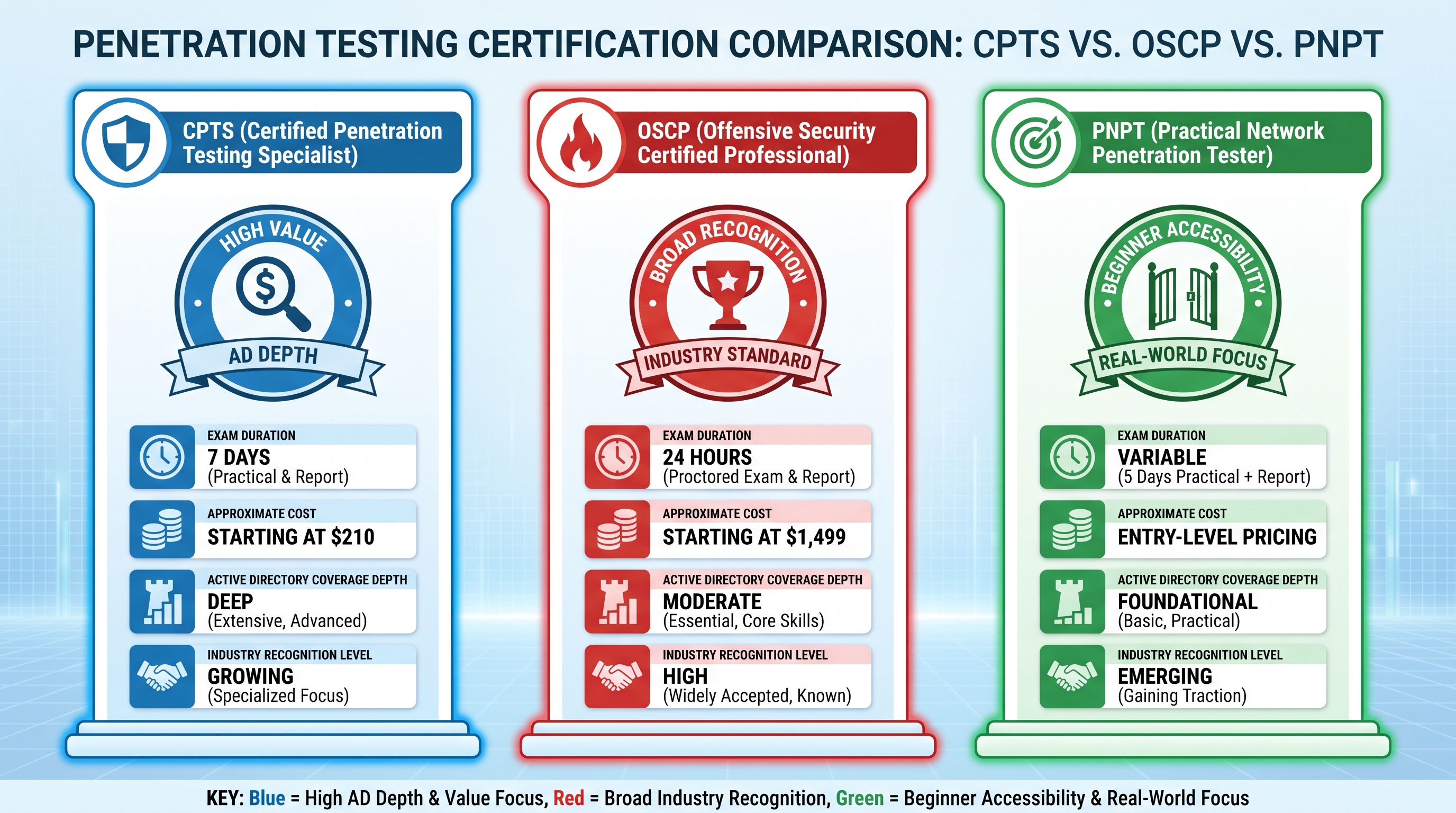
The CPTS and OSCP are the two most frequently compared penetration testing certifications in 2026, and choosing between them depends on your current skill level, budget, and career target.
| Factor | HTB CPTS | OSCP (OffSec) |
|---|---|---|
| Exam duration | 7 days hacking + 3 days report | 24 hours hacking + 24 hours report |
| Cost (approx.) | ~$210 USD | ~$1,499 USD (annual sub) |
| Industry recognition | Growing rapidly | Widely recognized (gold standard) |
| Active Directory coverage | Extensive | Moderate |
| Report requirement | Full professional report | Full professional report |
| Learning path included | Yes (HTB Academy) | Yes (PEN-200 course) |
The OSCP still holds stronger name recognition in corporate HR filters. However, the CPTS offers significantly deeper Active Directory and modern network attack coverage at a fraction of the price. Many practitioners now pursue both, starting with CPTS to build skills and then using OSCP to satisfy recruiter checklists. You can explore the full OSCP service and resource list to compare preparation paths side by side.
CPTS vs PNPT: Entry-Level Comparison
The PNPT (Practical Network Penetration Tester) by TCM Security is a popular starting point for candidates who find CPTS too advanced as a first certification. Understanding the differences helps you sequence your certification journey correctly.
| Factor | HTB CPTS | PNPT (TCM Security) |
|---|---|---|
| Difficulty level | Intermediate-Advanced | Beginner-Intermediate |
| Exam format | Full corporate network lab | 5-day pentest + report |
| Cost (approx.) | ~$210 USD | ~$400 USD |
| Active Directory focus | High | Medium |
| Web app coverage | Solid | Limited |
If you are brand new to penetration testing, completing the PNPT first is a sensible investment. Once you are comfortable with the methodology, the CPTS will deepen your technical breadth significantly. For PNPT-specific prep materials, the PNPT exam dump and walkthrough resource on Cyber Services gives you realistic practice questions and scenario guidance.
HTB CPTS Study Plan: A Step-by-Step Approach
A structured, phased study plan is the single most reliable way to reach exam-ready status for the HTB CPTS certification without burning out.
- Complete the HTB Penetration Testing job role path in full. Every module is examinable. Do not skip the Active Directory and reporting sections.
- Practice each module’s skills immediately in HTB labs. Passive reading is not enough. Run each technique in a live environment the same day you study it.
- Build a personal methodology document. Write down your enumeration and exploitation steps in your own words. This becomes your exam cheat-sheet (allowed during the test).
- Complete at least 10 medium-to-hard HTB machines. Focus on Windows Active Directory machines and multi-host pivoting scenarios.
- Practice report writing before the exam. Write a mock report for one of your practice machines. Clear, professional reporting is worth points.
- Run a timed mock engagement. Give yourself 7 days to fully compromise a complex HTB Pro Lab or similar environment and draft the report in 3 days.
- Review your weak areas with targeted resources. Use the CPTS exam dump and walkthrough on Cyber Services to identify common exam scenarios and knowledge gaps.
“Candidates who practice report writing before exam day consistently score higher on the reporting component, which is not a bonus, it is a core pass requirement.”
Best Resources for CPTS Exam Preparation
Quality study materials determine how efficiently you can cover the broad CPTS syllabus without wasting weeks on content that does not appear in the exam.
Primary resource: HTB Academy’s Penetration Testing job role path is the official curriculum. It covers network enumeration, privilege escalation, Active Directory attacks, web application exploitation, pivoting, tunneling, and reporting.
Supplementary resources:
- HTB Pro Labs (Offshore, RastaLabs) for multi-machine pivoting practice
- Cyber Services walkthrough reports for exam-scenario familiarity
- SANS Institute publishes research and reading lists on penetration testing methodology at sans.org that complement your technical study
- TryHackMe for lower-pressure enumeration drills if you need to revisit fundamentals
Cyber Services has supported over 500 clients worldwide with continuously updated reports and walkthrough materials. The platform’s privacy-first approach and best-price guarantee make it a practical addition to any CPTS prep stack without overcomplicating your budget.
Exam Day Tips for the CPTS
Effective exam-day execution separates candidates who pass on the first attempt from those who need a second try, regardless of their technical level.
- Start with full network enumeration. Map every host, open port, and service before touching an exploit. Rushing early leads to missed attack surfaces late.
- Document as you go. Take screenshots and command output notes continuously. You cannot recreate them at report time.
- Do not tunnel-vision on a single machine. If you are stuck after 90 minutes, pivot to another host and return with fresh eyes.
- Allocate at least 2 full days to the report. Three days sounds generous; it disappears fast when you are writing professional findings with remediation recommendations.
- Use your personal methodology document. This is allowed and should be your first reference before searching externally.
- Sleep during the exam period. With 7 days available, fatigue is a choice. Candidates who rest perform better on complex multi-step attack chains.
“The 10-day format rewards preparation and pacing. Treat it like a real consulting engagement, not a 24-hour sprint.”
How the CPTS Fits Into Your Cybersecurity Career
The HTB CPTS certification positions you as a candidate with verified, hands-on penetration testing skills that are directly applicable to junior and mid-level offensive security roles.
Job titles that frequently list CPTS as a relevant or preferred credential include: Junior Penetration Tester, Vulnerability Assessment Analyst, Red Team Operator (entry level), and Offensive Security Consultant. The certification’s emphasis on professional reporting also supports consulting roles where client communication is as important as technical findings.
For candidates who want to continue building credentials, the natural progressions from CPTS are the OSCP (for wider market recognition), the CRTO (for red team operations and C2 framework skills), or the OSWE (for advanced web application exploitation). You can review the CRTO exam dump and walkthrough to assess whether that path fits your current level.
The CPTS is not an entry-level certification in the traditional sense. It requires genuine technical competency. Passing it signals to employers that you can operate independently in a real-world engagement context, which is exactly what hiring teams in offensive security need to see in 2026.
Frequently Asked Questions
How long does it take to prepare for the HTB CPTS certification?
Most candidates with some prior networking and Linux knowledge need between 3 and 6 months of consistent study, averaging 10-15 hours per week. Completing the full HTB Penetration Testing job role path and practicing on live machines throughout that period is the most reliable preparation approach.
Is the CPTS harder than the OSCP?
The CPTS is considered comparable in difficulty to the OSCP by most candidates who have attempted both. The CPTS covers a broader Active Directory attack surface and requires a full professional report, while the OSCP is time-pressured at 24 hours. Difficulty is subjective, but neither should be underestimated.
Can I use notes during the CPTS exam?
Yes. The CPTS exam is open-notes and open-internet. You can use your personal methodology documents, cheatsheets, and online resources during the hacking phase. Building a comprehensive personal notes system before exam day is one of the most valuable investments you can make during preparation.
What happens if I fail the CPTS exam?
HackTheBox provides one free retake voucher with the CPTS exam purchase. If you do not pass on the first attempt, you can retake the exam after reviewing your weak areas. Candidates who fail typically report that incomplete enumeration or poor report quality, rather than missing exploits, caused their result.
Did you like this article?
Everything you just read is available on our site, tools, resources, and updates are delivered directly to you. Click the “Buy Now” button on the homepage to get full access today.
{“@context”:”https://schema.org”,”@type”:”Article”,”headline”:”HTB CPTS Certification: Resources, Tips and Study Plan to Pass”,”author”:{“@type”:”Organization”,”name”:”Cyber Services”},”publisher”:{“@type”:”Organization”,”name”:”Cyber Services”,”logo”:{“@type”:”ImageObject”,”url”:”https://xhdswqyfzrihqsonlzcp.supabase.co/storage/v1/object/public/logos/17f6a2f4-f796-4940-b1e6-6bfd4e9d1c2a.png?v=1786023724192″}},”image”:[“https://xhdswqyfzrihqsonlzcp.supabase.co/storage/v1/object/public/article-images/17f6a2f4-f796-4940-b1e6-6bfd4e9d1c2a/29caffbb-d16b-462a-8249-63f191bc19b1/e1316430-bf6d-400b-906e-e5558e40ba9e.jpg”],”url”:”https://cyberservices.store/htb-cpts-certification/”,”mainEntityOfPage”:{“@type”:”WebPage”,”@id”:”https://cyberservices.store/htb-cpts-certification/”},”datePublished”:”2026-08-11″,”dateModified”:”2026-08-11″}
{“@context”:”https://schema.org”,”@type”:”FAQPage”,”mainEntity”:[{“@type”:”Question”,”name”:”How long does it take to prepare for the HTB CPTS certification?”,”acceptedAnswer”:{“@type”:”Answer”,”text”:”Most candidates with some prior networking and Linux knowledge need between 3 and 6 months of consistent study, averaging 10-15 hours per week. Completing the full HTB Penetration Testing job role path and practicing on live machines throughout that period is the most reliable preparation approach.”}},{“@type”:”Question”,”name”:”Is the CPTS harder than the OSCP?”,”acceptedAnswer”:{“@type”:”Answer”,”text”:”The CPTS is considered comparable in difficulty to the OSCP by most candidates who have attempted both. The CPTS covers a broader Active Directory attack surface and requires a full professional report, while the OSCP is time-pressured at 24 hours. Difficulty is subjective, but neither should be underestimated.”}},{“@type”:”Question”,”name”:”Can I use notes during the CPTS exam?”,”acceptedAnswer”:{“@type”:”Answer”,”text”:”Yes. The CPTS exam is open-notes and open-internet. You can use your personal methodology documents, cheatsheets, and online resources during the hacking phase. Building a comprehensive personal notes system before exam day is one of the most valuable investments you can make during preparation.”}},{“@type”:”Question”,”name”:”What happens if I fail the CPTS exam?”,”acceptedAnswer”:{“@type”:”Answer”,”text”:”HackTheBox provides one free retake voucher with the CPTS exam purchase. If you do not pass on the first attempt, you can retake the exam after reviewing your weak areas. Candidates who fail typically report that incomplete enumeration or poor report quality, rather than missing exploits, caused their result.”}}]}