CPENT AI Exam Report analysis provides a practical overview of the cybersecurity skills represented in a multi-range penetration testing assessment, including Active Directory, IoT firmware, binary analysis, CTF environments, and web application security. The reviewed report contains 53 challenges across five technical ranges, with 47 recorded as completed and a reported score of 1,950 out of 2,500 points.
Rather than publishing passwords, hashes, flags, or complete examination solutions, this article examines the report’s technical coverage, the knowledge required to interpret its findings, and the lessons relevant to professional penetration testing.
CPENT AI Exam Report Overview
The reviewed CPENT AI Exam Report demonstrates how a practical assessment can combine different security disciplines within a single examination environment.
| Report metric | Recorded result |
|---|---|
| Total challenges | 53 |
| Completed challenges | 47 |
| Not attempted | 6 |
| Reported score | 1,950 / 2,500 |
| Technical ranges | 5 |
| Main domains | Active Directory, IoT, Binary, CTF, Web |
These figures describe the particular report being reviewed. They should not be interpreted as the guaranteed structure, question count, or scoring outcome of every current CPENT examination.
The official EC-Council CPENT AI certification program emphasizes practical enterprise penetration testing, AI-assisted methodologies, segmented networks, IoT environments, binary exploitation, and structured reporting.
The reviewed report illustrates several of those areas through specific technical exercises.
Active Directory and RODC Security
Active Directory represents a substantial part of the CPENT AI Exam Report. The reviewed questions involve Windows domain infrastructure, Read-Only Domain Controllers (RODCs), domain users, cached credentials, and administrative relationships.
An RODC maintains a read-only copy of the Active Directory database and is commonly associated with branch-office environments. Its security depends partly on which account credentials may be cached and how administrative responsibilities are delegated.
The report examines concepts such as:
- Domain Controller identification and role differentiation
- Windows domain accounts and client systems
- RODC Password Replication Policies
- Cached authentication information
- Kerberos and NTLM security concepts
- Local and domain account distinctions
- Administrative access and credential protection
Why RODC Password Replication Policies Matter
A Password Replication Policy determines which credentials may be cached by an RODC. This matters because a compromised branch-office system can create wider risks if sensitive account information is unnecessarily available.
For penetration testers, the key skill is understanding how the policy relates to the organization’s identity infrastructure.
An accurate finding should explain the affected accounts, the security implications of credential caching, and the controls that reduce exposure.
Credential Security and Authentication
Credential-related questions appear throughout the CPENT AI Exam Report, reflecting the importance of identity security across enterprise environments.
The report covers local account passwords, domain credentials, cached authentication information, NTLM, MsCacheV2, SSH keys, encoded secrets, and weak credential storage.
These topics share an important security principle: credentials should be evaluated according to where they are stored, which services accept them, and what privileges they provide.
A secure enterprise environment should combine strong authentication policies with least-privilege access, appropriate secret storage, administrative account separation, and monitoring.
From a reporting perspective, sensitive authentication material should be redacted. Public study articles do not need to reproduce actual credentials to explain the underlying vulnerability class.
IoT Firmware Analysis and Embedded Security
The IoT range introduces firmware analysis, embedded operating systems, device configuration, and executable file formats.
Unlike conventional web testing, firmware assessment often requires understanding software distributed as a device image rather than a running application.
The reviewed report references several technical concepts:
| Technology | Relevance |
|---|---|
| Blackfin | Embedded processor architecture |
| ELF | Executable and Linkable Format |
| BusyBox | Utilities commonly used in embedded Linux |
| JFFS2 | Flash-oriented filesystem |
| Linux kernel | Embedded operating system component |
| GCC | Compiler and build-environment identification |
These details illustrate the breadth of knowledge required for embedded-device assessments.
What Can Firmware Analysis Reveal?
Firmware may contain configuration files, operating system components, certificates, network settings, software version information, and authentication-related artifacts.
The security significance depends on the information present and whether it is appropriately protected.
For example, an outdated software component may require further vulnerability validation, while an exposed private key can create a direct confidentiality and authentication risk.
The CPENT AI Exam Report uses these topics to illustrate why IoT security requires both systems knowledge and careful evidence interpretation.
Binary Analysis and Reverse Engineering
Binary analysis forms another distinct part of the assessment.
The reviewed report includes questions concerning execution flow, memory management, instruction pointers, return-address concepts, input validation, and executable structures.
These subjects are essential for understanding how compiled applications behave and why certain programming errors become security vulnerabilities.
Memory Safety and Application Behavior
Memory corruption vulnerabilities can occur when applications incorrectly handle memory boundaries or unsafe operations.
Depending on the affected program and its protections, consequences may include crashes, unexpected behavior, information disclosure, or unauthorized execution.
The report also references the Luhn algorithm, a checksum mechanism used in various identification and validation systems.
Recognizing familiar algorithms during reverse engineering helps analysts distinguish ordinary program functionality from security-relevant behavior.
For CPENT preparation, the broader skill is understanding the purpose and behavior of compiled code rather than memorizing a specific binary’s solution.
CTF Range: Web Applications and Linux Security
The CTF portion of the CPENT AI Exam Report combines application analysis, operating system security, credential handling, and privilege boundaries.
The reviewed environment includes a ticketing application, Linux-based systems, and content management platforms.
Relevant security topics include:
- Web application configuration and access control
- Database exposure and sensitive information
- SSH authentication and private-key protection
- Linux user permissions
- Local administrative boundaries
- Web server configuration
- CMS extensions and plugin security
- Evidence collection and finding validation
The value of this range lies in understanding how multiple components of a system contribute to its overall security posture.
A web application finding may have implications for the underlying server, but those implications must be supported by actual evidence rather than assumed.
Joomla and WordPress Security
The reviewed report includes both Joomla and WordPress environments.
One Joomla system is identified in the report as version 4.1.0, while another exercise concerns WordPress and a slideshow gallery plugin.
These details are useful for understanding common CMS assessment activities, including software identification, extension inventory, authentication controls, file permissions, and backup exposure.
However, a software version or plugin name alone is not proof of exploitation.
A professional assessment must establish whether a relevant vulnerability exists in the tested configuration and whether the necessary conditions are present.
This distinction helps reduce false positives and improves the credibility of the final report.
Web Security and AI-Assisted Applications
The web range of the CPENT AI Exam Report focuses heavily on sensitive information exposure.
The reviewed questions involve internal documents, server files, archived reports, backups, logs, and other potentially confidential material.
An AI-assisted application also appears in the broader report environment, introducing the importance of information boundaries in chatbot-enabled systems.
Sensitive Information Exposure
A web application does not need to contain a sophisticated software exploit to present a serious security risk.
Exposed backups, internal documentation, private keys, or configuration files may reveal information that should never be publicly accessible.
Security teams should therefore review:
- Access controls on stored documents
- Publicly reachable backup files
- Server and application logs
- Sensitive data in application responses
- Unnecessary files in web directories
- AI application access to confidential information
The relevant lesson is data protection: sensitive information should remain appropriately restricted regardless of whether it is accessed through a traditional web interface or an AI-assisted feature.
Professional Reporting in CPENT AI
The CPENT AI Exam Report also demonstrates the importance of technical documentation.
A useful penetration testing report should communicate more than a collection of screenshots or discovered vulnerabilities.
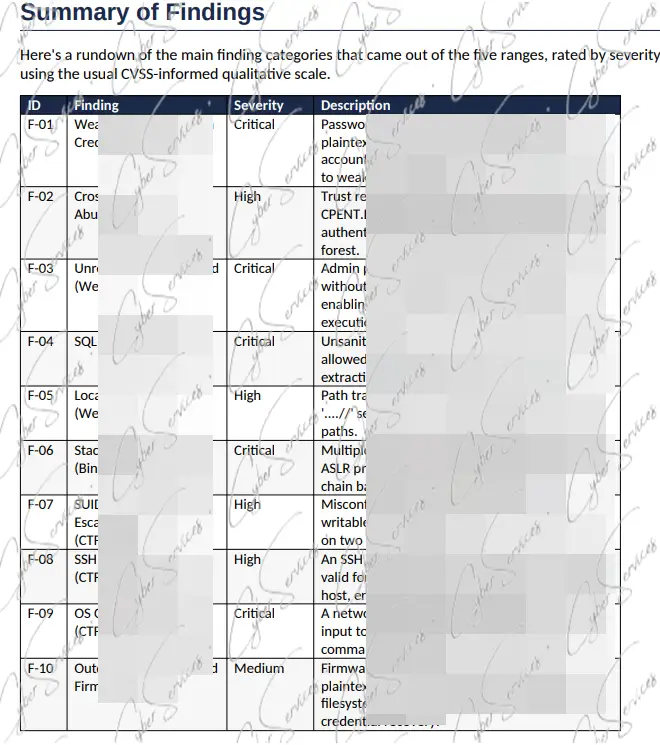
Each finding should establish the affected asset, security weakness, supporting evidence, potential impact, and recommended remediation.
What Makes a Strong Penetration Testing Report?
A well-structured report typically includes:
- Assessment scope and methodology
- Executive summary
- Technical findings and severity
- Supporting evidence
- Business and technical impact
- Remediation recommendations
- Assessment limitations
Sensitive values should be redacted in public-facing versions.
For additional guidance, read our Pentest Report Template and Example, which explains how to structure findings and communicate technical evidence.
What Practical Skills Does the CPENT AI Exam Report Highlight?
Across its five ranges, the reviewed report illustrates the importance of combining multiple penetration testing disciplines.
Active Directory exercises require identity and authorization knowledge. IoT tasks demand firmware and embedded-system understanding. Binary analysis requires familiarity with low-level program behavior, while web and CTF environments emphasize application security and operating system fundamentals.
The most transferable skills include systematic enumeration, technical interpretation, accurate documentation, security-impact assessment, and time management.
These capabilities remain valuable beyond any individual examination environment.
How to Prepare for CPENT AI
Candidates studying CPENT AI should use the official EC-Council curriculum as the primary reference for current examination requirements.
A practical preparation plan should cover enterprise networks, Active Directory, segmented environments, IoT firmware, binary analysis, web security, and penetration testing reporting.
Supplementary study materials can help candidates review unfamiliar concepts and compare technical documentation approaches, but they should not replace independent practice.
CyberServices.Store maintains a collection of related CPENT exam preparation materials, including resources associated with practical labs and reporting.
Explore CPENT Exam Preparation Resources
For a different perspective on the examination environment, see our CPENT AI Exam Writeup.
CPENT AI Exam Report FAQ
What is a CPENT AI Exam Report?
A CPENT AI Exam Report documents technical findings, assessment results, and supporting evidence from a practical penetration testing environment. The report reviewed here covers Active Directory, IoT, binary analysis, CTF, and web security.
How many challenges are included in the reviewed report?
The reviewed report contains 53 challenges, of which 47 were recorded as completed and six as not attempted.
What score does the reviewed report show?
The report records 1,950 out of 2,500 points. This is a result from the reviewed material, not a prediction of another candidate’s performance.
Does the report cover Active Directory?
Yes. It includes RODC security, Windows domain infrastructure, credential protection, and authentication-related concepts.
Is IoT firmware analysis included?
Yes. The report examines embedded Linux concepts, firmware structures, executable formats, and device configuration information.
Does CPENT AI involve binary analysis?
The reviewed report includes binary analysis and reverse engineering questions, consistent with the broader technical areas described in EC-Council’s CPENT AI program.
Are Joomla and WordPress included?
Yes. The reviewed report contains CTF exercises involving Joomla and WordPress environments.
Does this article contain passwords or complete exam solutions?
No. This article discusses technical domains, assessment concepts, and reporting skills without publishing passwords, hashes, flags, exploit commands, or complete examination solutions.
Where can I find CPENT preparation resources?
Explore the CyberServices.Store CPENT collection and consult the official EC-Council training materials for current certification requirements.
Final Thoughts
The CPENT AI Exam Report illustrates the technical breadth of a practical penetration testing assessment. Its 53 recorded challenges span identity infrastructure, embedded devices, compiled software, web applications, and operating system security.
The central lesson is that successful penetration testing requires the ability to interpret evidence across different technologies and explain security risks accurately.
Candidates who develop those skills through authorized practice, structured learning, and professional reporting will be better prepared for complex cybersecurity assessments.
Buy this dump:
Vendor: https://www.eccouncil.org/train-certify/certified-penetration-testing-professional-cpent/
Check our cert list: https://cyberservices.store/