

CWES exam preparation is the structured process of building the offensive web security skills required to pass the HackTheBox Certified Web Exploitation Specialist (CWES) certification. Unlike entry-level web certifications, CWES targets professionals who can chain complex vulnerabilities in realistic enterprise environments. If you are aiming to earn this credential in 2026, a deliberate, phased study plan is what separates candidates who pass on their first attempt from those who do not.
- What Is the CWES Certification?
- Prerequisites Before You Start
- CWES Exam Preparation: Step-by-Step Study Plan
- What to Expect on Exam Day
- Tools and Resources That Actually Help
- Frequently Asked Questions
What Is the CWES Certification?
The CWES (Certified Web Exploitation Specialist) is an advanced, practical certification issued by HackTheBox that validates a candidate’s ability to exploit enterprise-grade web applications. The exam is fully hands-on: you receive a live lab environment, not a multiple-choice question bank. CWES sits above CWEE (Certified Web Exploitation Expert) in terms of attack complexity, requiring candidates to demonstrate multi-stage exploitation chains, bypass modern security controls, and produce a professional penetration testing report.
A clear definition first: CWES is a practitioner-level certification, meaning theoretical knowledge alone will not get you a passing grade. Every objective must be demonstrated in a live environment under timed conditions.
“Practical certifications like CWES test whether you can actually exploit a system, not just describe how it might be done. That distinction matters enormously when employers screen candidates.”
Prerequisites Before You Start
Jumping into CWES without a baseline will cost you time and money. Before scheduling your exam, confirm you are comfortable with the following areas:
- HTTP internals: request/response lifecycle, headers, cookies, and session management.
- Common vulnerability classes: SQL injection, XSS, SSRF, IDOR, XXE, SSTI, and deserialization flaws.
- Burp Suite proficiency: intercepting, modifying, and replaying requests without hesitation.
- Basic scripting: Python or Bash for automating repetitive tasks during the exam.
- Report writing: the ability to document findings clearly for a technical audience.
If you have already passed CWEE, you have most of this foundation. Candidates coming from BSCP or EWPTX also tend to transition smoothly. Those starting from scratch should budget at least 3-4 months of consistent study before attempting CWES.
CWES Exam Preparation: Step-by-Step Study Plan
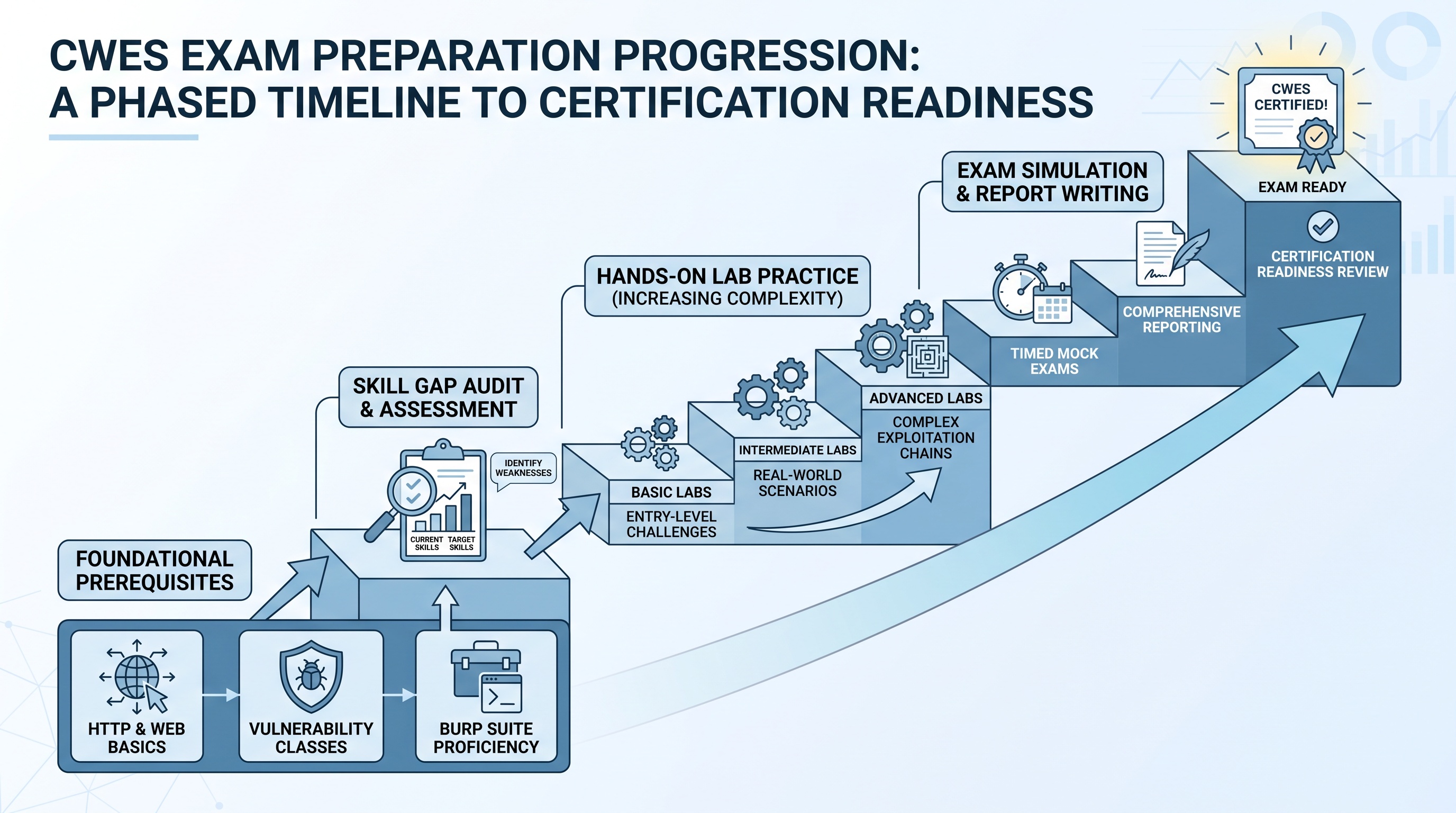
A structured, phased approach is the most reliable way to cover the CWES syllabus without burning out. The plan below assumes roughly 10-15 hours of study per week and is organized as an actionable checklist.
- Audit your current skill gaps. Take a free HTB Starting Point or CWEE-level challenge and note every technique that slows you down. Write these gaps in a list. This becomes your personal study backlog.
- Complete the HTB Academy “Bug Bounty Hunter” and “Advanced Web Attacks” modules. These cover the core vulnerability classes tested in CWES and are maintained to reflect current attack techniques. Do not skip the exercises, they mirror exam scenarios closely.
- Master server-side exploitation chains. Focus on SSRF to internal service pivoting, SQL injection with blind and out-of-band techniques, and second-order injection patterns. Spend at least two weeks here before moving on.
- Study client-side attack vectors in depth. CWES includes advanced XSS, CSRF bypass, and prototype pollution. Practice exploiting these against intentionally vulnerable apps such as DVWA or custom HTB challenges, not just reading write-ups.
- Practice Web Application Firewall (WAF) bypass techniques. Enterprise environments always have at least one layer of filtering. Learn encoding tricks, HTTP smuggling basics, and parameter pollution. OWASP maintains a comprehensive, regularly updated reference on web attack classifications that is invaluable for understanding how WAFs detect and miss payloads.
- Simulate timed exam conditions. At least two weeks before your exam date, pick a retired HTB Pro Lab or a curated set of machines and give yourself a strict time limit. This builds the mental stamina the exam demands.
- Write a mock penetration testing report. CWES requires a written deliverable. Use a standard pentest report template, document every finding with proof-of-concept screenshots, CVSS scores, and clear remediation steps. Practice makes this fast under pressure.
- Review your weak areas one final week before the exam. Do not start new topics in the last seven days. Re-read your notes, re-run exploits you struggled with, and check your tooling (Burp extensions, wordlists, scripts) works correctly in a clean environment.
What to Expect on Exam Day
The CWES exam is a proctored, time-limited practical assessment conducted entirely in an HTB-hosted lab environment. You will receive a VPN connection and a set of target applications representing a simulated enterprise network. You are expected to identify, exploit, and document multiple vulnerabilities across different web application components before time runs out.
Key facts to keep in mind:
- The exam is typically 48 hours long (check current HTB policy before scheduling, as terms can update).
- No internet searches are prohibited, but having your own well-organized notes is far faster.
- Report submission usually follows the lab session with a defined deadline, often 24 hours after the hacking window closes.
- Passing requires meeting a minimum score threshold across both exploitation and report quality.
Candidates who fail most commonly cite poor time management and weak report writing, not insufficient technical skill. Treat the report as a first-class deliverable, not an afterthought.
Tools and Resources That Actually Help
Using the right tools consistently during preparation means you will not waste time configuring them under exam pressure. Below is a focused set that covers the CWES scope without overkill.
| Tool / Resource | Purpose | When to Use |
|---|---|---|
| Burp Suite Pro | Intercepting, fuzzing, scanning web requests | Every practice session and the exam itself |
| SQLMap | Automated SQL injection detection and exploitation | Confirmation and blind SQLi scenarios |
| ffuf / feroxbuster | Directory and parameter fuzzing | Reconnaissance phase of every target |
| HTB Academy modules | Structured curriculum aligned to CWES objectives | Study phase (steps 2-4 of the plan above) |
| Cyber Services CWES exam writeup | Real walkthrough and exam experience insight | Final review week |
For candidates who want structured support beyond solo study, Cyber Services offers a CWES exam dump and walkthrough report built from real exam experience. With over 500 clients supported worldwide and continuously updated materials, it gives you a realistic picture of what the exam environment actually looks like, which no amount of generic lab time can fully replicate.
If you are also preparing for related certifications in the HackTheBox ecosystem, the CDSA exam dump covers the detection and defense side of web security, a useful complement to CWES for anyone building a well-rounded enterprise security skillset.
Frequently Asked Questions
How long does CWES exam preparation realistically take?
Most candidates with a solid CWEE or BSCP background need 6-10 weeks of focused preparation at 10-15 hours per week. Candidates starting from an intermediate web security level should plan for 3-4 months. Rushing the timeline is the most common reason for first-attempt failures.
Is CWES harder than CWEE?
Yes. CWES targets enterprise-grade attack chains that require combining multiple vulnerability classes to achieve meaningful impact. CWEE focuses on foundational web exploitation skills, while CWES adds WAF bypass, multi-stage chaining, and a more demanding report writing requirement. Think of CWEE as a prerequisite, not an equivalent.
Can I use my own tools and notes during the CWES exam?
Yes, CWES is an open-book exam in the sense that you can use your own notes, custom scripts, and publicly available tools. You cannot use AI-assisted exploitation tools or violate the exam rules published by HackTheBox. Having well-organized personal notes is a significant practical advantage during the exam window.
Does Cyber Services offer support specifically for the CWES exam?
Yes. Cyber Services provides a detailed CWES walkthrough report based on real exam scenarios, updated continuously to reflect the current exam environment. The platform also offers mentoring and remote-pass support for candidates who want hands-on guidance through the preparation process.
Did you like this article?
Everything you just read is available on our site, tools, resources, and updates are delivered directly to you. Click the “Buy Now” button on the homepage to get full access today.
{“@context”:”https://schema.org”,”@type”:”Article”,”headline”:”CWES Exam Preparation: Enterprise Web Security Certification Study Plan”,”author”:{“@type”:”Organization”,”name”:”Cyber Services”},”publisher”:{“@type”:”Organization”,”name”:”Cyber Services”,”logo”:{“@type”:”ImageObject”,”url”:”https://xhdswqyfzrihqsonlzcp.supabase.co/storage/v1/object/public/logos/17f6a2f4-f796-4940-b1e6-6bfd4e9d1c2a.png?v=1786023724192″}},”image”:[“https://xhdswqyfzrihqsonlzcp.supabase.co/storage/v1/object/public/article-images/17f6a2f4-f796-4940-b1e6-6bfd4e9d1c2a/03604d73-ccef-4cf6-a980-280b498183ed/744541e0-8636-4f8b-aa1f-073024ecbbd5.jpg”],”url”:”https://cyberservices.store/cwes-exam-preparation/”,”mainEntityOfPage”:{“@type”:”WebPage”,”@id”:”https://cyberservices.store/cwes-exam-preparation/”},”datePublished”:”2026-08-19″,”dateModified”:”2026-08-19″}
{“@context”:”https://schema.org”,”@type”:”FAQPage”,”mainEntity”:[{“@type”:”Question”,”name”:”How long does CWES exam preparation realistically take?”,”acceptedAnswer”:{“@type”:”Answer”,”text”:”Most candidates with a solid CWEE or BSCP background need 6-10 weeks of focused preparation at 10-15 hours per week. Candidates starting from an intermediate web security level should plan for 3-4 months. Rushing the timeline is the most common reason for first-attempt failures.”}},{“@type”:”Question”,”name”:”Is CWES harder than CWEE?”,”acceptedAnswer”:{“@type”:”Answer”,”text”:”Yes. CWES targets enterprise-grade attack chains that require combining multiple vulnerability classes to achieve meaningful impact. CWEE focuses on foundational web exploitation skills, while CWES adds WAF bypass, multi-stage chaining, and a more demanding report writing requirement. Think of CWEE as a prerequisite, not an equivalent.”}},{“@type”:”Question”,”name”:”Can I use my own tools and notes during the CWES exam?”,”acceptedAnswer”:{“@type”:”Answer”,”text”:”Yes, CWES is an open-book exam in the sense that you can use your own notes, custom scripts, and publicly available tools. You cannot use AI-assisted exploitation tools or violate the exam rules published by HackTheBox. Having well-organized personal notes is a significant practical advantage during the exam window.”}},{“@type”:”Question”,”name”:”Does Cyber Services offer support specifically for the CWES exam?”,”acceptedAnswer”:{“@type”:”Answer”,”text”:”Yes. Cyber Services provides a detailed CWES walkthrough report based on real exam scenarios, updated continuously to reflect the current exam environment. The platform also offers mentoring and remote-pass support for candidates who want hands-on guidance through the preparation process.”}}]}