

The OSAI exam walkthrough is the most searched resource by candidates preparing for OffSec’s AI security certification, and for good reason: the exam blends traditional offensive techniques with AI-specific attack surfaces that most pentesters have never formally studied. If you want a clear, honest breakdown of what awaits you inside the exam environment, this guide covers every major domain, compares OSAI to adjacent certifications, and gives you a prioritized prep checklist.
- What Is the OSAI Certification?
- OSAI Exam Structure and Format
- Key Domains Covered in the OSAI Exam
- OSAI vs. Other OffSec Certifications
- How Difficult Is the OSAI Exam?
- OSAI Exam Prep Checklist
- Useful Resources and Study Materials
- Frequently Asked Questions
What Is the OSAI Certification?
The OSAI (OffSec AI) is a certification designed to validate a candidate’s ability to identify, exploit, and report security vulnerabilities that are unique to AI and machine learning systems. It sits within the OffSec ecosystem alongside OSCP, OSWE, and OSED, but targets a rapidly growing niche: AI/ML attack surface testing. As organizations deploy large language models, recommendation engines, and computer vision pipelines, the demand for professionals who can test these systems offensively has grown sharply. OSAI is OffSec’s formal answer to that demand.
The certification assumes you already have foundational web and network pentesting skills. Candidates with an OSCP or equivalent real-world experience report a smoother entry into OSAI material, while those without prior offensive security background often need additional ramp-up time on tooling and methodology.
OSAI Exam Structure and Format
The OSAI exam is a hands-on, proctored assessment conducted inside an OffSec-managed lab environment, typically lasting 48 hours for the practical portion followed by a 24-hour report submission window. The exam presents a realistic AI/ML application environment where you must discover and exploit vulnerabilities, then document your findings in a professional penetration test report.
There are no multiple-choice questions. Every point is earned by demonstrating technical compromise: extracting model outputs you should not have access to, manipulating inference pipelines, bypassing input sanitization designed to protect AI endpoints, or achieving data exfiltration through model inversion or membership inference techniques. The report is graded separately and must meet OffSec’s documentation standards to receive full credit for each finding.
| Component | Duration | Weight |
|---|---|---|
| Practical Lab Exam | 48 hours | Primary scoring |
| Penetration Test Report | 24 hours (submission) | Required for full credit |
| Multiple Choice / Theory | None | Not applicable |
Key Domains Covered in the OSAI Exam Walkthrough
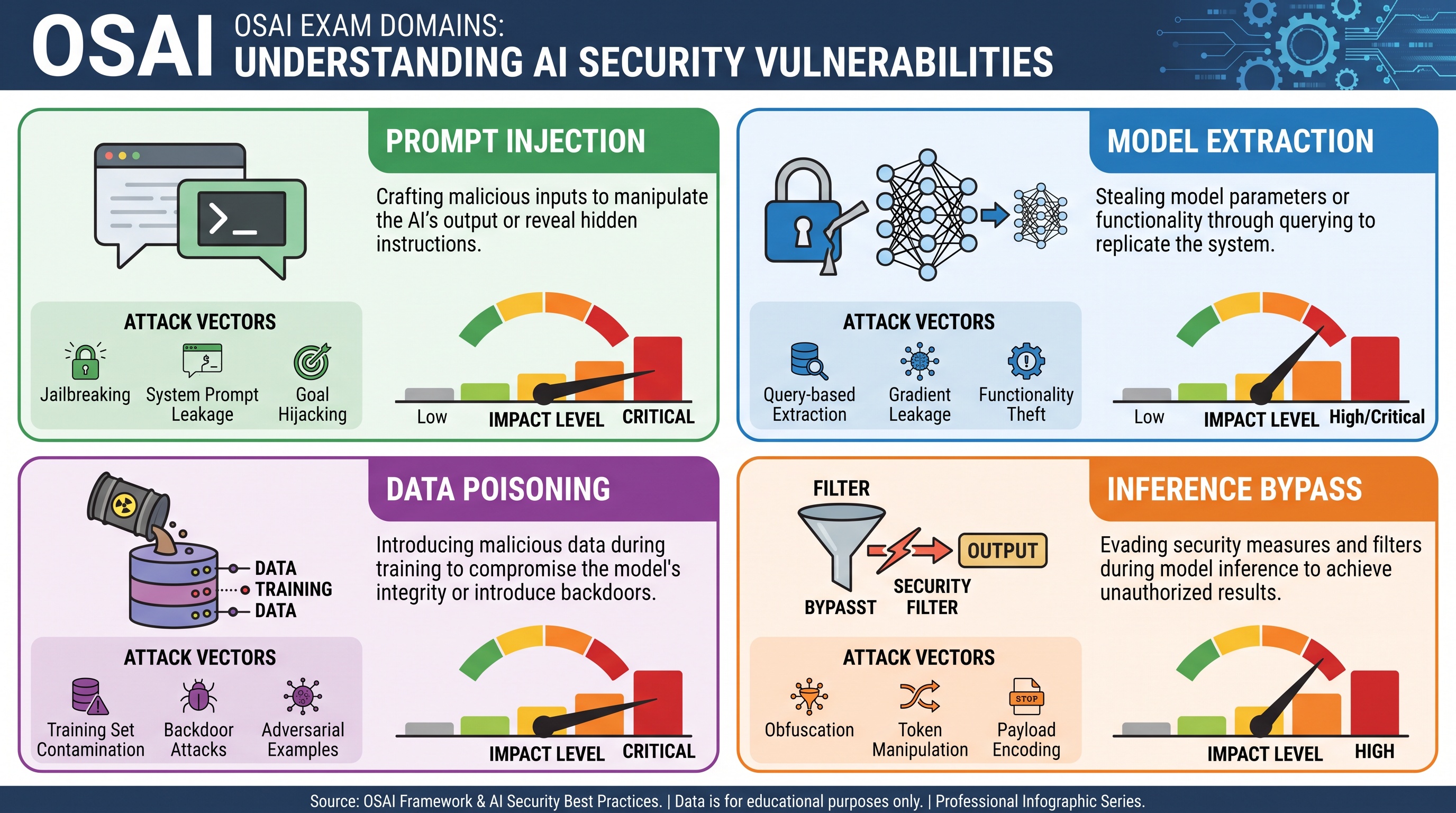
The OSAI exam tests a specific set of AI security domains that differ meaningfully from classic web or network pentests. Understanding these domains is the core of any effective osai exam walkthrough.
- Prompt Injection: Manipulating user-controlled input to override or redirect AI model behavior, including indirect injection via external data sources.
- Model Inversion and Extraction: Recovering training data or model parameters through repeated querying of an inference API.
- Adversarial Inputs: Crafting inputs that cause misclassification or unexpected outputs in image, text, or tabular models.
- Data Poisoning Awareness: Identifying signs that a model’s training pipeline may be a target, even if active exploitation is out of scope.
- API and Backend Security: Traditional vulnerabilities (IDOR, broken authentication, insecure deserialization) as applied to AI serving infrastructure.
- Reporting and Evidence: Documenting AI-specific findings in a format that non-technical stakeholders can act on.
AI system vulnerabilities are not just theoretical: prompt injection alone has been used to extract confidential data from production LLM deployments in real-world incidents recorded throughout 2024 and 2025. The OSAI exam reflects this operational reality.
No need to struggle for months. Buy once, protect the most valuable thing you have: Your time.
OSAI vs. Other OffSec Certifications
Choosing between OSAI and other OffSec credentials depends on your career direction, not just difficulty preference. OSAI is not a replacement for OSCP; it is a specialization that extends your offensive toolkit into AI-native environments.
| Certification | Primary Focus | Exam Format | Best For |
|---|---|---|---|
| OSAI | AI/ML system attacks | 48h lab + report | Pentesters entering AI security |
| OSCP | General network/web pentesting | 24h lab + report | Entry-to-mid offensive security |
| OSWE | Advanced web application attacks | 48h lab + report | Web specialists and developers |
| OSED | Exploit development (Windows) | 48h lab + report | Low-level exploit researchers |
If your goal is a well-rounded offensive profile, the recommended path is OSCP first, then OSAI or OSWE depending on whether you lean toward AI environments or traditional web targets. Candidates already holding OSWE report that the API security portions of OSAI feel familiar, while the AI-specific attack classes require dedicated study regardless of prior experience.
| Skill Area | OSAI Requirement | OSCP Requirement |
|---|---|---|
| Web Application Attacks | Intermediate | Intermediate |
| AI/ML Attack Techniques | Core requirement | Not covered |
| Network Exploitation | Foundational | Core requirement |
| Report Writing | Required | Required |
| Active Directory | Not primary focus | Core requirement |
How Difficult Is the OSAI Exam?
The OSAI exam is considered moderately difficult for candidates with prior offensive security experience, but significantly harder for those entering directly from a theory background. The 48-hour window is generous enough for methodical testers but punishing for those without a structured approach to unfamiliar attack surfaces.
The most common failure points reported by repeat candidates are: underestimating AI-specific attack classes (especially indirect prompt injection and model extraction), spending excessive time on classic web vulnerabilities that yield few or no points, and submitting reports that lack the specificity required for full credit. Time management and prioritization matter as much as raw technical skill.
Candidates who dedicate focused preparation to AI-specific attack techniques before the exam consistently report higher first-attempt pass rates than those who rely solely on general pentesting experience.
OSAI Exam Prep Checklist
Use this prioritized checklist in the weeks before your exam attempt. Complete items in order: foundational gaps will compound on exam day if left unaddressed.
- Confirm prerequisites: Verify you are comfortable with web application pentesting basics (HTTP, authentication flaws, API testing) before diving into AI-specific content.
- Study prompt injection thoroughly: Practice both direct and indirect injection scenarios using publicly available LLM sandbox environments.
- Learn model extraction concepts: Understand how repeated API queries can leak training data or model behavior; practice with open-source inference servers.
- Review adversarial ML fundamentals: FGSM (Fast Gradient Sign Method) and basic evasion techniques are representative of the conceptual depth expected.
- Practice API security testing: Use Burp Suite against AI-serving REST APIs to identify authentication and authorization flaws specific to ML endpoints.
- Build a report template: Draft a professional pentest report template before exam day so you are not formatting under pressure during the 24-hour submission window.
- Review the official OffSec course material: The course tied to OSAI covers exactly the domains assessed; do not skip any module.
- Use a walkthrough report for reference: A high-quality OSAI exam dump and walkthrough resource can clarify what a passing report looks like and which findings carry the most weight.
Useful Resources and Study Materials
Pairing official OffSec course content with supplementary materials gives you the broadest preparation. Candidates who cross-reference multiple sources report feeling more confident when they encounter unfamiliar AI system configurations during the exam.
Beyond the official curriculum, consider reviewing OWASP’s Top 10 for LLM Applications (published and maintained at owasp.org), which maps directly to several OSAI exam domains. Practice labs that simulate realistic AI API environments are more valuable than static reading, so prioritize hands-on time over passive review. For report structure, study how professional AI security audit reports differ from traditional pentest reports: they must explain model-specific findings to both technical and non-technical audiences.
Cyber Services has supported over 500 certification candidates worldwide with continuously updated walkthrough reports and exam preparation resources. If you are also preparing for related credentials, check out the OSWE exam service list for a comparable certification in web application attack specialization.
Frequently Asked Questions
Do I need prior AI or machine learning knowledge to take the OSAI exam?
You do not need a data science or ML engineering background, but you do need to understand how AI systems are deployed and queried. The exam tests offensive techniques against AI applications, not the ability to build or train models. Candidates with solid web and API pentesting skills can learn the AI-specific attack classes through focused study in four to eight weeks.
How long should I spend on the OSAI exam report after the lab closes?
The standard submission window is 24 hours after the practical lab ends. Most candidates who pass spend eight to twelve hours writing and reviewing their report. Rushed, incomplete reports are a leading cause of failure even when the technical findings are correct, so allocate time deliberately and do not start writing only in the final hours.
Is the OSAI exam harder than the OSCP?
Difficulty is subjective and depends on your background. Candidates with OSCP already completed tend to find OSAI’s network and web components manageable, but rate the AI-specific domains (prompt injection, model extraction) as genuinely novel and requiring separate preparation. OSAI is not “harder overall,” but it tests a narrower, less-practiced skill set that catches many experienced pentesters off guard.
Can a walkthrough report help me prepare for the OSAI exam?
Yes. A high-quality walkthrough report shows you the structure, language, and depth expected in a passing submission. It also helps you understand which finding categories the exam environment is likely to include, so you can calibrate your time during the 48-hour practical window. Use walkthrough resources as a preparation reference, not a replacement for hands-on practice.
Did you like this article?
Everything you just read is available on our site-tools, resources, and updates are delivered directly to you. Click the “Buy Now” button on the homepage to get full access today.