

OSDA exam dumps are structured study resources that help you understand the question formats, scenario patterns, and knowledge domains tested in the OffSec Defense Analyst (OSDA) certification, so you walk into exam day with confidence, not guesswork. The OSDA (SOC-200) is OffSec’s defensive security certification targeting blue team analysts, SOC professionals, and anyone who wants to prove they can detect, analyze, and respond to real attacks. This guide breaks down exactly what you need to know before, during, and after the exam.
- What Is the OSDA Certification?
- OSDA Exam Dumps Explained: What They Cover
- Exam Dumps vs. Other Study Resources: A Direct Comparison
- OSDA Exam Day Structure and Format
- Key Domains Tested on the OSDA Exam
- OSDA Exam Preparation Checklist
- Common Mistakes Candidates Make
- Frequently Asked Questions
What Is the OSDA Certification?
The OSDA (Offensive Security Defense Analyst) is OffSec’s entry point into defensive security, built on the SOC-200 course. OSDA certifies that a candidate can analyze attacker behavior, interpret logs, and produce actionable incident reports, skills that are directly applicable to SOC Tier 1 and Tier 2 analyst roles. Unlike OSCP, which tests offensive penetration testing, OSDA focuses on understanding attacks from the defender’s perspective: SIEM queries, log correlation, and threat hunting.
The certification is proctored and time-limited. Candidates receive access to a live lab environment where they must detect and analyze simulated attack chains within a set window. A written report is required as part of the final submission, which makes documentation skills just as important as technical analysis.
“Passing OSDA is not just about knowing what happened, it is about proving you can explain it clearly enough that a non-technical stakeholder can act on it.”
OSDA Exam Dumps Explained: What They Cover
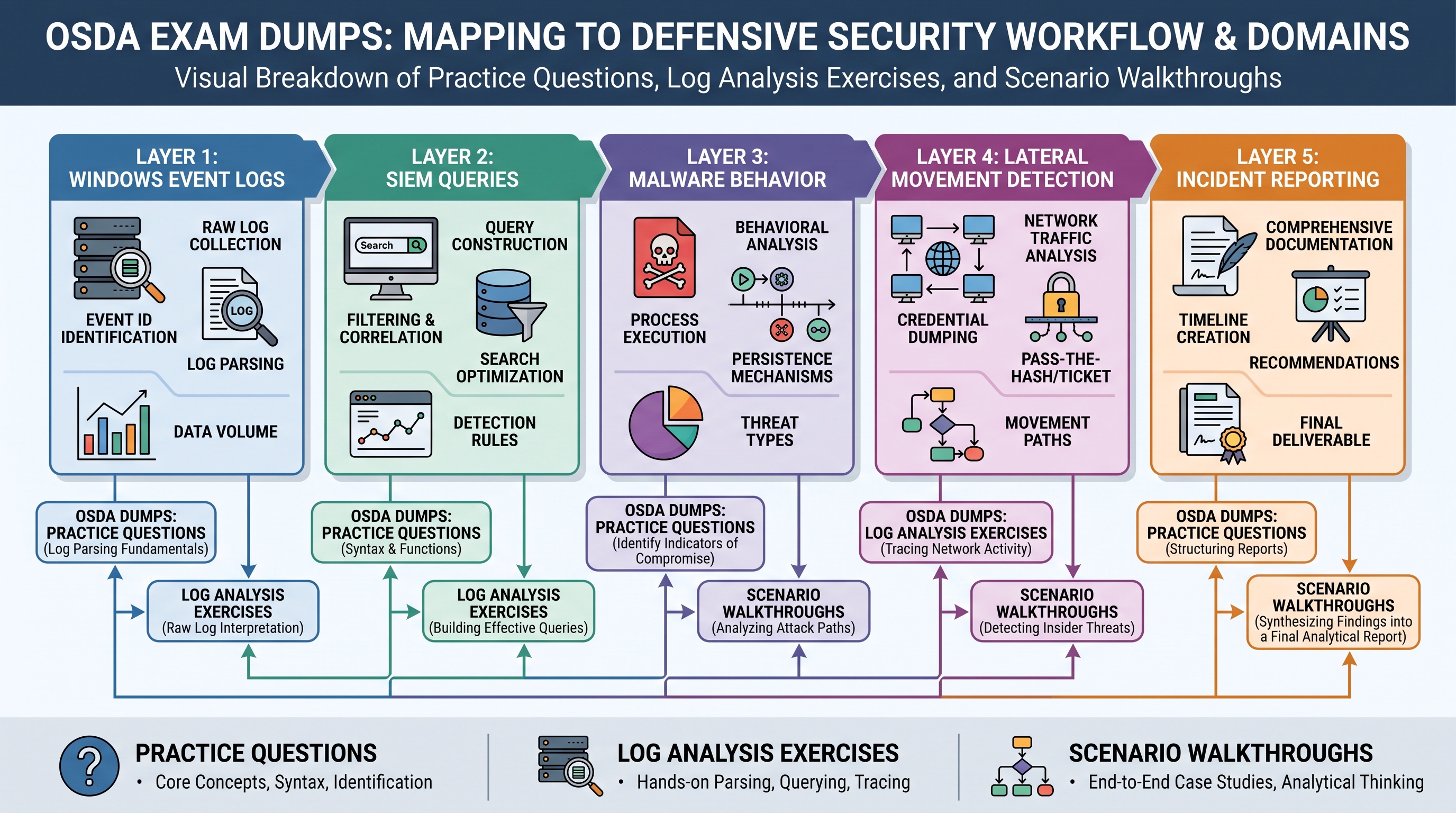
OSDA exam dumps are curated collections of past scenario questions, log analysis exercises, and report-writing prompts that reflect the real exam’s structure and difficulty level. They are not answer keys to copy blindly; they are diagnostic tools that reveal which topic areas need more attention before exam day.
High-quality OSDA exam dumps cover all major SOC-200 domains: log analysis (Windows Event Logs, Sysmon, Zeek), SIEM query construction, malware behavior identification, and lateral movement detection. A good dump also includes annotated explanations so you understand the “why” behind each answer, not just the “what.”
At Cyber Services, the OSDA exam dump is continuously updated to reflect the current exam format, covering real scenario patterns with full walkthroughs. With over 500 clients served across six years, the resources are built from direct exam experience, not speculation.
Exam Dumps vs. Other Study Resources: A Direct Comparison
Choosing the right study resource depends on your current skill level and the time you have before the exam. Each resource type serves a different purpose in your preparation.
| Resource Type | Best For | Covers Report Writing? | Time to Complete |
|---|---|---|---|
| OSDA Exam Dumps | Scenario pattern recognition | Yes (annotated examples) | Low (targeted review) |
| SOC-200 Course (OffSec) | Deep conceptual learning | Partially | High (full course) |
| HTB/TryHackMe Blue Team Labs | Hands-on practice | No | Medium (lab-by-lab) |
| Walkthrough Reports | Exam report format and structure | Yes (primary purpose) | Low to medium |
The most effective candidates combine the SOC-200 coursework for conceptual depth with exam dumps for targeted review and walkthrough reports for report-writing confidence. Relying on any single resource alone leaves gaps.
OSDA Exam Day Structure and Format
The OSDA exam is a 72-hour proctored challenge that includes both a live lab analysis phase and a written report submission deadline. Unlike multiple-choice exams, you are evaluated on the quality of your findings, not just whether you flagged the right event ID.
| Exam Phase | Duration | What Is Evaluated |
|---|---|---|
| Lab Access (Analysis) | 48 hours | Detection accuracy, SIEM queries, artifact collection |
| Report Submission | 24 hours after lab ends | Clarity, completeness, professional formatting |
| Grading Period | Varies (typically several business days) | Overall pass/fail decision by OffSec reviewers |
Time management is critical. Many candidates spend too long on a single log source and run out of time to document other findings. Practicing with timed exam dumps before the real exam trains the mental discipline needed to move efficiently through scenarios.
Key Domains Tested on the OSDA Exam
The OSDA exam tests six core knowledge domains, each mapped directly to real SOC analyst responsibilities. Understanding the weight of each domain helps you prioritize study time effectively.
| Domain | Examples | Relative Difficulty |
|---|---|---|
| Windows Log Analysis | Event IDs 4624, 4688, 4720, Sysmon | Medium |
| Network Traffic Analysis | Zeek logs, pcap interpretation | High |
| SIEM Query Construction | Splunk SPL, Elastic KQL | High |
| Malware Behavior Analysis | Process injection, persistence mechanisms | Medium-High |
| Lateral Movement Detection | Pass-the-Hash, WMI, PSExec indicators | High |
| Incident Report Writing | Executive summary, timeline, recommendations | Medium |
“Network traffic analysis and SIEM query construction are consistently the highest-difficulty domains on the OSDA exam, candidates who skip hands-on practice in these areas rarely pass on the first attempt.”
OSDA Exam Preparation Checklist
A structured checklist prevents last-minute gaps and ensures you have covered every testable domain before your exam window opens. Work through this list in order during the final two weeks of preparation.
- Complete all SOC-200 course modules and attempt every included exercise.
- Review OSDA exam dumps to identify your weak domains by scenario type.
- Build and run at least 10 custom SIEM queries against sample log sets (Splunk or Elastic).
- Practice identifying Windows lateral movement indicators using Sysmon and Event Log data.
- Analyze at least three full network capture (pcap) files using Zeek or Wireshark.
- Write a full practice incident report using a walkthrough report as a formatting reference.
- Test your exam environment setup (VPN, browser, proctoring software) at least 24 hours before the exam.
- Review your practice report for clarity and ensure each finding has evidence, impact, and remediation sections.
Common Mistakes Candidates Make
The most common reason candidates fail the OSDA exam is submitting an incomplete or poorly structured report, not failing to find the artifacts. Many analysts correctly identify attack indicators in the lab environment but lose marks because the report does not clearly explain the attack chain or include actionable remediation steps.
Other frequent mistakes include:
- Focusing exclusively on Windows logs and neglecting network traffic evidence.
- Using only one log source to support a finding instead of correlating across multiple data points.
- Running out of time because of poor pacing during the 48-hour lab phase.
- Submitting a report with generic recommendations (“update your software”) instead of specific, evidence-backed guidance.
“A technically strong analyst who writes a weak report will fail. A methodical analyst who documents every finding clearly will pass, the report is the exam.”
Using premium walkthrough reports and updated exam dumps as preparation tools directly addresses these failure points by showing you exactly what a passing submission looks like, before you are under exam pressure.
Frequently Asked Questions
Are OSDA exam dumps enough to pass on their own?
Exam dumps are a powerful preparation tool, but they work best when combined with hands-on SOC-200 lab practice and report-writing exercises. Dumps help you recognize scenario patterns and close knowledge gaps; practical experience ensures you can apply that knowledge under timed conditions.
How long should I prepare for the OSDA exam?
Most candidates with a foundation in log analysis and SIEM tools need four to eight weeks of focused preparation. Candidates new to blue team concepts may need two to three months to cover all domains at the depth the exam requires.
Is the OSDA harder than the PNPT or eJPT?
The OSDA is harder than the eJPT and broadly comparable in difficulty to the PNPT, but it tests a completely different skill set. PNPT and eJPT assess offensive penetration testing; OSDA assesses defensive detection and analysis. A professional comfortable with one side of security may still struggle with the other.
Can I retake the OSDA exam if I fail?
Yes. OffSec allows retakes for OSDA, but each attempt requires an additional exam fee. Using exam dumps and walkthrough reports before your first attempt significantly reduces the risk of needing a retake, which saves both time and money.
Did you like this article?
Everything you just read is available on our site, tools, resources, and updates are delivered directly to you. Click the “Buy Now” button on the homepage to get full access today.