

The PJPT certification review question comes up constantly in entry-level pentest communities: is TCM Security’s Practical Junior Penetration Tester exam actually worth your time and money in 2026? The short answer is yes, for candidates who want hands-on, report-based validation of real junior pentesting skills without the steep price tag of vendor-heavy alternatives.
- What Should You Know About PJPT Certification Review?
- Exam Format and What to Expect
- PJPT vs eJPT: Which Entry-Level Cert Wins?
- How Does PJPT Compare to OSCP?
- How Hard Is PJPT and How Should You Prepare?
- Career Value: Will Employers Recognize PJPT?
- Cost Breakdown and Retake Policy
- Frequently Asked Questions
What Should You Know About PJPT Certification Review?
The PJPT (Practical Junior Penetration Tester) is a certification issued by TCM Security, a well-regarded training provider founded by Heath Adams (The Cyber Mentor). It targets candidates who are new to offensive security and want a practical, affordable entry point into professional pentesting. Unlike multiple-choice exams, PJPT requires candidates to compromise a real network and deliver a written report, mimicking actual junior pentest engagements.
The exam focuses on internal network penetration testing, Active Directory attacks, and basic privilege escalation, making it highly relevant to real junior roles. TCM Security positions it as a stepping stone rather than an advanced credential, which sets realistic expectations from day one.
“A certification that demands a written report forces candidates to communicate findings clearly, a skill often ignored by multiple-choice exams but essential in every real-world engagement.”
Exam Format and What to Expect
The PJPT exam gives candidates 48 hours to compromise a small internal network and an additional 24 hours to submit a professional penetration testing report. There are no multiple-choice questions. The entire assessment is practical: you connect to a VPN, attack the provided environment, gather evidence, and write up your findings in a format that mirrors client deliverables.
Key areas tested include network enumeration, LLMNR/NBT-NS poisoning, SMB relay attacks, basic Active Directory exploitation, and lateral movement. If you have completed TCM Security’s Practical Ethical Hacking (PEH) course, you will recognize the methodology used in the exam directly. The report is graded by a human reviewer, which adds credibility but also means turnaround time for results can take a few days.
PJPT vs eJPT: Which Entry-Level Cert Wins?
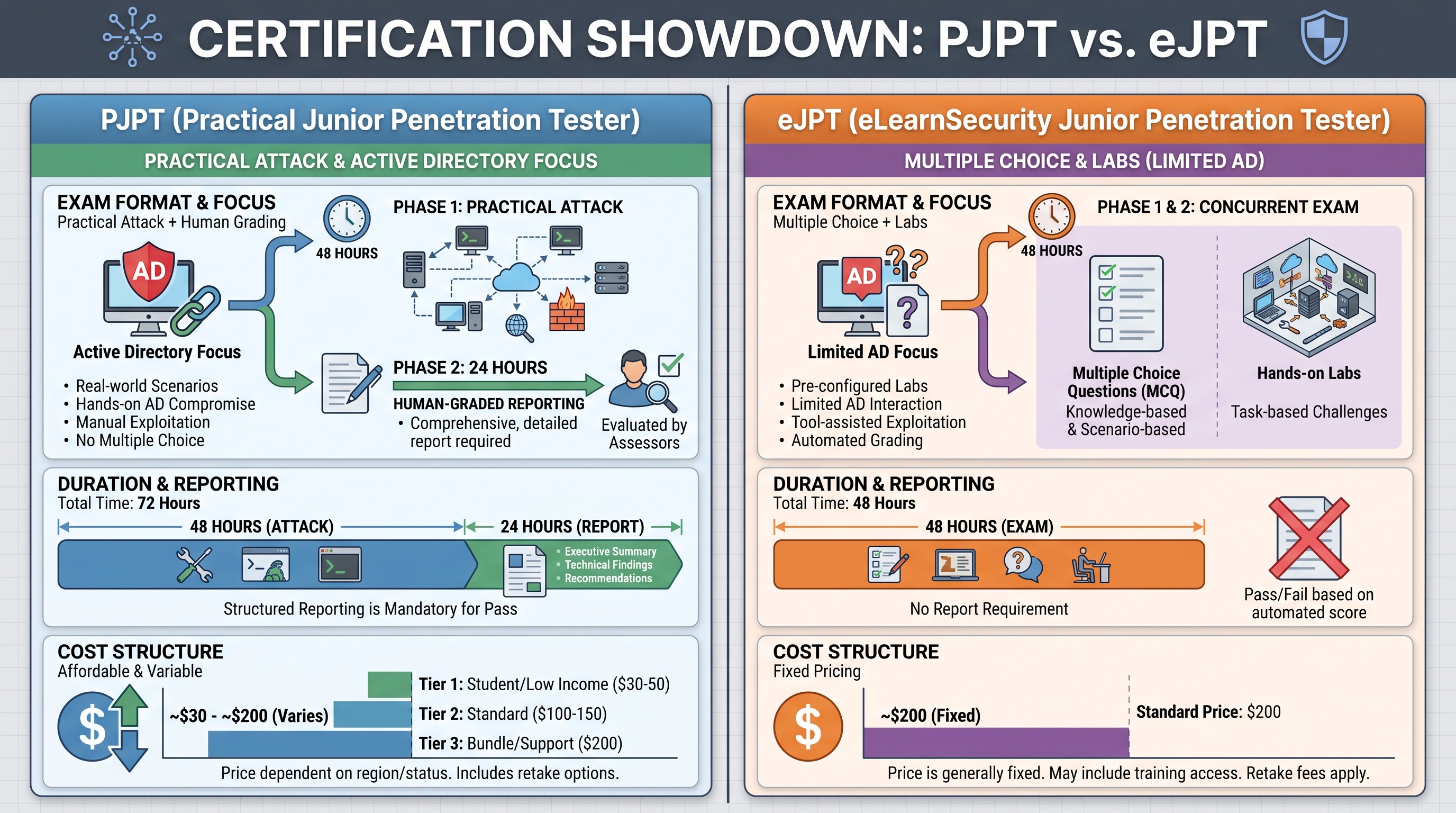
PJPT and eJPT are the two most compared entry-level pentest certifications in 2026, but they differ significantly in format, depth, and cost.
| Feature | PJPT (TCM Security) | eJPT (INE/eLearnSecurity) |
|---|---|---|
| Exam Format | Practical + written report | Multiple choice + practical labs |
| Duration | 48 h attack + 24 h report | 48 hours total |
| Price (approx.) | ~$30-$200 (bundle dependent) | ~$200 |
| Active Directory Focus | Yes, core topic | Limited |
| Report Writing Required | Yes | No |
| Industry Recognition | Growing, community-driven | Broader HR name recognition |
If your goal is to learn how to write a pentest report and practice Active Directory fundamentals, PJPT delivers more realistic training. If you need a cert name that HR filters might recognize first, eJPT currently has broader brand awareness in automated applicant tracking systems. Both are valid starting points, but PJPT better prepares you for the day-to-day work of a junior pentester.
How Does PJPT Compare to OSCP?
PJPT is not a competitor to OSCP; it is an on-ramp toward it. OSCP (Offensive Security Certified Professional) remains the industry benchmark for professional penetration testers, while PJPT serves as a confidence-building prerequisite for candidates who are not yet ready for OSCP’s 23-hour exam and strict proctoring environment.
| Feature | PJPT | OSCP |
|---|---|---|
| Issuer | TCM Security | Offensive Security |
| Exam Length | 48 h + 24 h report | 23 h 45 min + 24 h report |
| Difficulty | Entry level | Intermediate-Advanced |
| Cost (approx.) | Low (under $200) | ~$1,499 |
| Market Recognition | Junior roles, community | Industry standard globally |
| Active Directory | Core focus | Covered, not the only focus |
Many candidates use the PJPT as a structured checkpoint before investing in OSCP lab time. If you can pass PJPT confidently, you have validated your foundational methodology and report-writing workflow, both of which directly transfer to OSCP preparation. You can explore the full OSCP service list at Cyber Services to understand what support is available when you make that next step.
How Hard Is PJPT and How Should You Prepare?
PJPT is designed for true beginners, but “beginner” does not mean trivial. Candidates who attempt the exam without any prior hands-on lab practice typically struggle with the Active Directory exploitation chain and with structuring a professional report under time pressure.
A realistic preparation checklist before sitting PJPT:
- Complete TCM Security’s Practical Ethical Hacking course (covers 90% of exam content directly).
- Practice LLMNR poisoning and SMB relay in a home lab using two Windows VMs.
- Run through at least 5 beginner-level HackTheBox or TryHackMe machines focused on Windows/AD.
- Write a mock penetration testing report for at least one lab machine before exam day.
- Review a professional report template so your deliverable meets junior industry standards.
Candidates with 2-3 months of consistent lab practice pass on their first attempt at a high rate. The report component surprises many: technical skill alone is not enough if your findings are poorly written or disorganized.
“Practicing report writing on lab machines before the exam is the single most underrated preparation step for PJPT, and the one most candidates skip.”
Career Value: Will Employers Recognize PJPT?
PJPT is increasingly recognized by security-savvy hiring managers, especially at smaller consultancies and managed security service providers where practical skill matters more than brand recognition. Large enterprises with rigid HR filters may not have PJPT in their keyword lists yet, but this gap is closing as TCM Security’s reputation grows.
The report-based format gives PJPT holders a tangible artifact to share in interviews, a real deliverable that demonstrates both technical competence and communication ability. This is a genuine advantage over multiple-choice certs when hiring managers ask candidates to walk through a past engagement. For junior roles in internal red teams or boutique pentest firms, PJPT is a credible signal. Pairing it with OSCP or PNPT resources from Cyber Services accelerates your career trajectory significantly.
According to OWASP, understanding web application attack surfaces is foundational for any penetration tester, and PJPT’s curriculum, while primarily network-focused, introduces candidates to the thinking patterns that carry over into web app work later in their career.
Cost Breakdown and Retake Policy
The PJPT exam is one of the most affordable practical certifications on the market. The exam voucher is typically bundled with TCM Security’s course content, bringing the total cost well below competing entry-level certifications.
| Item | Approx. Cost |
|---|---|
| Exam voucher only | ~$30 |
| PEH Course + Exam bundle | ~$30-$200 depending on offer |
| Retake (first) | Free (included in purchase) |
| Additional retakes | Paid, check TCM site for current pricing |
TCM Security includes at least one free retake with most exam purchases, which removes a significant financial barrier for candidates who need a second attempt. This policy reflects the platform’s community-first approach and is a meaningful differentiator compared to higher-cost certifications where a failed attempt costs hundreds of dollars. Always verify current pricing directly on TCM Security’s official site before purchasing, as bundle prices change with promotions.
“At under $200 all-in, PJPT removes the financial barrier that stops many aspiring pentesters from ever attempting a practical certification.”
Frequently Asked Questions
Is PJPT good for complete beginners with no IT background?
PJPT is designed for beginners, but candidates with zero IT background will need additional preparation time. A solid understanding of networking fundamentals (TCP/IP, DNS, SMB) and basic Linux command-line usage is recommended before starting exam prep. TCM Security’s free and paid beginner resources can bridge that gap effectively.
Can PJPT help me get my first cybersecurity job?
PJPT alone is unlikely to land you a senior role, but combined with a strong GitHub portfolio and hands-on lab evidence, it can differentiate you in junior pentester and SOC analyst applications. Security-aware hiring managers at smaller firms value the practical format over generic multiple-choice credentials.
How does PJPT fit into a certification roadmap toward OSCP?
PJPT fits naturally as a first milestone before OSCP. It validates your Active Directory fundamentals and report-writing process, both of which are tested in OSCP. Passing PJPT gives you a realistic gauge of your readiness and helps you identify skill gaps to close before investing in the OSCP lab subscription.
Does Cyber Services offer resources for PJPT candidates?
Yes. Cyber Services provides exam dumps and walkthrough reports for a wide range of certifications. For candidates progressing beyond PJPT, resources covering PNPT, OSCP, CPTS, and CRTO are available to support every stage of a pentesting career. With over 500 clients supported worldwide and continuously updated materials, the platform is built for serious certification candidates.
Did you like this article?
Everything you just read is available on our site, tools, resources, and updates are delivered directly to you. Click the “Buy Now” button on the homepage to get full access today.