
Passing the OSCP comes down to one repeatable habit: building a hacking methodology that survives 23 hours and 45 minutes of active exam pressure, then proving it on standalone and Active Directory targets before you ever book a slot. If you are searching for how to prepare for oscp exam, the honest answer is that success is less about collecting exploits and more about disciplined enumeration, privilege escalation, domain chaining, and a report that OffSec will actually accept. At Cyber Services we work with candidates every week who have the raw skill but no structure, so this guide breaks down what the exam tests, how OffSec defines the rules, and how to turn scattered practice into exam-day readiness.
Table of contents
What the OSCP exam actually measures
The OSCP is a hands-on penetration testing exam: you compromise multiple lab machines under a timed window and then deliver a professional report. Candidates get 23 hours and 45 minutes of active exam time, followed by an additional 24 hours to submit that report, so documentation is not an afterthought.
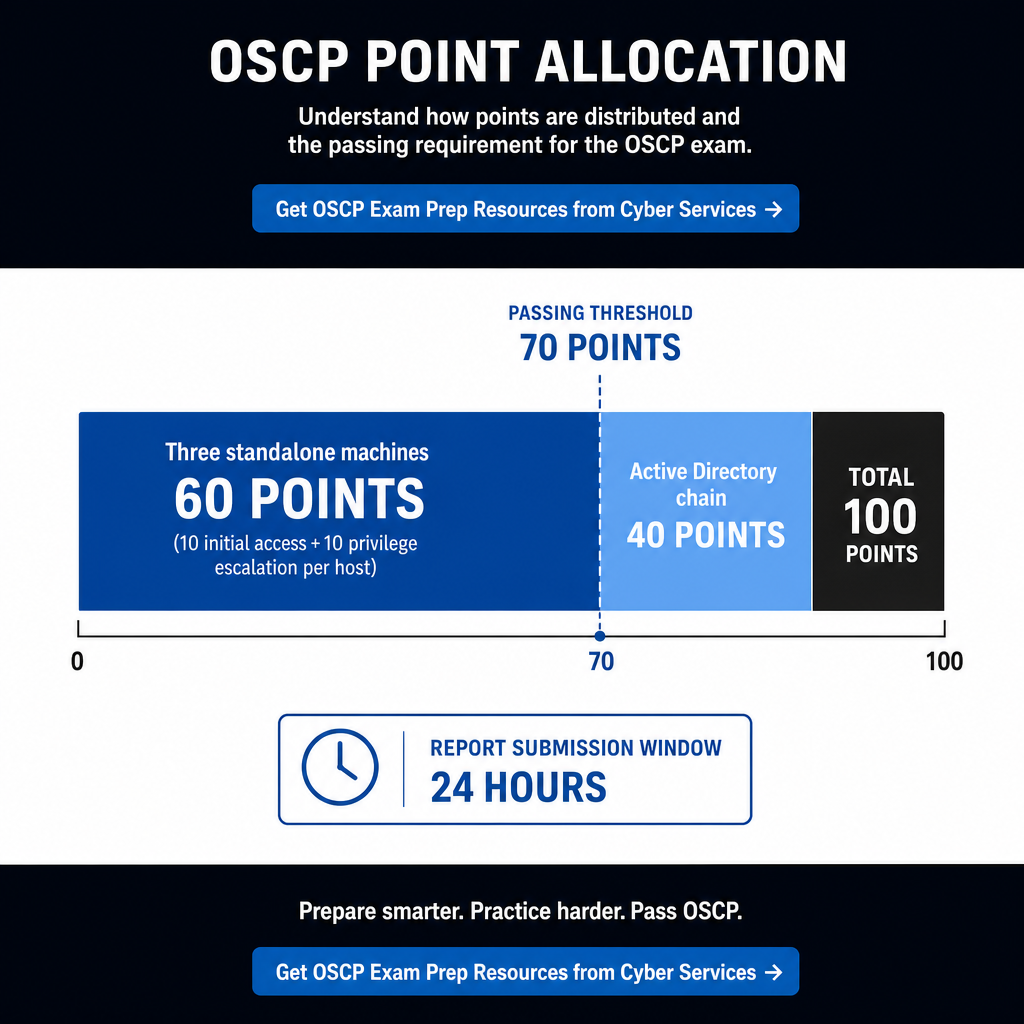
The current format is point-based and splits into two parts. Three standalone machines carry 60 points total, typically 10 points for initial access and 10 for privilege escalation per host. One Active Directory set of chained machines, delivered as an assumed-compromise scenario, is worth 40 points. You need at least 70 out of 100 points plus a properly formatted report to pass.
Read that scoring model carefully, because it dictates strategy. Getting a shell is only half the work; privilege escalation, AD chaining, and clear proof capture decide whether partial compromises turn into full points. OffSec maps the exam to the PEN-200 curriculum and an official body of knowledge covering enumeration, exploitation, Active Directory attacks, and writing effective technical reports. The first real preparation decision is accepting that you are being tested on methodology, not on a bag of random tricks.
Is OSCP the right next step for you
Before committing months of practice, be clear about the decision. OSCP is positioned as an intermediate-level penetration testing certification built around PEN-200, and it assumes solid fundamentals in networking, Linux and Windows, and basic scripting. The AD component and reporting requirements deliberately mirror real internal and red-team style engagements rather than isolated CTF puzzles.
OffSec’s own preparation guidance emphasises time in labs, structured practice, and disciplined note-taking over shortcut memorisation. OSCP is a strong fit if you want defensible proof that you can run an end-to-end penetration test: discovery, exploitation, privilege escalation, domain compromise, and professional reporting under a clock.
For time-constrained professionals, the real fork is whether to build that plan entirely alone or compress the learning curve with curated labs, structured roadmaps, and on-demand mentoring. We built our OSCP exam support services around exactly that problem, keeping candidates aligned with exam-relevant material instead of drifting through unrelated boxes. If you want the wider context first, our full OSCP certification overview explains where the credential sits among red-team paths.
Lock in the official rules before you touch a lab
Before a single machine, internalise the non-negotiables OffSec sets. The OSCP Exam Guide and Exam FAQ define allowed tools, prohibited resources, proctoring and identification requirements, and how to submit your report. They specify which exploit code you may use, which public resources are permitted, and how to document each compromise with proof files and screenshots. The guide also explains reverts, environment resets, and what technical support you can expect during the exam.
These rules matter because violating them can invalidate an otherwise passing attempt. Treat early familiarisation with the official OSCP Exam Guide as a core preparation task, not a last-minute skim the night before. Knowing what counts as valid proof and which tooling is restricted changes how you practise from day one.
Build the technical foundation first
The body of knowledge and PEN-200 modules outline what OffSec expects you to know before and during the course. Skipping these foundations is the most common reason strong-looking candidates fail: they cannot interpret what their tools are showing them.
- Networking: TCP/IP, routing, DNS, and basic defence mechanisms so you can read scans and reason about attack paths.
- Operating system internals: Linux and Windows users, groups, permissions, services, and routine administration.
- Scripting and automation: Bash plus at least one higher-level language, commonly Python, to adapt public exploits and automate repetition.
- Web application flaws: injection, authentication and authorisation weaknesses, and file-handling issues.
- Entry-level exploit development: 32-bit Windows buffer overflow concepts that appear in PEN-200 and typical prep paths.
PEN-200 is designed to teach these through structured modules and hands-on labs. Build competence here before you start counting boxes, because enumeration output only becomes useful once you understand the systems underneath it.
Use PEN-200 and labs with intent
OffSec’s guidance recommends actively engaging with PEN-200 modules and their labs rather than passively reading or watching. That means working through the core modules on enumeration, exploitation, privilege escalation, and AD topics, then treating every lab machine like a miniature engagement: full port scans, systematic enumeration, evidence capture, and a short set of notes or a mini-report afterward.
The PEN-200 challenges and AD sets exist specifically to build the chain-attack skills the exam’s 40-point AD environment demands. OffSec’s preparation guidance also stresses simulating real exam conditions as you progress: time-box your attempts, document everything, and review failures to find methodology gaps rather than moving on.
At this stage many candidates realise they need structure and accountability as much as more content. Our OSCP-oriented resources and mentoring are built to keep you moving through exam-relevant material efficiently. If you are also eyeing complementary paths, our CPTS exam writeup and PNPT exam writeup show how a single methodology carries across several practical credentials. Ready to compress your OSCP timeline? Talk to our team about a tailored plan built around your current gaps.
Rehearse exam-day execution, not just knowledge
Knowing how to exploit a service is different from performing under OSCP conditions. Rehearse these behaviours until they are automatic:
- Time management: with nearly 24 hours across multiple machines, front-load the easy points and refuse to get stuck early on one host.
- Machine selection: many candidates secure initial access and privilege escalation on standalone hosts before committing to the AD chain.
- Enumeration before exploitation: full port scans, service fingerprinting, directory brute-forcing, and credential-reuse checks are mandatory pre-steps, not optional extras.
- AD workflows: practise enumeration and attack paths in AD labs so you move efficiently through the chained 40-point environment.
- Pacing and breaks: planned rest and fatigue management measurably improve performance across such a long window.
Turn these into a routine by running full exam simulations, including a dry-run of the report, before your real slot. A rehearsed workflow removes the improvisation that burns hours you cannot spare.
Treat reporting as a scored skill
OffSec requires a professional penetration test report, and falling short on formatting or content can affect your result even if you cleared the point threshold. The body of knowledge lists writing effective technical penetration testing reports as a dedicated learning area, which tells you how seriously it is weighted.
A strong OSCP report documents each compromise clearly with steps, commands, and evidence such as proof files and screenshots. Structure it with an executive summary, methodology, per-host findings, and remediation recommendations, then submit within 24 hours of exam completion following OffSec’s formatting rules. The most reliable way to build this skill is to write mini-reports for lab machines and full mock reports for every simulated exam, so the format is muscle memory rather than a scramble after a sleepless night. Our mentors review report structure alongside technical paths, because a clean 70 depends on both.
Failure patterns that sink strong candidates
The recurring pitfalls across OSCP guides, FAQs, and community checklists are consistent enough to plan against:
| Failure pattern | Why it costs points | Preparation fix |
|---|---|---|
| Neglecting Active Directory | 40 points left on the table | Drill AD enumeration and chained attacks in dedicated labs |
| Weak privilege escalation | Partial compromises never become full points | Practise escalation on both Linux and Windows targets |
| Poor note and screenshot discipline | Incomplete report, missing proof at submission | Capture evidence live for every step in every lab |
| Ignoring official tool and resource rules | Risk of exam invalidation | Study the Exam Guide and FAQ before practising |
| Scheduling too early | Sitting before consistent success | Benchmark against intermediate boxes and full simulations |
A structured plan that explicitly bakes in AD practice, escalation drills, evidence habits, and report dry-runs neutralises most of these before exam day. If you already have fundamentals but keep hitting one of these walls, targeted mentoring on that specific gap is usually faster than more unstructured hours.
How to know you are ready to sit OSCP
You are in a strong position to book the exam when several conditions hold together, not just one:
- You consistently compromise intermediate-difficulty Linux and Windows machines without step-by-step walkthroughs.
- You have completed at least one full exam simulation covering three standalone-style machines and an AD-like chain inside a 24-hour window, finished with a written report.
- Your methodology for scanning, enumeration, exploitation, privilege escalation, and documentation is written down and rehearsed rather than improvised.
- You can complete a typical buffer overflow and baseline AD enumeration with enough time left over to debug during the real exam.
When those signals are present, the last decision is whether to lean entirely on self-study or reinforce your plan with guided resources and mentoring. For candidates pursuing more than one credential, working within a single ecosystem keeps your methodology consistent across OSCP and adjacent red-team exams instead of fragmenting your notes across unrelated sources. If you want a second set of eyes on your readiness or a plan built around your weakest area, reach out and we will map your remaining gaps to a concrete schedule.
Frequently asked questions
How long does it usually take to prepare for OSCP?
Timelines vary, but OffSec-aligned resources generally describe several months of steady practice, including completing major PEN-200 modules and a significant portion of the labs before scheduling the exam. Consistency matters more than raw hours.
Do you need to finish all PEN-200 content before taking OSCP?
OffSec strongly encourages completing PEN-200 materials and lab exercises, especially the AD challenges and reporting practice, because they map directly to the OSCP body of knowledge and exam format.
How important is Active Directory for OSCP?
Very important. The AD environment is worth 40 of 100 points as a chained, assumed-compromise scenario, so neglecting AD practice caps your scoring potential well below a pass.
Can mentor-supported resources really reduce study time?
Candidates who follow structured roadmaps, run realistic exam simulations, and get feedback on methodology and reporting tend to reach consistent performance sooner than those relying on unstructured practice. Our OSCP support is built around those efficiency gains.
What is the fastest way to start with Cyber Services?
Share your current experience level, target exam date, and the areas you struggle with most, and we will recommend a tailored OSCP preparation plan through our OSCP support services.