

A remote pass cybersecurity certification service lets a verified expert complete your certification exam on your behalf, using a remote session, so you receive the credential without sitting through the full exam process yourself. Whether you are pivoting careers, pressed for time, or simply want to eliminate the risk of failing an expensive exam, understanding how these services work is essential before spending a single dollar.
- What Is a Remote Pass Service?
- How to Pass Your Remote Cybersecurity Certification Step by Step
- Which Cybersecurity Certifications Are Covered?
- Remote Pass vs. Exam Dump vs. Full Support: Which Should You Choose?
- Who Actually Benefits from a Remote Pass Service?
- Privacy and Security: What You Need to Know Before You Buy
- How to Choose a Trustworthy Provider
- Decision Flow: Which Service Type Fits Your Situation?
- Frequently Asked Questions
What Is a Remote Pass Service?
A remote pass service is a professional arrangement where a skilled specialist accesses your exam environment remotely and completes the certification exam for you, delivering the passing result under your registered account. This is different from buying study guides or exam dumps: you are purchasing an outcome, not preparation material.
The concept is straightforward. Certifications such as OSCP, CPTS, CRTO, and BSCP involve lab-based or practical exams that require active exploitation of machines or web applications. A remote pass provider connects to your exam lab, completes all required objectives, and submits the exam report where applicable. The credential is then issued to you by the certification body.
A remote pass service is not a shortcut for the unprepared. It is a strategic tool for professionals who already understand the domain but cannot afford repeated exam failures or scheduling delays.
How to Pass Your Remote Cybersecurity Certification Step by Step
The typical remote pass workflow follows a clear sequence from initial contact to certificate delivery, and knowing each stage helps you set accurate expectations.
- Initial consultation: You contact the provider, specify your target certification, and discuss your exam scheduling window.
- Agreement and payment: Terms, pricing, and privacy arrangements are confirmed. A reputable provider will offer a clear refund or retry policy if the pass is not delivered.
- Exam booking: You register and book the exam through the official certification body using your own account and payment method.
- Remote session setup: On exam day, you grant the specialist access to your exam environment using a secure, agreed-upon remote connection method.
- Exam execution: The expert works through all objectives, labs, or machines within the exam time window.
- Report submission (if required): For certifications that require a written penetration test report (such as OSCP or CPTS), the provider prepares and submits a professional report on your behalf.
- Certificate issuance: Once the certification body grades the submission and confirms a pass, your certificate is issued to your registered profile.
At Cyber Services, this process is refined over six years of experience with over 500 clients worldwide, meaning the workflow is tight, communication is direct, and delivery timelines are realistic.
Which Cybersecurity Certifications Are Covered?
Not every certification is eligible for a remote pass model. Purely multiple-choice exams with proctored browser lockdowns are generally handled through exam dump services instead, while practical, lab-based exams are the natural fit for remote pass delivery.
| Certification | Exam Format | Remote Pass Eligible | Report Required |
|---|---|---|---|
| OSCP (OffSec) | 24-hour lab + report | Yes | Yes |
| CPTS (HTB) | Lab-based practical | Yes | Yes |
| CRTO (Zero-Point Security) | 48-hour lab | Yes | No |
| BSCP (PortSwigger) | Practical web exam | Yes | No |
| PNPT (TCM Security) | 5-day practical + report | Yes | Yes |
| CPENT (EC-Council) | 24-hour lab | Yes | Yes |
| CEH (EC-Council) | Multiple choice | Dump preferred | No |
Cyber Services covers a wide certification catalog including OSWE, OSEP, OSED, OSWA, OSDA, CRTP, CRTE, CARTP, CWEE, CAPE, CDSA, eJPT, eWPT, eWPTX, and many others. If your target cert is not listed above, contact support directly to confirm availability.
Remote Pass vs. Exam Dump vs. Full Support: Which Should You Choose?
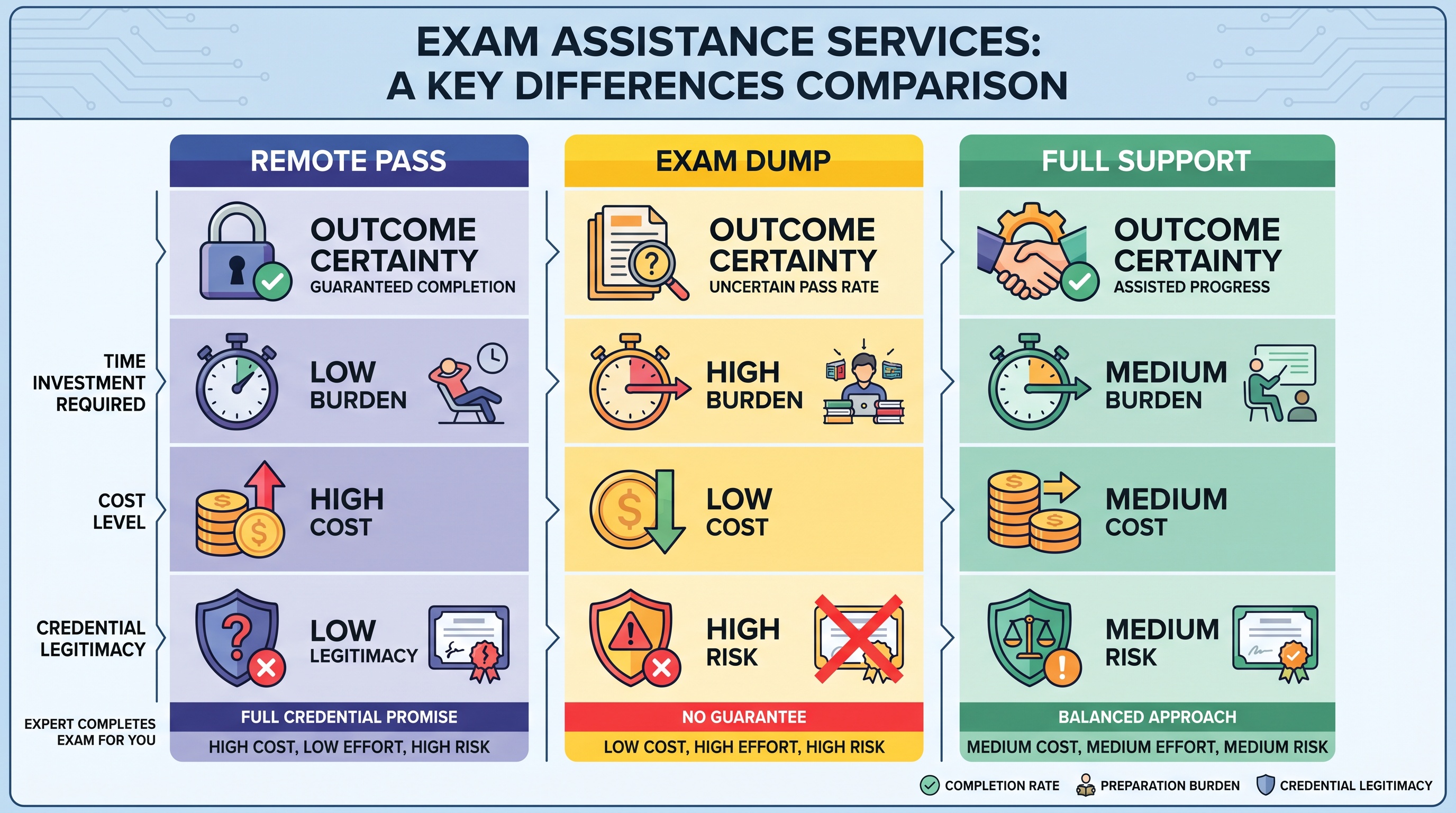
The three main service types each solve a different problem. Choosing the wrong one wastes money and time, so comparing them side by side is critical before you commit.
| Service Type | Best For | Exam Format Fit | Price Range | Effort Required |
|---|---|---|---|---|
| Remote Pass | Professionals needing a guaranteed outcome | Practical / lab-based | Higher | Minimal (book and coordinate) |
| Exam Dump / Walkthrough | Self-studiers wanting real exam insight | MCQ + some practical | Lower | Moderate (study from material) |
| Full Support | Candidates who want guided preparation plus exam assistance | Any format | Mid to high | Low to moderate (mentored) |
If your exam is lab-based and you have already tried once or simply cannot risk a retake fee, the remote pass service offers the clearest cost-to-outcome ratio.
For certifications that blend multiple-choice theory with practical labs, a full support service often makes more sense: a mentor helps you through the preparation phase, and the remote specialist handles the lab component on exam day. Cyber Services offers both as separate or bundled options, with a best-price guarantee across its full catalog.
Who Actually Benefits from a Remote Pass Service?
Remote pass services are most valuable for a specific set of professionals, and being honest about your situation before purchasing leads to a better return on investment.
- Career changers with a deadline: Professionals moving from IT support or sysadmin roles into security who have a job offer contingent on holding a specific certification.
- Experienced practitioners blocked by exam format: Senior red teamers or pentesters who already apply the skills daily but struggle with the time-pressured exam structure.
- Re-takers after one or more failures: Retake fees for certifications like OSCP can exceed $200 USD per attempt. One remote pass may cost less than two retakes combined.
- Professionals in regions with limited study time: Consultants billing 60-hour weeks who lack the bandwidth to run a full 3-month study program.
- Compliance-driven certification mandates: Security teams where management requires a specific certification for contract compliance, regardless of the holder’s existing skill level.
According to SANS Institute, the skills gap in cybersecurity remains one of the sector’s most pressing operational challenges. Certifications are increasingly used as proxies for capability, making credential attainment a business-critical priority for many teams.
Privacy and Security: What You Need to Know Before You Buy
Privacy is the single most important factor when evaluating a remote pass provider, because you are granting temporary access to an exam account and, in some cases, sharing personal booking details.
A trustworthy provider will never ask for your permanent account password. Instead, access is granted only to the exam environment during the exam window, using temporary credentials or a scoped remote session tool. Communication channels should be encrypted, and no personal data should be retained after the engagement closes.
Cyber Services operates on a privacy-first model: client identities are never shared, no records of engagements are stored publicly, and all communication is handled through secure channels. This policy has supported over 500 clients across six years without a reported privacy incident.
Before signing with any provider, ask these three questions directly: How do you access my exam environment? What data do you retain after the engagement? What happens if the exam is detected or cancelled?
How to Choose a Trustworthy Provider
Choosing a reliable remote pass provider comes down to verifying transparency, track record, and support quality before any money changes hands.
| Criterion | Green Flag | Red Flag |
|---|---|---|
| Experience | Years in operation, verifiable client count | No history, anonymous with no reviews |
| Certification coverage | Specific cert names listed clearly | Vague “all certifications” claims |
| Privacy policy | Written policy, no data retention | Asks for permanent credentials or personal ID |
| Pricing transparency | Fixed or clearly ranged pricing on site | Price only revealed after contact; no refund policy |
| Communication | Responsive, answers specific questions | Scripted replies, avoids direct questions |
| Report quality (if needed) | Sample report available or described in detail | No mention of report; “we handle everything” only |
For certifications where a written report is graded (OSCP, CPTS, PNPT), the quality of the penetration test report is as important as the lab performance. Verify that your provider’s specialists have real-world pentest writing experience, not just lab skills.
If OSCP is your target, review the full range of services available on the OSCP service list at Cyber Services to compare remote pass, full support, and supplementary options in one place.
Decision Flow: Which Service Type Fits Your Situation?
Use this decision flow to match your current situation to the right service before purchasing.
- Is your target exam purely multiple-choice or theory-based?
- Yes: Consider an exam dump or walkthrough report for self-study preparation.
- No: Continue below.
- Do you have 2-4 months available to study and practice labs?
- Yes, and you want expert guidance: Choose a full support mentoring service.
- No, or you have already studied and need to pass now: Consider a remote pass service.
- Have you already failed the exam once or more?
- Yes: A remote pass eliminates further retake costs and delays.
- No, first attempt: Weigh the retake cost against the remote pass fee before deciding.
- Does your exam require a written penetration test report?
- Yes: Confirm your provider includes professional report writing in the service scope.
- No: A standard remote pass session is sufficient.
- Is privacy your top concern?
- Yes: Only work with providers who publish a clear no-data-retention policy and do not require permanent credential access.
The best service is the one that matches your timeline, budget, and risk tolerance. Buying the most expensive option is not always the right move; buying the wrong type always is.
For certifications in the HTB (HackTheBox) ecosystem such as CPTS, CDSA, or CWEE, dedicated walkthrough resources are also available. Browse the CPTS exam dump and walkthrough to understand what level of preparation detail is included alongside or instead of a remote pass.
Frequently Asked Questions
Is a remote pass service legal?
Remote pass services operate in a legally grey area that varies by jurisdiction and certification body terms of service. Most certification vendors prohibit third-party exam completion in their candidate agreements. Buyers should read their exam registration terms carefully. The legal risk to the buyer is typically limited to credential revocation by the certification body, not criminal liability, but this varies. Cyber Services provides information and services transparently; responsibility for compliance with individual exam terms rests with the buyer.
How long does the remote pass process take from purchase to certificate?
The timeline depends on how quickly you can book the exam with the certification body, not on the provider’s processing time. Once the exam date is set, the remote pass itself happens within the official exam window. Certificate issuance typically follows within 48 to 72 hours for most vendors after a confirmed pass, though some (like OffSec) may take longer during busy periods.
What happens if the remote specialist does not achieve a passing score?
A reputable provider will offer a clear retry or refund policy. At Cyber Services, the terms of the service agreement cover outcome guarantees. Always confirm what the provider commits to before paying. Avoid any provider that refuses to state a policy on failed attempts in writing.
Can I use a remote pass service for Active Directory or cloud-based certification exams?
Yes. Certifications that involve Active Directory lab environments (such as CRTP, CRTE, or CARTP) or cloud penetration testing tracks are fully compatible with the remote pass model, since they are lab-based and do not rely on traditional proctoring software that blocks remote access. Always confirm with your provider that they have demonstrated experience with the specific exam environment before booking.