
If you are weighing htb cpts vs offsec oscp, the fastest honest answer is this: OSCP is still the stronger choice when you need immediate HR recognition and screening power, while CPTS is the stronger choice when you want deeper, structured penetration-testing skills at a lower cost and with a far more forgiving exam window. Both are legitimate, technical, hands-on credentials. The right pick depends on your goal, your budget, your learning style, and how much time you can realistically protect. We built our exam-support model at Cyber Services around exactly this problem: helping serious, time-constrained professionals reach either certification faster and pass on the first attempt with mentor-supported preparation and remote exam support.
Table of contents
What “htb cpts vs offsec oscp” really asks
You are not just picking an exam. You are choosing how you will learn real penetration testing, how hiring managers and applicant-tracking systems will read your CV, and how much time, money, and stress you are willing to spend to pass on the first try.
CPTS is the newer, highly structured, skills-heavy penetration testing path from Hack The Box. OSCP is the long-standing credential from Offensive Security that most of the industry still treats as the entry-to-mid-level benchmark. Both prove you can compromise machines and write about it; they simply optimize for different things.
The practical tension is speed versus depth versus recognition. A candidate who needs interviews next quarter reads the decision differently than a security analyst who wants to become a genuinely dangerous tester. Below, we break down each credential on its own terms, then set them side by side so the trade-offs are impossible to miss. We work with candidates across the full CPTS preparation and OSCP support tracks, so this comparison reflects where people actually get stuck.
HTB CPTS: structure, mechanics, and reality
HTB Certified Penetration Testing Specialist (CPTS) is Hack The Box’s job-role penetration testing certification, tied directly to the HTB Academy “Penetration Tester” path. It is marketed as a hands-on, intermediate-level credential that validates the ability to perform real penetration tests and deliver commercial-grade reports.
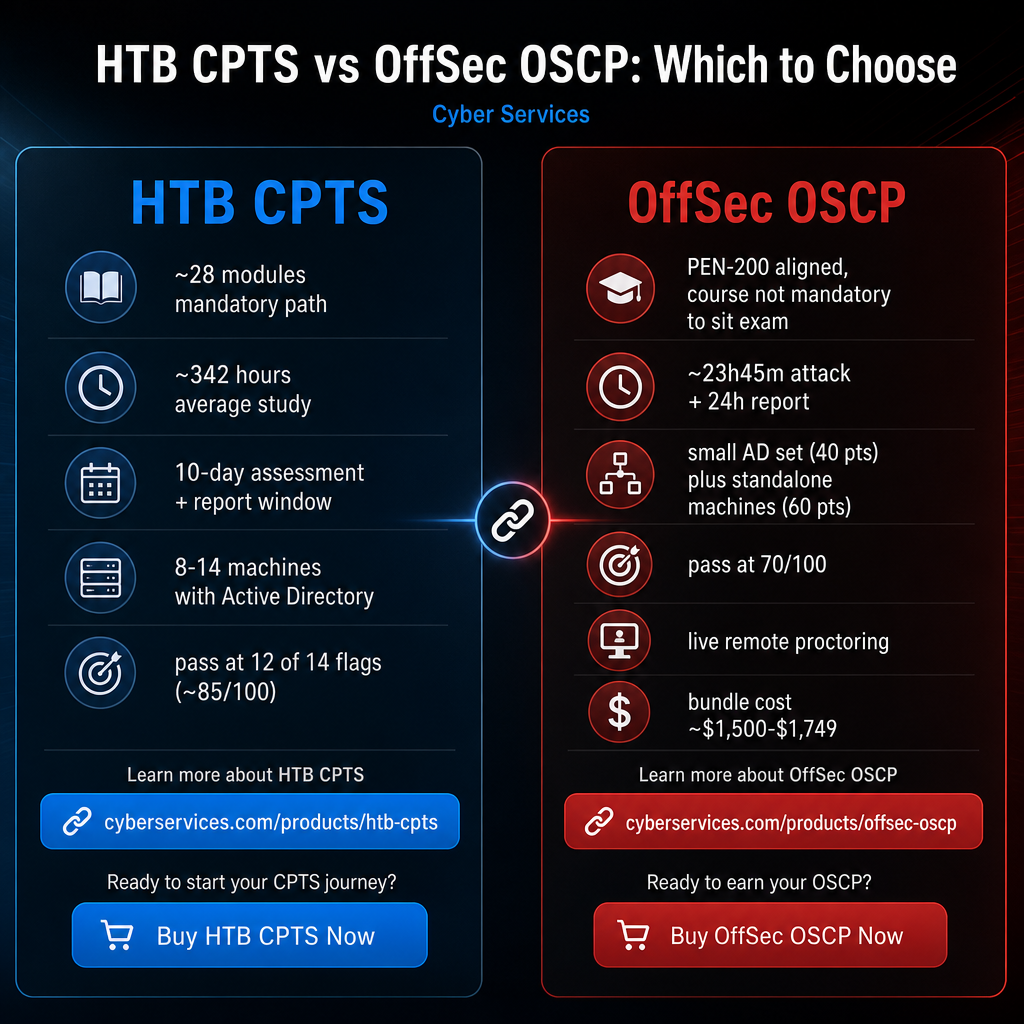
One thing surprises many candidates: you cannot simply buy the CPTS exam and sit it. You must complete a prescribed learning path first. That path runs to roughly 28 modules covering methodology, information gathering, Windows and Linux attacks, Active Directory, web application testing, exploitation, pivoting, privilege escalation, and reporting. Each module includes practical labs and Skill Assessments, and you only gain exam eligibility after finishing the entire path. Independent analysis places average CPTS study time at around 342 hours, which makes it one of the most thorough publicly documented pentest training paths available.
The exam is engineered to feel like a real engagement rather than a short capture-the-flag sprint. You get a 10-day assessment window, with a separate report submission period afterwards (commonly seven days). The scope is a black-box enterprise environment of roughly 8 to 14 connected Windows and Linux machines with Active Directory and pivoting paths. Many public write-ups describe 14 flags distributed across the environment; you generally need at least 12 of them plus a detailed professional report to pass, which lands near 85 out of 100 points. This format rewards methodical enumeration, chaining misconfigurations, and holding a consulting mindset from first scan to final report.
On recognition, CPTS is newer than OSCP but climbing fast. It is documented in respected competence frameworks that describe it as technically demanding and report-heavy, and Hack The Box notes it as a FedRAMP-recognized training provider certification, which strengthens its standing in regulated environments. For a technical hiring manager who understands modern pentesting, CPTS signals that you can both break in and report like a consultant. If you want the fundamentals first, our overview of what the CPTS certification covers explains the path in plain terms.
OffSec OSCP: structure, mechanics, and reality
Offensive Security Certified Professional (OSCP, now issued as OSCP and OSCP+) is OffSec’s flagship penetration testing credential, aligned with the PEN-200 “Penetration Testing with Kali Linux” course. OffSec and much of the industry describe OSCP as the gold-standard entry-to-mid-level pentesting certification, and it appears in job postings worldwide.
Unlike CPTS, completing the course content is not strictly required to sit the exam. PEN-200 covers Kali-based tooling, enumeration, exploitation, privilege escalation, web and AD attacks, and report writing. Course packages bundle lab access (often 90 days) and one exam attempt, with total cost generally between roughly $1,500 and $1,749 depending on bundle and region. Some candidates work through PEN-200 in full; others combine official materials with external labs, write-ups, and mentor-supported resources to compress prep time.
The exam itself is short, intense, and heavily proctored. You get about 23 hours and 45 minutes of attack time on the exam network, then 24 hours afterwards to write and upload the report. The scope is a small Active Directory set worth 40 points plus several standalone machines worth 60 points, and you need 70 out of 100 to pass, with partial credit available on some machines. Live remote proctoring monitors your webcam and screen, and rule violations can result in bans. This structure stresses time management, resilience, and the ability to find a way in quickly under pressure. If you are mapping out that grind, our guide on how to prepare for the OSCP exam step by step lays out a realistic sequence.
One recent change matters for planning. Passing the updated exam now grants both OSCP and OSCP+. OSCP itself remains valid indefinitely and does not expire. OSCP+ is time-bounded and must be renewed every three years, with recertification via continuing-education credits rather than a multiple-choice retest. For HR filters and job adverts, “OSCP” is still the keyword that unlocks automated tracking systems and recruiter shortlists.
How CPTS and OSCP differ in practice
Comparative guides and practitioner write-ups converge on the same handful of distinctions. This table compresses them so you can see the trade-offs at once.
| Dimension | HTB CPTS | OffSec OSCP |
|---|---|---|
| Learning path | Mandatory guided path (~28 modules) | PEN-200 aligned; course not required to sit exam |
| Exam window | 10-day engagement + report period | ~24h attack + 24h report |
| Environment | 8-14 machines, AD, pivoting | Small AD set + standalone machines |
| Pass mark | ~12 of 14 flags + report (~85/100) | 70/100 with partial credit |
| Proctoring | Engagement-style | Live webcam + screen |
The learning experience diverges first. CPTS is a guided path: you build breadth across methodology, AD, web, and reporting before you are allowed near the exam. OSCP is course-linked but flexible, so you can lean on PEN-200 plus whatever external labs and mentor-backed resources you prefer. For candidates who need structure and accountability, CPTS feels like an integrated bootcamp; OSCP feels like a capstone you prepare for on your own terms.
Exam style splits them next. OSCP is a roughly 24-hour, CTF-like penetration test with heavy proctoring and a hard cut-off, so it rewards sprint-style hacking under pressure. CPTS gives you a 10-day engagement with room to enumerate, pivot, document, and think like a consultant. If you thrive against a ticking clock, OSCP plays to your strengths; if you want realistic project flow and time to breathe, CPTS is more forgiving.
Focus and depth differ too. OSCP concentrates on enumeration, exploitation, privilege escalation, and AD compromise under strict time constraints. CPTS leans toward full methodology, deep Active Directory pivoting, advanced enumeration, and robust reporting. This is why some practitioners frame OSCP as the “HR gatekeeper” and CPTS as the “skill builder.”
Cost and recognition round out the picture. CPTS delivers a full path plus exam for a fraction of an OSCP bundle, which makes it the near-term choice for self-funded candidates and those in weaker-currency regions. Yet OSCP still wins decisively on HR recognition, with many pentest job postings listing it as required or strongly preferred, while CPTS is respected by practitioners and appears in competence frameworks but is still catching up on raw keyword presence.
Time, risk, and how mentor support changes the math
Preparing for either exam solo can mean hundreds of hours of lab time, stalled progress, and the very real risk of failing a costly attempt. There are three risk dimensions worth naming.
Time risk is underestimating the hours required and burning out before exam day. Exam-day risk is mismanaging the OSCP clock or struggling to chain the CPTS environment within engagement constraints. Reporting risk is losing points to an incomplete or poorly structured report even when your technical work was solid. That last one catches strong hackers off guard, because both exams weight documentation heavily.
Our model at Cyber Services is built to attack all three. We provide premium, exam-aligned resources, mentor-supported preparation, and remote exam support with professional report writing that you schedule ahead of your booked exam window. We cover the full OffSec track plus HTB CPTS and many adjacent pentest and red-team certifications, with instant delivery of resources and a focus on results for professionals who cannot disappear for six months to study.
Rather than assembling a plan from scratch, you can set CPTS or OSCP as the target, lean on curated exam-aligned resources and reporting workflows, and add remote support on exam day. For someone comparing the two credentials with limited free time, that structure can turn a long, lonely grind into a shorter, guided campaign with a realistic first-attempt pass probability.
How to decide: CPTS, OSCP, or both
Strip away the marketing and the decision reduces to four questions.
Your immediate career goal comes first. If your priority is clearing HR filters and landing interviews as fast as possible, OSCP usually wins on brand and job-post presence. If you are already in a security role and want deeper methodology, AD pivoting, and reporting experience, CPTS is often the more educational path.
Budget and funding are next. Self-funded candidates and students frequently start with CPTS because it delivers a full path and exam for a fraction of an OSCP bundle. Those with employer sponsorship may go straight to OSCP for recognition and add CPTS later to round out skills.
Learning style and time pressure matter more than people admit. If you learn best from a structured curriculum with a longer exam window, CPTS’s Academy path and 10-day engagement are gentler. If you handle intense pressure and prefer short, high-stakes sprints, OSCP’s roughly 24-hour exam can suit you, especially when you compress prep with mentor guidance.
Existing skill level closes the loop. Beginners with limited real AD exposure often benefit from doing CPTS first to internalize modern enterprise attack chains. Candidates already comfortable with AD, Linux and Windows privilege escalation, and web exploitation can target OSCP directly and use CPTS-style labs later for refinement.
Many experienced practitioners argue the optimal long-term route is CPTS first, then OSCP: learn the trade deeply, then secure the recognition and HR power. If your timeline is tight, mentor-supported resources and remote exam support make that combined path realistic inside a single year. When you are ready to move, tell us your target exam, your current level, and your booking window through our certification support services and we will shape a plan around your situation instead of a generic checklist.
Frequently Asked Questions
Which is harder, CPTS or OSCP?
Most comparative reviews conclude OSCP is harder on exam day because of the roughly 24-hour, proctored sprint and strict scoring, while CPTS is harder across the breadth of skills due to its long curriculum and engagement-style exam. They stress different muscles.
Which certification is better for getting my first pentest job?
OSCP remains the safer choice for CV screening because many adverts list it by name and recruiters recognize the brand. CPTS is respected by practitioners and appears in formal frameworks, but it is still building HR keyword presence.
Is CPTS enough on its own for a penetration testing career?
CPTS can demonstrate strong practical skills in methodology, Active Directory, and reporting, backed by rigorous training and exam requirements. For maximum global recognition and long-term mobility, adding OSCP later still helps.
How long should I plan to study for CPTS vs OSCP?
Independent sources estimate the CPTS Academy path at roughly 342 hours, often spread across three to six months. OSCP prep is commonly framed as three to six months of focused work, depending on your starting level and bundle duration.
If I have to choose one right now, which should I pick?
Pick OSCP if you urgently need a widely recognized credential for applications or promotion. Pick CPTS if you want more comprehensive skill development at lower cost and can articulate its value in interviews. When your situation allows, add the other with a mentor-backed plan.