
The best study resources for OSCP start with OffSec’s official PEN-200 course and guides, add realistic practice labs, and layer in curated community notes and mentor support so time-constrained professionals can pass on the first attempt. That is the short answer. The longer answer is a decision about how you combine these pieces, because OSCP is not a memorization test you can shortcut with a single PDF. It is a 24-hour hands-on exam that rewards fluency built through repetition, disciplined enumeration, and clean reporting. Below we break down what actually earns points, which resources map to those skills, how each one works mechanically, and how to assemble a stack that fits your background and your deadline.
Table of contents
Understanding what the OSCP exam actually tests
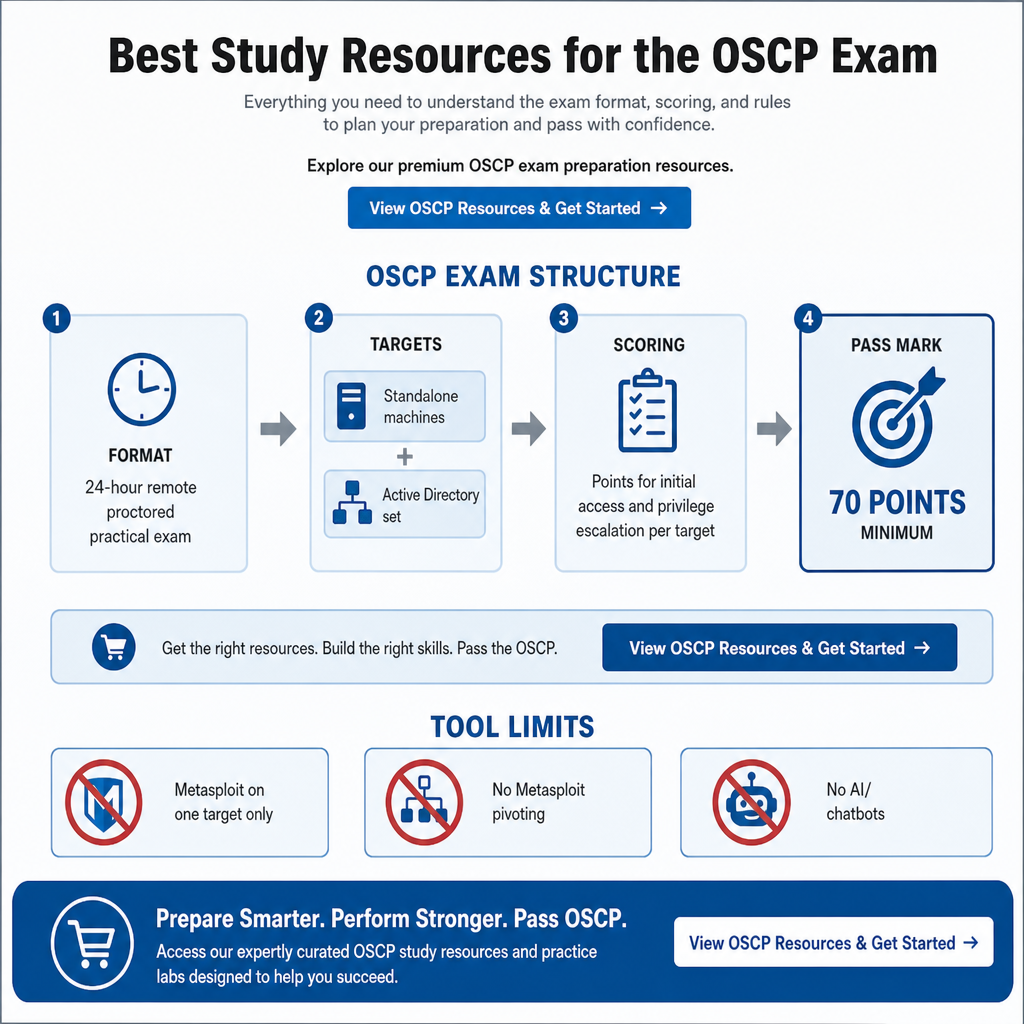
Before you pick resources, know the target. OSCP is a remote, proctored, 24-hour practical penetration test where you compromise several machines in a lab environment and submit a detailed report for scoring. Candidates must reach at least 70 points across standalone machines and an Active Directory environment, with points awarded for initial access and privilege escalation on each target. Study resources that do not build both footholds and escalation habits leave points on the table.
There are no formal prerequisites; anyone who purchases the PEN-200 course bundle can attempt the exam. That said, OffSec and independent guides strongly recommend solid TCP/IP networking knowledge, Linux and Windows administration experience, and basic scripting in Bash or Python before starting PEN-200. The OSCP Body of Knowledge and Authoritative References list confirm PEN-200 is the official study guide, mapping learning modules directly to assessed skills.
The exam rules also shape your prep. OffSec’s policies restrict certain tools: Metasploit is limited to one target, pivoting via Metasploit is not allowed, and AI or chatbots are prohibited during the exam and the reporting phase. Your study plan therefore has to emphasize manual enumeration, exploit modification, and careful documentation rather than reliance on automation. A resource that trains you to lean on point-and-click tooling will not survive contact with those constraints.
Core authoritative study resources for OSCP
The strongest OSCP stack has three layers, each doing a job the others cannot.
PEN-200 course and labs (primary). PEN-200 (Penetration Testing with Kali Linux) is the core OSCP training, bundled with lab access and at least one exam attempt. It combines written modules, video content, and extensive hands-on labs that mirror the exam’s focus on real-world penetration testing. OffSec explicitly designates the PEN-200 study guide as the only authoritative reference for OSCP, so it should anchor every serious plan. OffSec also publishes dedicated prep materials, including the PEN-200 and OSCP Prep Guide and the OSCP Prep Ebook, which consolidate exam-focused best practices, suggested study sequences, and lab usage strategies to help you prioritize modules and avoid common mistakes.
Practice labs and platforms (secondary but essential). Independent OSCP guides consistently recommend supplementing PEN-200 with realistic third-party environments. The platforms cited most often include Hack The Box, especially OSCP-style labs and curated machine lists; TryHackMe OSCP preparation paths; OffSec Proving Grounds Practice; and VulnHub with other community-maintained vulnerable machines. Together they provide a broad range of Linux and Windows targets, privilege escalation scenarios, and Active Directory environments, so you practice under conditions similar to or harder than the exam.
Curated community notes, checklists, and write-ups (reference layer). Experienced OSCP holders publish consolidated notes that compress months of experimentation into focused reference material. Well-known examples include the Total OSCP Guide, comprehensive notes and cheat-sheets from other practitioners, and large collections of Hack The Box walkthroughs and Active Directory attack references. Used well, they help you identify common OSCP-style misconfigurations and escalation paths, build personal Linux and Windows escalation checklists, and study complete end-to-end attack chains in report style. A carefully chosen set of notes reduces time wasted on dead ends and helps you recognize recurring patterns during labs and the exam.
If your time is short, trying to consume every community resource alone is usually the slow path. Combining PEN-200, a curated set of OSCP-style lab machines, and mentor-driven planning is more efficient, which is exactly how we structure our OSCP Exam Support Services: mentor support, instant access, and a success-oriented structure for candidates who cannot afford a long, unfocused study window.
Mechanisms: how these resources actually help you pass
Each layer changes a different variable in your readiness.
Authoritative OffSec resources give you a structured map of the required skills: reconnaissance, web and infrastructure exploitation, privilege escalation, Active Directory attacks, and professional report writing. The modules intentionally align with exam tasks, so thorough coverage of PEN-200 directly reduces surprises on exam day. This is the layer that defines scope, so you stop studying topics the exam never asks about.
Practice platforms convert that theory into reflex. By solving many different machines on Hack The Box, TryHackMe, Proving Grounds, and VulnHub, you build efficient enumeration workflows so you stop scanning the wrong surface, learn to chain multiple vulnerabilities or misconfigurations to reach SYSTEM or root, and develop the discipline to track findings for the report while the clock runs. Repetition, not reading, is what makes 24 hours feel workable.
Community notes and checklists act as an external memory and pattern library. They surface common privilege escalation techniques such as misconfigured services, scheduled tasks, dangerous SUID binaries, and vulnerable drivers, plus typical Active Directory paths like Kerberoasting, AS-REP roasting, and constrained delegation abuse. Combined with your own lab experience, they enable quick triage: instead of randomly trying commands, you systematically test likely vectors in a known order.
Mentor-supported preparation adds a fourth mechanism aimed at time-constrained professionals. It helps you select the right subset of resources, sequence them for maximum impact, and hold to a realistic schedule. We emphasize mentor support and instant delivery precisely to compress the path from PEN-200 onboarding to exam-ready status while keeping the focus on practical understanding rather than rote memorization. If you also plan to stack adjacent credentials, our guide on how to study for the HTB CPTS exam shows how the same disciplined lab-first approach transfers across certifications.
Decision criteria: choosing your OSCP study stack
The real decision is not which single resource to use, but how to combine authoritative material, labs, and guided support to match your background and constraints. Four factors settle it.
Your starting skill level. With strong Linux and Windows administration, network fundamentals, and scripting already in hand, you can move aggressively through PEN-200 and lean on difficult external labs. Without that foundation, plan more time in the official course and OffSec prep guides so you are not fighting basic tasks during a timed exam.
Time before your exam window. PEN-200 bundles include fixed lab access windows such as 90 or 180 days, and the exam is a high-stakes 24-hour event with a separate reporting window. Short access periods favor tight plans with heavier use of curated lab lists and mentor guidance; longer windows allow broader, more exploratory learning. Match the intensity of your stack to the calendar you actually have.
Risk tolerance and retake cost. Failing OSCP usually means paying for a retake, and public guides note typical retake fees plus the added cost of more lab time. Under-preparation or unfocused study raises both the financial and the opportunity cost of extended prep. A balanced stack of official OffSec materials, proven practice platforms, and targeted mentoring mitigates that risk more effectively than a random pile of tutorials.
Learning style and need for accountability. Disciplined self-directed learners can succeed with PEN-200, external labs, and community notes alone. Many working professionals, though, benefit from external scheduling and progress tracking, clarification of confusing PEN-200 topics, and guided selection of lab machines that mirror exam difficulty. Those are the gaps mentor support is built to fill.
| Constraint | What to weight more | Practical move |
|---|---|---|
| Strong prior skills | Hard external labs | Fast PEN-200 pass, focus on AD scenarios |
| Weak foundation | Official course + prep guides | Slow down early, drill enumeration basics |
| Short lab window | Curated lists + mentoring | Skip broad exploration, target exam-style boxes |
| Low retake tolerance | Balanced official + labs + mentor | Verify readiness on OSCP-style machines first |
| Needs accountability | Mentor-driven schedule | Fixed weekly targets and reporting practice |
Where our OSCP support fits into your study plan
We are a specialized platform for OffSec, HTB, and red-team certifications, including OSCP, OSWP, OSWE, OSEP, CPTS, CRTO, and PNPT. Our OSCP Exam Support Services are built for candidates who want condensed, exam-aligned study materials instead of broad, unfocused content; mentor guidance to interpret PEN-200, external labs, and community notes against current OSCP requirements; and instant access with a success-oriented structure that minimizes wasted study time.
The intended arrangement is layered, not replacement. You still use PEN-200 and OffSec prep guides as your authoritative base and treat practice platforms as your training ground. We sit on top of that stack to orchestrate your day-to-day preparation, prioritize the OSCP-relevant techniques, and keep you moving toward a passing score. For aspiring penetration testers, entry-level candidates, and experienced red team operators pursuing further credentials, that orchestration is where a tight deadline is usually won or lost.
If your priority is fast, efficient OSCP preparation with mentor accountability and minimal trial-and-error, the practical route is to combine PEN-200, OffSec prep guides, and curated practice labs with our OSCP Exam Support Services, then extend the same method to adjacent goals using our CPTS certification explainer once OSCP is secured.
Frequently Asked Questions
Do I really need PEN-200, or can I rely on third-party resources alone?
PEN-200 is the official OSCP training and the only authoritative reference listed by OffSec, and exam attempts are bundled with the course rather than sold separately. Third-party resources should complement PEN-200, not replace it.
How many practice machines should I solve before booking the exam?
There is no official minimum, but guides that track successful OSCP journeys often describe large numbers of completed labs across Hack The Box, TryHackMe, Proving Grounds, and VulnHub, plus multiple Active Directory environments. Consistently solving OSCP-style machines and AD scenarios is a strong readiness signal.
Are exam dumps or leaked write-ups safe to use?
OffSec’s policies stress integrity and strictly prohibit cheating, and the exam evolves over time, which reduces the usefulness of static dumps. Using any resource purely as a shortcut without understanding the underlying techniques risks both ethical problems and failure against unseen machines.
How does mentor support help if I already use PEN-200 and labs?
Mentor-driven support turns a broad set of resources into a coherent plan by mapping PEN-200 modules to specific labs, prioritizing OSCP-relevant techniques, and enforcing regular reporting and accountability. For busy professionals, that structure often matters as much as the content.
Where should I go for the fastest, commercially focused OSCP path?
Combine OffSec’s PEN-200 and official prep guides with curated OSCP-style practice platforms and our mentor-supported OSCP Exam Support Services. This stack respects OffSec’s requirements while aligning your study time squarely with passing OSCP on schedule.