
The offsec certification path is not a single ladder you climb rung by rung. It is a framework from Offensive Security that lets you combine role-based learning paths with specific hands-on exams to build a portfolio matched to the job you actually want. For most practitioners it orbits around OSCP delivered through the PEN-200 course, then branches into specializations such as OSEP, OSWA, OSWE, and OSED depending on whether you are aiming at network penetration testing, application security, or exploit development. Understanding how those tracks connect is what turns a scattered list of acronyms into a deliberate multi-year career plan.
Table of contents
What the OffSec certification path actually is
Offensive Security delivers hands-on cybersecurity training and certifications through guided learning paths that span introductory content all the way to advanced exploit development and red teaming. Those paths are organized by difficulty level, job role such as penetration tester or security engineer, and security domain including penetration testing, web application security, exploit development, and defensive operations.
The key mental shift is this: rather than one fixed sequence, the path is a matrix. You pick a role-based learning path, then attach the specific exams that certify the skills that role demands. Someone targeting a network pentesting seat and someone targeting an application security seat both start near OSCP, but they diverge quickly afterward. Treating the path as a personal route instead of a universal staircase is the difference between accumulating credentials and building a coherent specialization.
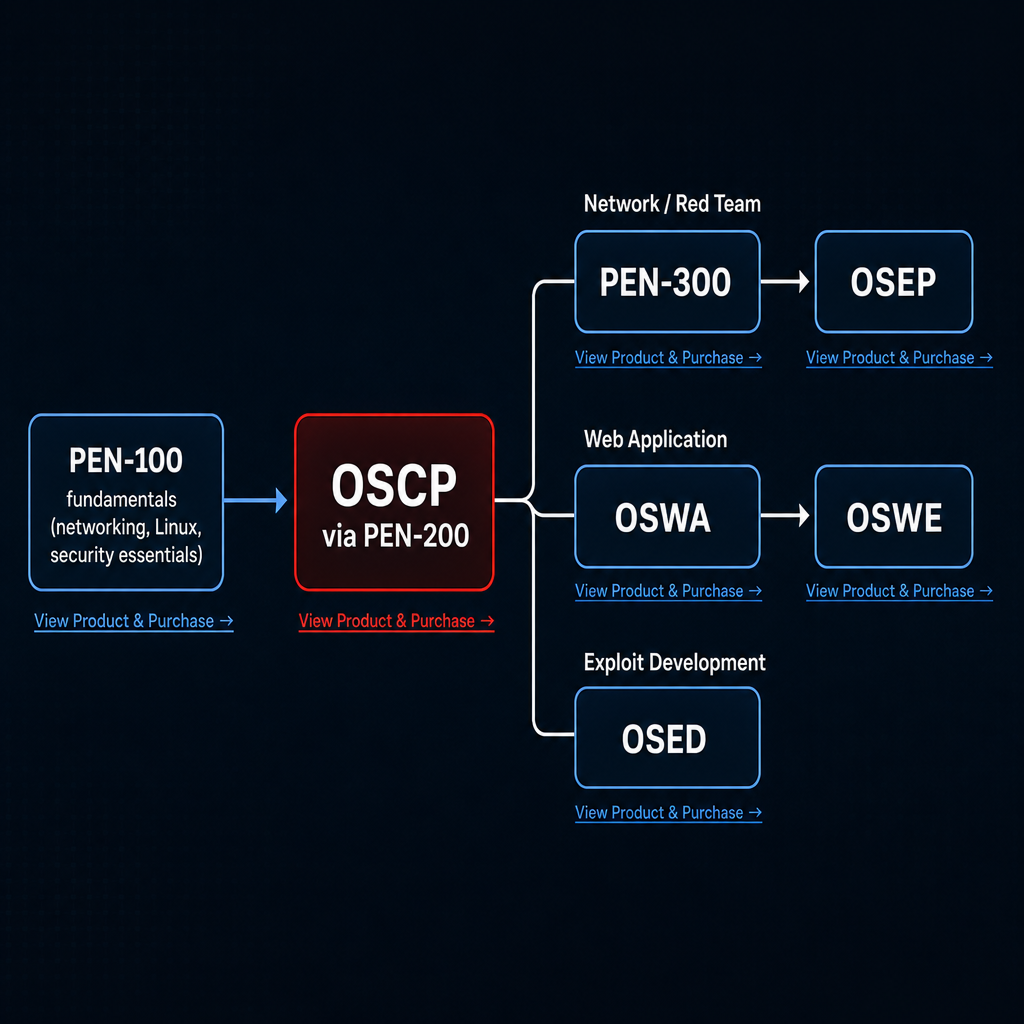
How the main OffSec tracks fit together
OffSec’s learning experience is built around subscription-based access to courses, labs, and their associated certification exams, delivered under “Learn” tiers that cover fundamentals through advanced content. Within that ecosystem OffSec publishes formal Learning Paths that group courses and certifications by discipline and level, so you follow a coherent progression instead of stitching together random standalone exams.
The penetration testing core runs through the PEN family. PEN-100 and other fundamentals content cover networking, Linux, and security essentials for absolute beginners. PEN-200, “Penetration Testing with Kali Linux,” is the primary course for aspiring penetration testers; passing its exam grants the OSCP/OSCP+ certification. PEN-300, “Advanced Evasion Techniques and Breaching Defenses,” builds on OSCP-level skills and leads to OSEP, focused on advanced adversary simulation and bypassing modern defenses.
The web application track combines intermediate and advanced courses. OSWA validates intermediate web assessment skills, and OSWE is the advanced web exploitation certification. Both sit inside OffSec’s web-focused learning paths, and both are listed as qualifying exams for maintaining OSCP+.
The exploit development track lives on the deeper end of the catalog. OSED targets advanced exploit development and is aimed at experienced practitioners who have already mastered core penetration testing. It is also recognized as a qualifying certification for OSCP+ renewal.
Beyond offense, OffSec maintains additional learning paths covering defensive roles and blue-team workflows, organized by role and difficulty in the same way. That lets you blend offensive and defensive skills when your target role sits between the two. If you are still weighing which credentials give the strongest return for pentesting work, our overview of the best cybersecurity certifications for pentesting breaks down where each one fits.
The decision you are really making
Choosing “the OffSec certification path” is less about picking one exam and more about answering three questions honestly. Which role do you want: hands-on penetration tester, application security specialist, exploit developer, or a mixed offensive-defensive practitioner? How deeply do you want to specialize versus staying broad? And how much real lab time and exam pressure can your current schedule absorb?
From OffSec’s own positioning, OSCP via PEN-200 sits at the center of the penetration tester path and acts as the springboard into higher-level exams like OSEP, OSWA, OSWE, and OSED. That means the outcome you commit to, for example “OSCP then OSEP” versus “OSCP then OSWA and OSWE,” is essentially a career decision wearing a credential’s clothing. Pick the branch first, then let the exams follow the branch.
If time is your binding constraint rather than ambition, we can help you compress the OSCP stage without abandoning the plan. Our OSCP exam support services are built to turn the official course material into a focused exam plan instead of an open-ended slog.
How OffSec exams and recertification work
OffSec certifications are practical, hands-on exams. You perform real-world style attacks in a lab environment and then submit a report, rather than answering multiple-choice questions. Access to these exams is typically bundled with the associated course through OffSec’s Learn subscriptions, which combine course content, lab access, and at least one exam attempt.
OSCP now carries an enhanced designation, OSCP+, offered through the PEN-200 course and exam. Once you earn it, OffSec defines a three-year cycle for maintaining or renewing the “+” designation. You can take a dedicated recertification exam within a specific window before the designation expires. Alternatively, you can pass another qualifying OffSec certification such as OSEP, OSWA, OSED, or OSWE before your OSCP+ lapses, which also counts as continuing education.
This is the detail that reshapes planning. Your path is cumulative: each advanced exam expands your skillset and can simultaneously keep your OSCP+ standing alive. A second certification chosen well does double duty. If you want the fine print on cost and attempts before you commit, our OSCP exam cost breakdown lays out the numbers, and the OSCP exam preparation checklist covers the readiness signals to hit before you book.
Decision criteria for mapping your route
Rather than memorizing every acronym, apply a small set of lenses and let them narrow the field.
| Decision lens | What to weigh | Typical path implication |
|---|---|---|
| Career role | Pentester, web specialist, exploit dev, or hybrid | OSCP anchors most routes; branch after it |
| Current skill level | Networking, Linux, scripting comfort | Start with fundamentals if core gaps exist |
| Time and risk tolerance | Hours per week, exam pressure capacity | One specialization beats stacking many |
| Maintenance strategy | OSCP+ three-year renewal | Choose follow-ons that also recertify |
| Support ecosystem | Self-study vs guided | Mentor support shortens the cycle |
Career role and target job. If you want to work as a penetration tester or red team operator, OSCP via PEN-200 is the standard anchor. For web application security, it is common to complement OSCP with OSWA and then OSWE. If you are aiming at exploit development or low-level security engineering, OSED is a later-stage goal.
Current skill level. OffSec’s learning paths include fundamentals content for learners who need to build core skills before tackling OSCP. If networking, Linux, or scripting are unfamiliar, starting at PEN-100-level material reduces the risk of failing OSCP because of basic gaps rather than offensive technique.
Time and risk tolerance. These exams are demanding, hands-on, and time-intensive. If your schedule is tight, stacking several advanced exams in one window is unrealistic. Progressing from OSCP to a single carefully chosen specialization is more practical than chasing the entire catalog at once.
Maintenance strategy. Because OSCP+ can be maintained by earning another qualifying certification, pick follow-on exams that match your career and feed your renewal plan. That turns the path into an integrated three-to-six-year roadmap rather than a series of disconnected purchases.
Support ecosystem. OffSec supplies labs, community, and documentation, but much of the exam strategy and troubleshooting is left to you. If you prefer structured guidance and walk-through style resources, adding mentor-supported help to the official paths can meaningfully shorten preparation.
How we help you accelerate the journey
OffSec provides the official training and certification ecosystem, and the study load, especially for OSCP and above, is heavy. That is exactly the gap we fill. At Cyber Services we curate premium, exam-focused resources and mentor support across the OffSec range, from OSCP through advanced tracks like OSEP, OSWE, and OSED, so you can match your current or planned exam to a concrete, guided bundle.
If you are balancing full-time work with study, this kind of mentor-supported assistance helps you convert dense course material into a real exam plan instead of spending months mapping it out alone. Tell us your target exam, your available weekly hours, and your intended exam window, and we will point you to the resource that fits your route rather than a generic package. That keeps your preparation focused and aligned with when you actually plan to sit the exam.
The practical move is simple: fix your target role, map it to the matching OffSec learning path, anchor the journey on OSCP via PEN-200, then choose one or two advanced certifications that both deepen your specialization and support OSCP+ maintenance. Pair those official paths with our resources and your preparation stays time-efficient instead of open-ended.
Frequently asked questions
What is the typical OffSec path for an aspiring penetration tester?
A common route builds foundational skills with OffSec’s fundamentals content, then completes PEN-200 for OSCP/OSCP+, and later moves into advanced penetration content such as PEN-300 and the OSEP certification.
Do I need OSCP before taking OSEP, OSWA, OSWE, or OSED?
OffSec does not universally enforce OSCP as a formal prerequisite for every advanced exam, but OSCP-level skills from PEN-200 are strongly implied. OSEP, OSWA, OSWE, and OSED are all treated as advanced or qualifying certifications within the ecosystem.
How are OffSec learning paths structured?
The Learning Paths catalog is organized by difficulty such as fundamentals, intermediate, and advanced, plus job role and security domain, so you can follow sequenced content aligned with a specific career goal.
How does OSCP+ recertification influence my path?
OSCP+ has a three-year validity period. You can renew the “+” by taking a recertification exam or by earning another qualifying certification such as OSEP, OSWA, OSED, or OSWE before it expires, so your second and third certifications double as your renewal plan.
Where can I get structured help for OffSec exams like OSCP?
OffSec provides the official courses and labs. For additional premium exam resources and OSCP-focused support, we maintain curated, mentor-supported bundles aimed at candidates who want efficient, focused preparation.