
The crto vs oscp decision usually starts with one question: do you want to operate like a real adversary inside a Windows Active Directory estate, or prove you can break into varied systems and document it like a professional pentester? Both credentials are hands-on and respected, but they optimize you for different roles, engagement types, and preparation strategies. CRTO (Certified Red Team Operator) is built around adversary simulation and command-and-control tradecraft; OSCP (OffSec Certified Professional) validates broad, end-to-end penetration testing across mixed targets. Pick the wrong one first, and you spend months proving skills your target role never asked for. We built our CRTO and OSCP support around that exact fork, so this comparison stays focused on matching each path to the work you actually want.
Table of contents
The decision: red team path vs pentest path
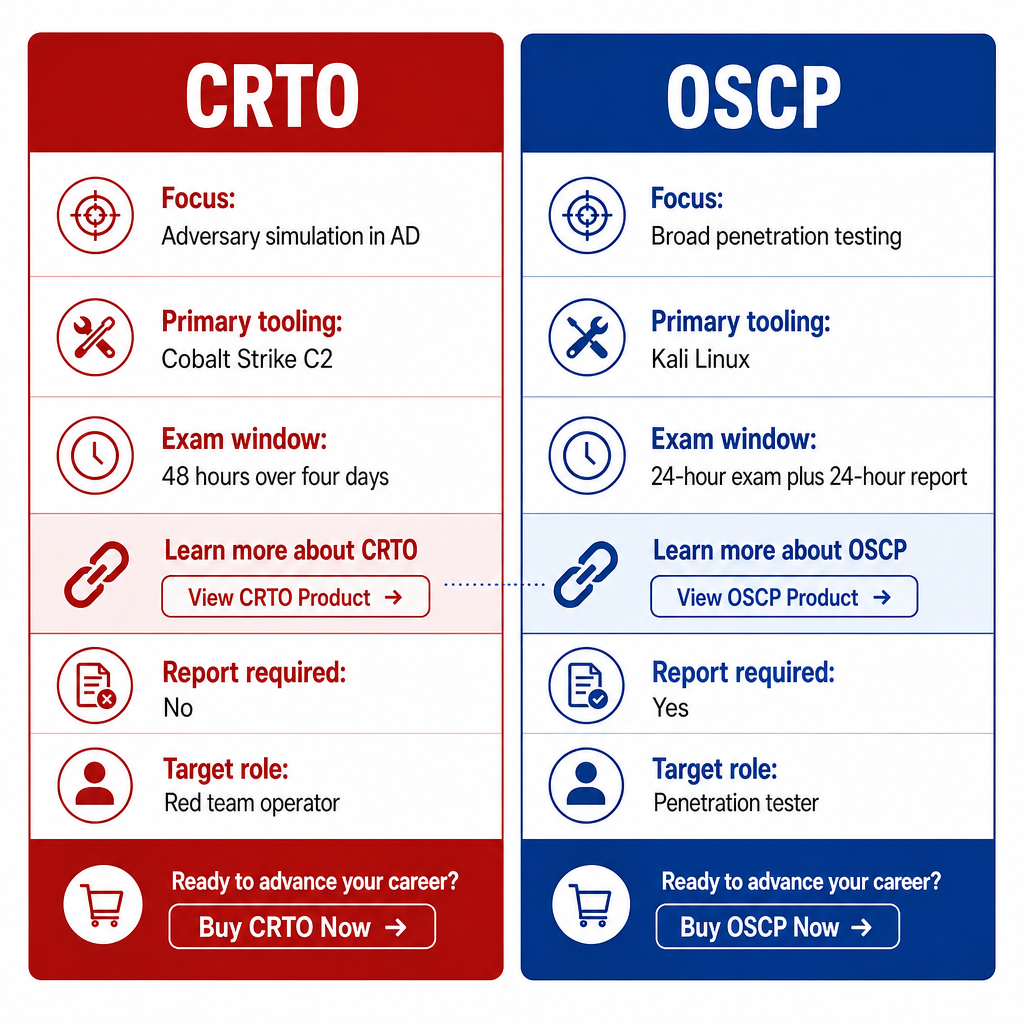
The cleanest way to frame crto vs oscp is by the daily workflow each one rehearses. CRTO prepares you to run stealthy, goal-driven engagements against enterprise Active Directory, managing beacons, pivoting, and long-lived campaigns using Cobalt Strike as the primary C2 framework. OSCP prepares you to conduct structured penetration tests across multiple hosts, identifying vulnerabilities, exploiting them, escalating privileges, and documenting findings with Kali Linux tooling.
That difference maps directly to job titles. If the role you want reads “red team operator,” CRTO aligns with the tradecraft, tooling, and objectives you will be judged on. If it reads “penetration tester” or names PEN-200, OSCP maps more literally to the requirement. Neither is a strictly higher rung; they are parallel specializations that happen to share offensive foundations. Reading each one as a step toward a specific role, rather than a generic prestige badge, is what keeps the decision honest.
CRTO: the red team operator path
CRTO is a practitioner-level certification from Zero-Point Security tied to the Red Team Ops course. The course and exam center on adversary simulation against a Windows Active Directory environment, covering the full attack lifecycle from initial access through data exfiltration.
The scope is deliberately deep rather than wide. You work inside multi-host AD networks that emulate an internal enterprise layout, not Internet-wide targets. Command and control sits at the core: beacons, pivoting, and infrastructure management through Cobalt Strike. Post-exploitation is where most of the weight lands — credential dumping, lateral movement, privilege escalation, persistence, and defence evasion in Windows enterprise setups. Around that, the curriculum layers red team planning: engagement scoping, objectives, and operational tradecraft aligned with how modern red teams actually run campaigns.
The exam reflects that operational bias. It is a practical lab with 48 hours of access spread over a four-day period, delivered through a browser-based Snap Labs environment that simulates a realistic internal AD network. It is objective-based: you collect flags by compromising hosts, and passing requires meeting a defined flag threshold, commonly cited around six of eight. There is no formal written report; your performance is measured directly through objective completion rather than a deliverable.
That design creates clear trade-offs. The strong focus on Windows AD and C2 means comparatively limited coverage of web, external, or Linux-heavy testing. The absence of a required report means less rehearsal of formal documentation, which some consulting roles lean on heavily. CRTO rewards practitioners who already grasp basic offensive security and want to deepen red team methodology; it is comparatively narrow if you have no pentest foundation to build on. Our CRTO track exists for that middle group — professionals with the fundamentals who need focused, exam-relevant tradecraft rather than another sprawling reading list. You can review scope and support details on our CRTO exam writeup and support page and lock in mentor-backed preparation before you book your window.
OSCP: the penetration tester path
OSCP is OffSec’s flagship hands-on penetration testing certification, tied to the PEN-200 “Penetration Testing with Kali Linux” course. It is structured to prove you can manually discover, exploit, and document vulnerabilities across multiple hosts using standard offensive tooling.
The methodology is broad by design: reconnaissance, enumeration, exploitation, and privilege escalation across mixed target types. The current exam pairs standalone Linux and Windows machines with an Active Directory set delivered in an assumed-breach model. Automation is intentionally constrained — the exam rewards custom enumeration, exploit adaptation, and scripting over reliance on point-and-click scanners. Crucially, the credential is not earned by compromise alone. Results are validated through a detailed penetration test report documenting methodology, findings, and remediation recommendations.
The format tests endurance as much as technique. You attack several machines on a private lab VPN during a 24-hour practical window, with points assigned per objective, then get an additional 24 hours to prepare and submit the report. There are no multiple-choice questions; the entire certification rests on hands-on performance and reporting.
The trade-offs run in the opposite direction from CRTO. OSCP is broad and demanding, often requiring significant time investment compared with narrower specialist exams. The pressure on time management is real, and many candidates struggle without realistic lab practice and a repeatable methodology. And while OSCP touches AD and some post-exploitation work, it is less focused on prolonged covert operations than a dedicated red team curriculum. Our OSCP exam support services address the most common failure point — a shortage of realistic practice — with an OSCP+ bundle of 52 standalone machines and 8 adsets plus Elite Early Access, giving you exam-style targets without building a lab ecosystem from scratch. Pair that with our OSCP exam preparation checklist to structure the run-up, then move to a purchase when your practice cadence is set.
Criteria-by-criteria comparison
The table below compresses the practical differences so you can match each credential to your role, timeline, and reporting expectations.
| Criterion | CRTO (Red Team Ops) | OSCP (PEN-200) |
|---|---|---|
| Primary goal | Execute all phases of a red team assessment against AD, from OSINT through lateral movement and exfiltration | Conduct structured pentests, exploiting and documenting vulnerabilities across multiple systems |
| Core environment | Internal Windows AD network with enterprise layout; Cobalt Strike operations | Mixed VPN lab: AD set plus multiple standalone Linux and Windows machines |
| Exam duration | 48 hours of lab time over four days | 24-hour practical exam plus 24 hours for report |
| Reporting | No formal report; validated via objective completion | Detailed professional pentest report required to pass |
| Skill emphasis | C2 operations, AD attacks, credential abuse, lateral movement, persistence, evasion | Enumeration, exploitation, privilege escalation, methodology, reporting |
| Positioning | Practitioner-level; assumes basic offensive foundation | Core entry-to-mid pentest credential |
Beyond the grid, four factors tend to decide the outcome.
Objective vs methodology. CRTO measures your value by how closely you mimic real adversaries in AD, including stealth and long-term operations. OSCP measures standardized methodology, repeatable testing, and clear reporting that plugs into compliance and remediation workflows. If employers judge you on emulating a named threat actor, CRTO fits; if they judge you on repeatable, documented tests, OSCP fits.
Environment and tooling. CRTO’s Cobalt Strike-centric, AD-heavy environment matches organizations running internal red or purple teams that emulate specific adversaries. OSCP’s mixed Linux and Windows lab mirrors typical consulting engagements and internal tests against diverse infrastructure.
Reporting expectations. CRTO assumes reporting is handled outside the exam or already in your skill set; its focus is operational success. OSCP explicitly tests your ability to produce a coherent pentest report — a core requirement in most client-facing roles.
Recognition and trajectory. CRTO is highly attractive to teams that understand red team operations and want proof of adversary simulation skills, but it is less universally recognized outside that niche. OSCP carries broad name recognition across job postings and is frequently cited as a baseline requirement or a strong differentiator for penetration testing roles.
When to choose CRTO, OSCP, or neither
Choose CRTO when you already hold foundational pentest skills — OSCP-level or equivalent experience — and now work with or want to join a red team focused on AD environments. It also fits when your organization runs internal adversary simulation and needs operators who can manage C2 infrastructure and long-lived campaigns rather than short pentest sprints, or when you need to demonstrate modern Windows AD offensive technique beyond what a general pentest exam covers.
Choose OSCP when you are breaking into offensive security and need a widely recognized credential proving broad, hands-on capability. It is the clear pick when target roles explicitly name OSCP or PEN-200, or ask for equivalent penetration testing certifications. It also fits when you want structured training around Kali Linux, classic network and host exploitation, and professional reporting to support consulting or internal security work.
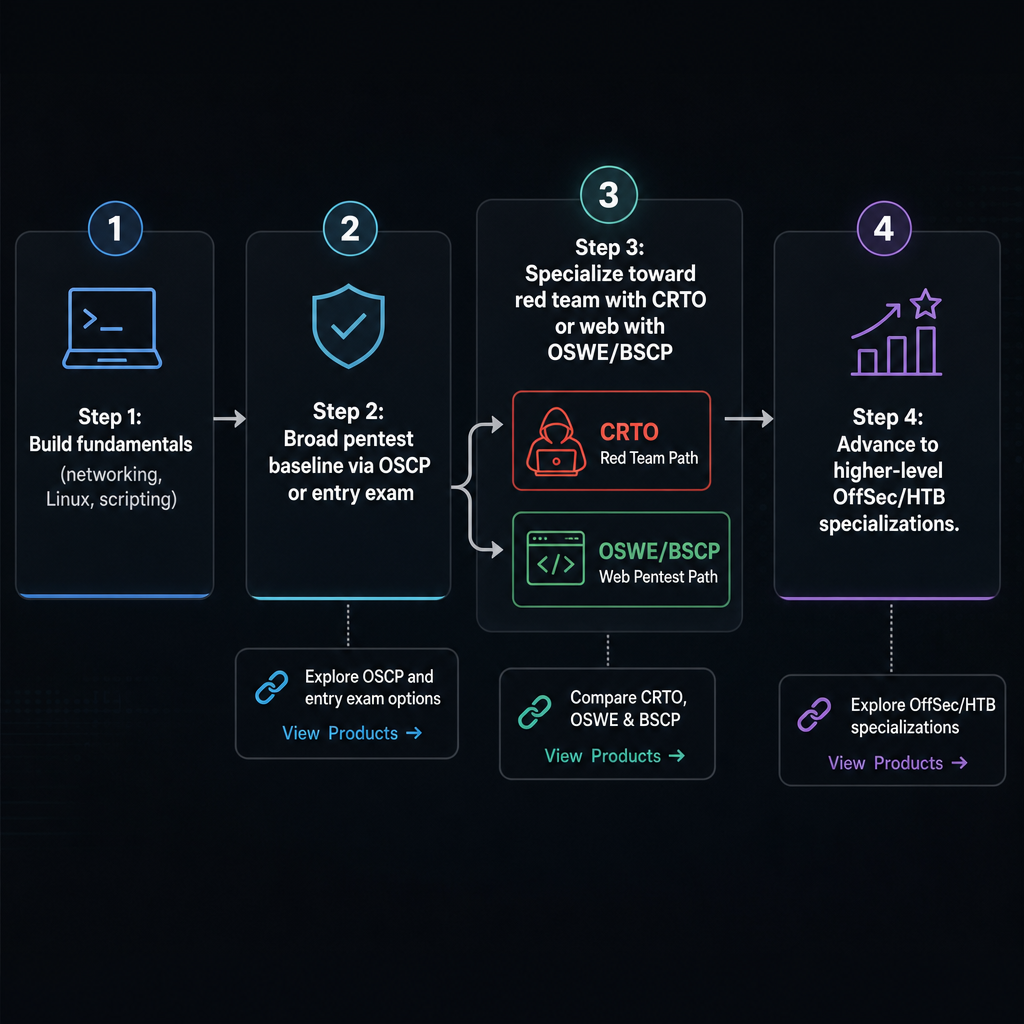
Consider neither as your immediate focus in three situations. If your daily work is primarily web application security, a web-focused path may validate your most critical skills more accurately — we maintain dedicated OSWE support services and BSCP exam preparation for exactly that audience. If you are very early and still building networking, Linux, and scripting fundamentals, a more accessible entry exam such as eJPT or PJPT can be a better starting point before either of these. And if your current role already demands advanced exploitation and evasion beyond both exams, higher-level specializations may align better once you have a solid baseline.
Adjacent paths and how we help you sequence them
CRTO vs OSCP is rarely a one-and-done decision. Most careers stack credentials, and the smarter question is often what comes before or after your first pick. A common broad-pentest complement to OSCP is CPTS or PNPT, which lean into network and infrastructure testing; for the head-to-head trade-offs there, our OSCP vs CPTS comparison breaks down where each earns its keep without forcing a winner. Web specialists often run OSWE or BSCP alongside an infrastructure credential, while experienced operators build toward advanced OffSec or HTB specializations after establishing an OSCP-level foundation.
We designed our preparation model for the practical bottleneck most candidates hit: not deciding what to learn, but reaching exam-ready performance fast. That means mentor-supported study resources mapped to OffSec, HTB, and red team exams, instant delivery of exam-focused material so you can start targeted practice immediately, and curated, realistic labs instead of weeks spent assembling your own. For OSCP that shows up as the OSCP+ bundle of practice targets; for CRTO and other red team credentials the same mentor-backed model concentrates your effort on exam-relevant tradecraft rather than generic reading. If you are still weighing the wider field, our overview of the best cybersecurity certifications for pentesting helps you frame the full ladder before you commit — and when you are ready, moving to a purchase early shortens your window and lowers retake risk.
Whichever direction you commit to, treat the decision as the starting line rather than the finish. Pick CRTO if your day-to-day will revolve around adversary simulation, C2 operations, and Windows AD campaign work. Pick OSCP if you need a broad, well-recognized pentest credential that demonstrates methodology, endurance, and reporting. Pick a precursor or sibling certification if your current level or job focus makes this particular fork premature. Then align your practice resources with that choice and convert it into a passed exam.
Frequently asked questions
Can CRTO replace OSCP for penetration testing roles?
CRTO demonstrates strong red team capability in AD environments, but it does not emphasize broad, multi-platform pentest methodology and reporting the way OSCP does. OSCP remains more commonly requested in general penetration testing job postings, so the two are better read as complementary than interchangeable.
Do I need OSCP before taking CRTO?
Not formally — CRTO has no official prerequisite that you hold OSCP first. In practice, many candidates find prior pentest experience, with or without OSCP, makes the CRTO exam more manageable because they already understand core offensive techniques and tooling.
Which exam is harder, CRTO or OSCP?
Difficulty depends on your background. OSCP demands broad skill coverage, time management, and a formal report across a 24-hour exam plus report window. CRTO demands depth in AD red teaming and C2 operations over a 48-hour engagement. The harder exam is usually the one furthest from your daily work.
How long should I prepare for each exam?
The Red Team Ops course is advertised with an estimated 20 hours of study time, though most candidates invest more hands-on practice before attempting CRTO. OSCP typically requires significantly more practice across many machines to build reliable methodology. Mentor-guided, exam-focused resources can compress that timeline with targeted labs instead of unstructured self-study.
What if I fail my first attempt?
Both certifications allow retakes under their providers’ policies, usually by purchasing another attempt. Structured, success-oriented preparation before booking or rebooking — curated machine bundles, writeups, and mentor feedback — reduces the chance of repeated failures.