
If you want the short answer, the best certifications for aspiring pentesters right now are OSCP, HTB CPTS, and PNPT — but the real decision is not which exam is hardest, it is which credential matches your current skill level, your available study hours, and the job you want next. All three validate hands-on penetration testing, yet they use completely different exam mechanics, and that difference is what should drive your choice. We work with candidates on all three tracks, so this guide maps each exam to the kind of tester it rewards, then gives you a decision framework instead of a popularity contest.
Table of contents
What “best certification” actually means for your situation
Before ranking anything, define what you need a credential to prove. For most aspiring pentesters, it comes down to three things: evidence that you can run a real test from recon to reporting, a name hiring managers already trust, and an exam format that fits how you actually work and schedule your time.
OSCP earns its reputation because OffSec built it to validate hands-on exploitation under real-world conditions, with a proctored practical exam and lifetime validity on the core credential. That combination is why so many job postings still reference it by name. HTB’s Certified Penetration Testing Specialist (CPTS) is positioned as an intermediate, hands-on exam that spans network, web, and Active Directory exploitation plus reporting. TCM Security’s Practical Network Penetration Tester (PNPT) pushes hardest toward realism: a full engagement that includes OSINT, internal and external testing, and a live client-style debrief.
The practical consequence is that “best” is personal. A proctored 24-hour sprint and a five-day engagement with a presentation reward different strengths. If you already know you want to move quickly with focused prep, you can skip generic study stacks and build a plan around whichever of these fits your path — our mentor-supported OSCP exam services exist specifically to compress that preparation without wasting weeks on material the exam never touches.
How OSCP, CPTS, and PNPT exams really work
Understanding the mechanism behind each exam makes the choice far easier, because the format tells you what skill the certification actually measures.
OSCP: proctored sprint plus reporting
OSCP is built around the PEN-200 course, but the certification is awarded solely on exam performance. Candidates connect to a private VPN with multiple vulnerable machines and an Active Directory set, then get roughly 23 hours and 45 minutes to compromise targets, capture proof, and document everything. The exam is fully proctored, with strict rules on tools, behavior, and identity verification. Passing requires two separate wins: meeting the minimum technical score across exploited machines and AD, and submitting a professional report clear enough for a client audience. That blend of time pressure, proctoring, and mandatory reporting is exactly why hiring pipelines read OSCP as a serious capability signal.
HTB CPTS: 10-day enterprise simulation
CPTS runs as a 10-day black-box penetration test against a simulated enterprise with multiple Linux and Windows hosts, including Active Directory. Candidates must compromise machines, capture flags (typically at least 12 of 14), and produce a professional report inside the window. There is a hard gate before you even sit it: you must complete 100% of the relevant HTB Academy role path and obtain an exam voucher, which guarantees a baseline of training and lab practice. CPTS is unproctored, but it rewards disciplined enumeration and thorough documentation across the whole network rather than a quick flag grab.
PNPT: full engagement with a live debrief
PNPT is explicitly marketed as a real penetration test, not a capture-the-flag exercise. You get five full days to run the engagement and two more to write the report. The scope expects OSINT and external recon, internal and external network testing, defensive-control bypass, privilege escalation, and compromising a domain controller — then a professionally reviewed report and a live, client-style debrief where you present your findings. PNPT is unproctored and, since 2023, lifetime-valid with no expiration, which appeals to candidates who do not want ongoing renewal.
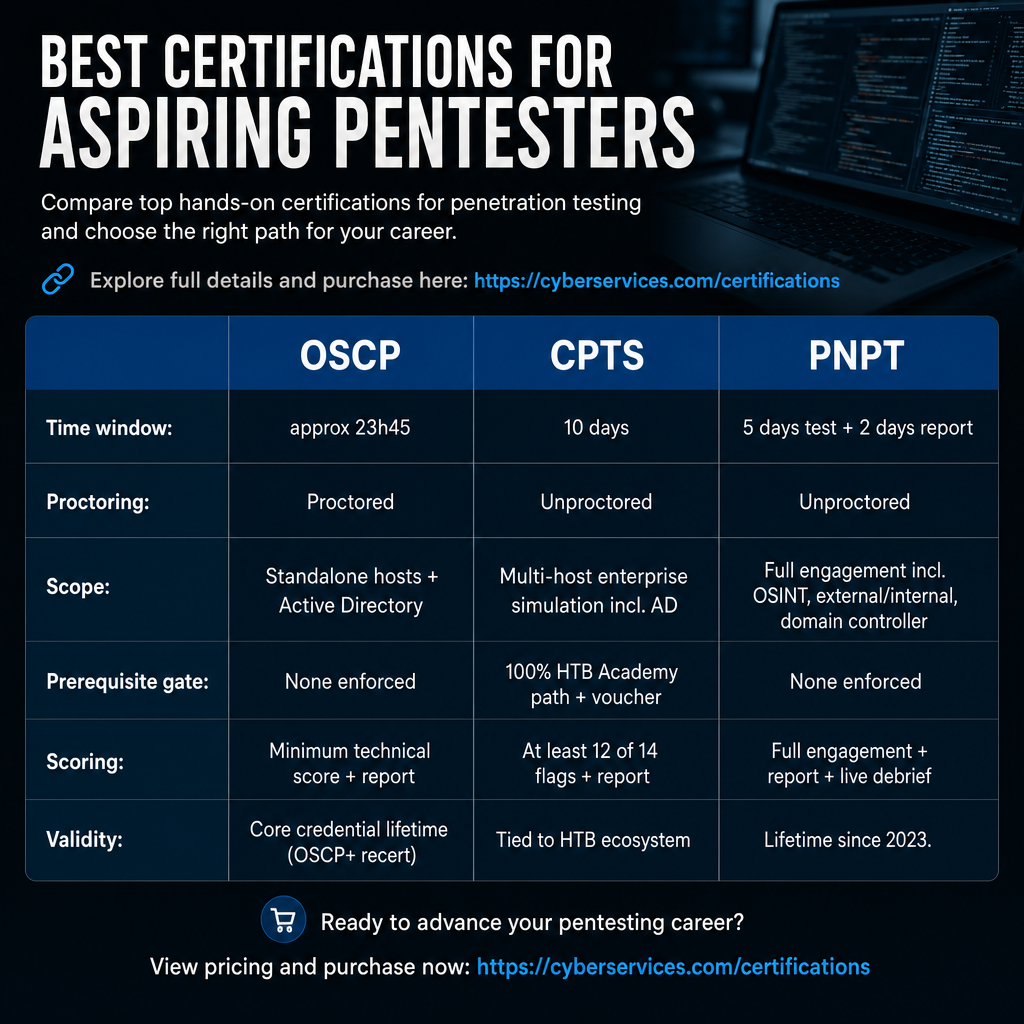
Three exams, three mechanisms: OSCP compresses the test under proctoring and strict scoring, CPTS spreads an enterprise simulation across a structured path, and PNPT adds the consulting layer of a debrief. If you want to move through any of them quickly, we can map your current skills to the right exam and keep your study hours aimed at what the assessment actually checks — our CPTS exam preparation resources are built around the Academy path for exactly that reason.
Who each certification is genuinely best for
Rather than crown one winner, match the exam to the tester.
When OSCP is the best first certification
OSCP fits aspiring pentesters who already have solid Linux familiarity and basic scripting, want a credential that HR, security leaders, and technical teams recognize instantly, and are ready for a proctored, high-pressure window focused on exploitation and privilege escalation across several targets. Because it is deeply tied to Kali tooling and standard methodology, it is especially strong if you are applying for roles labeled penetration tester, offensive security engineer, or security consultant. The common failure modes are underestimating how long reliable exploit chains take across multiple machines, and neglecting reporting practice — which can cost you the credential even when your technical score is sufficient. Focused, mentor-guided prep addresses both by compressing the plan around OSCP-style AD and privilege-escalation scenarios and coaching exam-quality reporting.
When HTB CPTS is the best first certification
CPTS suits testers who prefer a longer, less time-compressed window, want structured training through HTB Academy before the assessment, and like exams that model a full enterprise with multiple hosts and AD. It validates breadth — enumeration, web attacks, Active Directory, privilege escalation, and reporting — which maps well to junior-to-intermediate pentest and internal red team roles. The 10-day format rewards planners, not sprinters. The risks are predictable: treating 10 days as “easy” and procrastinating into a rushed report, or underpreparing for AD and pivoting, which sit at the center of the simulation. Prep that concentrates your limited hours on high-value modules and report structures neutralizes both.
When PNPT is the best first certification
PNPT is the right first cert for people who value client communication and consulting skill as much as raw exploitation, want an exam that mirrors a real engagement from scoping to debrief, and prefer unproctored, multi-day assessments with realistic recon-to-reporting timelines. The 5+2-day structure and live debrief check whether you can run a complete methodology, write a professional report, and explain findings to senior practitioners in an actionable way — which many employers value because it maps directly to consulting work. The two mistakes that sink candidates are underestimating how long OSINT and external recon take, and treating the debrief as a casual chat rather than a graded professional presentation. Rehearsing engagement planning, reporting, and debrief structure is where targeted mentoring pays off.
If you are unsure which of these is your best starting point, talk through your skills and timeline with a mentor so we can map your experience and target roles to a concrete certification path.
Decision criteria for your first pentest cert
Use these criteria to identify the best certifications for aspiring pentesters in your specific situation.
| Criterion | OSCP | CPTS | PNPT |
|---|---|---|---|
| Industry recognition | Most universally referenced | Strong in HTB-aware teams | Strong in consulting circles |
| Time pressure | Highest (proctored sprint) | Moderate (10 days) | Moderate (5+2 days) |
| Enforced prerequisites | None | Academy path + voucher | None |
| Reporting weight | Pass-or-fail report | Graded report | Report + live debrief |
| Renewal | Core lifetime; OSCP+ recert | Tied to HTB ecosystem | Lifetime since 2023 |
Read the table against your own profile. If you thrive under strict proctoring and want the broadest name recognition, OSCP aligns. If you prefer methodical, extended work and want a built-in training gate before the exam, CPTS fits. If you care about end-to-end engagement and client-facing delivery, PNPT is the closest to real consulting.
Career target over the next 12 to 24 months is often the deciding factor. OSCP maps cleanly to classic external and internal pentester, consultant, and SOC-to-offensive moves. CPTS suits penetration testing specialists and offensive engineers in teams that lean on HTB labs. PNPT favors consultant-style testers in organizations that reward full engagements and strong reporting. Pick one as your primary target, and only then decide whether a second credential makes sense as a follow-up. Our deeper comparison of the best cybersecurity certifications for pentesting breaks these fits down further, and the cluster hub on the best study resources for OSCP is the right next stop once you commit to a track.
Risks and reality checks before you book
Even the strongest credential carries concrete risk, and knowing it early protects your time and money.
The first trap is over-relying on the brand. A name like OSCP opens doors, but hiring teams still test live skills in interviews and practical assessments — the certificate gets you the conversation, not the offer. The second is ignoring reporting and communication. PNPT and CPTS explicitly grade documentation, and OSCP can fail candidates who hit the technical score but submit a weak report. The third is misaligned preparation: months on unrelated CTFs or unfocused lab time can leave you underprepared for the exact scoring and report expectations of your chosen exam.
Mentor support counters all three by tying prep directly to exam mechanics, setting realistic timelines, and flagging honestly whether you are ready to schedule. We focus on fast, mentor-supported preparation with instant delivery of targeted resources, which suits time-constrained IT workers and aspiring pentesters who need an efficient route to OSCP, CPTS, PNPT, and other offensive certifications. When you are ready to turn this decision into a dated study plan, start a conversation with our team and we will build it around the exam you choose.
Frequently Asked Questions
Which single certification should I start with if I’m new to pentesting?
If you have a solid technical base and want maximum hiring recognition, OSCP is usually the strongest first credential thanks to its reputation and practical, proctored exam. If you prefer a less time-compressed, more engagement-style experience, PNPT or CPTS may fit you better.
Is PNPT enough without OSCP?
PNPT is a full professional-level exam that validates your ability to run a complete engagement and present findings to a client. In organizations that know it, it stands on its own — especially for consulting-style roles — though OSCP may still carry broader recognition in some markets.
Does CPTS compete directly with OSCP?
Both are practical pentest certifications, but their formats and ecosystems differ: OSCP is a compressed, proctored 24-hour assessment, while CPTS is a 10-day multi-host enterprise simulation tied to HTB Academy training. Many candidates eventually pursue both, using CPTS as a stepping stone or a complement.
How can I pass faster with limited study time?
The fastest realistic path combines targeted lab work, exam-style reporting practice, and mentor support that keeps you aligned with each exam’s scoring and format. That focus is exactly what we build for time-constrained professionals, with mentor-guided prep and instant access to the materials that match your chosen exam.
Do any of these certifications expire?
The core OSCP credential is lifetime-valid, with OSCP+ adding an expiring recertification layer. PNPT has been lifetime-valid with no expiration since 2023. CPTS sits within HTB’s evolving Academy ecosystem, with value tied to its practical format and brand recognition.