
Before you commit to the 10-day CPTS window, you want one thing: a clear read on whether you actually meet the requirements to launch and pass. This cpts exam requirements checklist maps every vendor-gated condition Hack The Box enforces for the Certified Penetration Testing Specialist exam, separates hard prerequisites from practical advice, and flags the case-dependent variables that quietly sink candidates. Work through it and you will know exactly what blocks a booking, what raises failure risk, and where we at Cyber Services can compress your prep so you enter the exam with a tested methodology and a report template that holds up.
Table of contents
Master CPTS requirements checklist
Use this as your high-level control list before you spend money or lock a date. Each item is either a vendor gate that blocks the exam or a practical readiness factor that raises or lowers your failure risk.
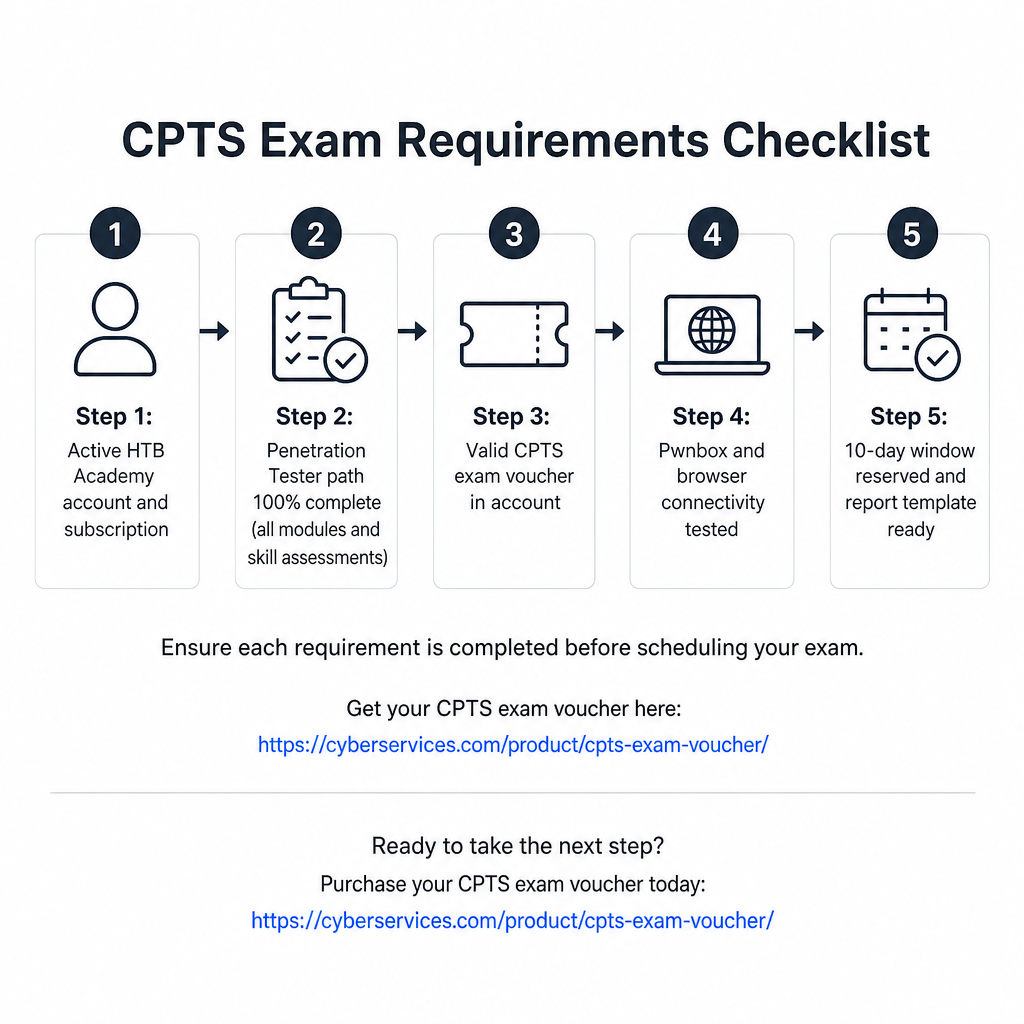
- Confirm an active Hack The Box Academy account with the subscription needed to access the Penetration Tester job-role path.
- Complete that path to 100%, including every module and skill assessment, to unlock CPTS eligibility.
- Obtain or redeem a valid CPTS exam voucher inside HTB Academy.
- Meet the stated skill baseline: networking, operating systems, web, and penetration testing fundamentals at an intermediate level.
- Verify your browser, network, and hardware can hold a stable connection to the in-browser Pwnbox environment for the full window.
- Reserve the entire 10-day exam window and settle work or personal arrangements before you start the clock.
- Prepare a repeatable methodology and a client-grade report structure written in English.
- Review the current scoring and flag model, then plan host and objective coverage against the time limit.
- Gather identity, payment, and contact details for your HTB account, keeping employer funding rules separate from vendor policy.
- Decide whether mentor-supported materials will validate your report approach and cut trial-and-error in the lab.
If you already see gaps against these items, our CPTS exam resources let you rehearse attack paths and report structure before you commit your window.
Eligibility and HTB Academy prerequisites
The question here is simple: can you even start? These are vendor-gated conditions, and until you satisfy them, registration is blocked.
The hard gate is the Penetration Tester job-role path. Hack The Box requires 100% completion of that path in HTB Academy before you are eligible for CPTS. The path currently spans more than 28 modules with associated skill assessments, and all of them must be completed. This is enforced by the platform, not advisory preparation, so there is no way to register or launch the exam without it.
You also need a valid exam voucher. HTB’s certification policy requires holding a voucher to sit any Academy certification exam, CPTS included. Vouchers are tied to your account and exam window and can carry their own terms such as expiration dates, so confirm the status inside your dashboard rather than assuming it stays valid indefinitely.
What you do not need is another certification first. Public guidance indicates there is no requirement to hold OSCP, CEH, or similar credentials before CPTS; they are optional background only. Some training providers suggest several years of security experience, but that is advice, not a gate enforced by HTB.
The issuer does expect a skill baseline. HTB describes CPTS as targeting junior to intermediate penetration testers, assuming intermediate knowledge of web and infrastructure testing plus fundamentals in operating systems, networking, and web applications. A weak baseline will not stop you from launching, but it sharply increases both failure risk and time pressure across the 10 days.
Before planning a date, open HTB Academy and confirm three things: the Penetration Tester path shows 100% completion, every skill assessment is marked complete or passed, and a CPTS voucher is visible and usable. If any of those is missing, you are not yet eligible.
Technical environment and account requirements
This section covers the conditions that decide whether you can actually perform exam activities: tooling, platform access, identity, and payment. Get these wrong and you risk connection failures or account issues that disrupt an otherwise valid attempt.
The exam runs in the browser through Pwnbox. HTB states the entire CPTS exam can be conducted directly from your browser via the Pwnbox environment, with no mandatory external infrastructure or tool requirements to participate. All penetration testing activity is performed through this in-browser system, which centralizes tooling and connectivity for you.
That convenience shifts the burden to your connection. HTB does not mandate specific hardware models, but your setup must reliably run a modern browser and hold a stable link to Pwnbox for the full window. Corporate proxies, VPNs, and restrictive firewalls can interfere with access to HTB labs; this varies by employer and region, so test it well ahead of time rather than on day one.
You also need a working HTB account with the required Academy subscription to reach both the path and the exam. Payment methods, invoicing, and any tax handling fall under HTB’s commercial policies and, where relevant, local law; these can change, so check your account area each time. Because CPTS documentation must be submitted in English, you must be able to describe technical findings in clear written English, and HTB may require accurate personal information for certificates and invoices. Inaccuracies there can delay or dispute certification issuance.
Two case-dependent variables sit on top of this. Employer-sponsored accounts can impose extra approvals for vouchers or subscriptions, and some national regulations restrict remote access to certain infrastructure, which may affect how you connect to HTB from specific regions.
Exam rules, time window and scoring
Here the live concern is what “passing” actually means and how the format constrains you. Misjudge the rules and you can make strong technical progress yet still walk away without the certification.
CPTS is a practical exam that runs over a strict 10-day window. Within that time you are expected to compromise a complex enterprise environment and produce a final report. You can typically choose when to begin once prerequisites are met, but once launched, the clock runs continuously.
Scoring is threshold-based. Public technical analyses describe CPTS as requiring at least 85 out of 100 points to pass, generally tied to obtaining most available flags in the environment. Current documentation references a structure where capturing a large majority of flags, for example 12 of 14, is needed for a passing score. The exact flag count and allocation can change as HTB updates the exam, so treat these numbers as date-volatile and confirm the current scoring model inside Academy before you book.
Integrity rules apply throughout the attempt. Sharing exam content, writeups, or solutions while your exam is in progress can violate HTB’s terms and lead to disqualification or revocation; these policies govern your conduct even though they are not published exhaustively. Unauthorized automation or tooling that breaches platform rules can invalidate an attempt in the same way.
Before booking, review the latest CPTS exam overview and Academy certifications policy inside HTB to confirm the current duration, the active scoring threshold, and any explicit rules on collaboration, tooling, and conduct.
If this checklist exposes gaps in your methodology or reporting, our CPTS exam materials and mentor guidance let you rehearse realistic attack paths and lock a report format before you spend a single day of the window.
Reporting and evidence you must submit
The reporting requirement is where technically capable candidates most often lose points, so treat it as a first-class deliverable, not an afterthought.
HTB’s certification guidance requires CPTS candidates to submit a detailed, professional penetration testing report in English at the end of the exam. That report must clearly document your attack methodology, the vulnerabilities identified, exploitation steps, and remediation guidance, reflecting commercial penetration testing standards rather than lab notes.
Evidence quality is part of the grade. You are expected to include proof such as screenshots, command output, and paths to obtained flags, organized so a non-technical stakeholder can follow the story. HTB combines this report with flag scoring to decide the outcome, which means an incomplete or poorly structured report can fail you even when you captured the flags.
Scope discipline matters too. CPTS prerequisites reference the ability to interpret a letter of engagement, signaling that the exam scenario includes scope and rules your report must respect. Deviating from the defined scope, in your actions or in how you write them up, can be treated as a methodology violation, with specific penalties governed by HTB’s internal policies.
The evidence artifacts worth preparing in advance:
- A reusable report template with executive summary, scope, methodology, findings, risk ratings, remediation, and conclusion.
- A consistent naming and storage convention for exam screenshots and notes.
- A clear narrative of your pivot and privilege-escalation steps aligned with professional practice.
Legal, contractual and compliance boundaries
Vendor rules are only one layer. Law, employer policy, and ethics form a separate set of obligations that apply regardless of your exam result, and conflating them is a real risk.
Start by separating exam scope from real-world authorization. CPTS runs inside HTB’s controlled lab, where HTB grants you permission to attack lab assets for the exam. That authorization does not extend to any other network or system; live penetration testing needs separate legal permission that depends on your jurisdiction and client contracts.
Employer and client policies can add conditions. If you attempt CPTS during working hours or on employer equipment, you may need internal authorization, and some organizations restrict use of external hacking platforms from corporate networks. These conditions vary by employer and are outside HTB’s or our control.
Data handling deserves the same care. Keep client or employer data out of your CPTS materials so exam notes and screenshots contain only HTB lab content. Sharing your report beyond permitted channels, such as posting detailed exam content publicly, can conflict with HTB terms and, in some regions, with local cybercrime or data protection laws.
The practical rule is to treat CPTS lab authorization as exam-specific permission and nothing more. If you plan to reuse exam workflows on live infrastructure, seek legal or internal compliance advice, because contracts, NDAs, and formal authorizations are case-dependent and cannot be generalized from an exam scenario.
Case-dependent variables that change your path
The same requirements land differently depending on your funding, schedule, region, and career stage. Evaluating these honestly is what turns a generic checklist into a plan.
Funding shapes the timeline. Self-funded candidates absorb exam and subscription costs into a personal budget, while employer-funded candidates often face approval workflows and proof-of-result expectations that add lead time. If you want a clear view of the spend involved, our breakdown of the CPTS certification price and what you pay sets the baseline.
Time availability versus path length is the most common squeeze. HTB estimates significant time to complete the Penetration Tester path, and public commentary points to a multi-week commitment to reach 100%. Compressing that into a short sprint raises burnout risk, and mentorship can accelerate understanding but cannot remove the obligation to finish the HTB modules yourself.
Your current role versus your target role also matters. CPTS is positioned as an intermediate, report-based penetration testing certification for junior and full penetration testers. If your day job rarely involves offensive testing, plan extra targeted practice on methodology and reporting before you attempt it. For context on where CPTS sits among adjacent credentials, our HTB certifications guide maps the options.
Finally, language and communication skills are a quiet failure point. Non-native English speakers should realistically assess whether they can produce a structured technical report inside the window, because reporting friction, not exploitation, ends many otherwise strong attempts.
Verify readiness before you schedule
Run this as a short, vendor-aligned audit right before you pick a date. Every item maps to a requirement above, so a clean pass here means you are genuinely ready to launch.
- HTB Academy shows the Penetration Tester path at 100% complete, with all skill assessments passed.
- A CPTS exam voucher is visible and valid in your account.
- Pwnbox connectivity and browser stability are tested on your primary exam device.
- The current CPTS exam description is reviewed for duration, scoring, and report requirements.
- Your reporting template and evidence-capture workflow are assembled and tested.
- The full 10-day window is blocked on your calendar, with work and family commitments negotiated.
- You have decided whether to benchmark your skills and report style with mentor-supported materials first.
On that last point, our mentor review is built to check off items 1 through 6 with less trial-and-error: we help validate that your exploitation workflow matches common CPTS attack paths, refine a report template aligned with HTB’s expectation for commercial-grade documentation, and pinpoint weak spots in infrastructure, web exploitation, or lateral movement so you practice with focus instead of studying broadly. If you want that support before you schedule, start with our CPTS exam preparation resources and bring your open checklist items to us.
Frequently asked questions
Do I need to complete every module in the Penetration Tester path before CPTS?
Yes. Current HTB policy makes 100% completion of the Penetration Tester job-role path a hard prerequisite for CPTS eligibility, including all modules and skill assessments.
How long is the CPTS exam, and can I pause it?
CPTS is a 10-day practical exam window. Once you start, time runs continuously, and pausing behavior is governed by HTB’s platform design rather than by candidate choice.
Is there a minimum score to pass CPTS?
Publicly documented analyses describe a threshold of at least 85 out of 100 points, typically requiring a majority of the available flags. HTB can adjust details over time, so verify the current model inside Academy before booking.
Does CPTS require another certification like OSCP beforehand?
No. There is no official requirement to hold OSCP or similar credentials to sit CPTS, though prior hands-on penetration testing experience is strongly recommended.
What happens if my report is weak but I collected many flags?
CPTS is report-based: HTB reviews both your flags and your professional report. A poorly structured or incomplete report can cause a failure even when your technical progress was strong, which is why the reporting template deserves real preparation.