

The eJPT certification review most beginners need in 2026 starts with one clear answer: eJPT (eLearnSecurity Junior Penetration Tester) is currently one of the most accessible, practical entry-level penetration testing certifications available, making it a solid first step for anyone entering offensive security without prior hands-on experience.
- What Is the eJPT and Who Is It For?
- eJPT Exam Format and Difficulty
- eJPT vs PJPT: Which Should You Choose First?
- eJPT vs CompTIA PenTest+: A Practical Comparison
- Does the eJPT Have Real Career Value?
- How to Prepare for the eJPT in 2026
- What Should You Know in Your eJPT Certification Review?
- Frequently Asked Questions
What Is the eJPT and Who Is It For?
The eJPT is a beginner-level penetration testing certification issued by INE Security (formerly eLearnSecurity), designed for candidates with little to no prior pentesting experience. It covers foundational concepts including network reconnaissance, web application testing, and basic exploitation techniques, all delivered through a fully practical, browser-based lab environment.
The certification is ideal for students, career-changers, and IT professionals who want to validate hands-on skills before investing in more demanding exams such as OSCP or CPTS. Unlike multiple-choice theory exams, eJPT requires candidates to actually compromise systems inside a virtual lab, answering flag-based questions as proof of exploitation. This practical approach makes it stand out from purely academic alternatives.
eJPT proves you can operate tools in a real lab, not just recall definitions on paper. That distinction matters when you apply for your first junior pentester role.
eJPT Exam Format and Difficulty
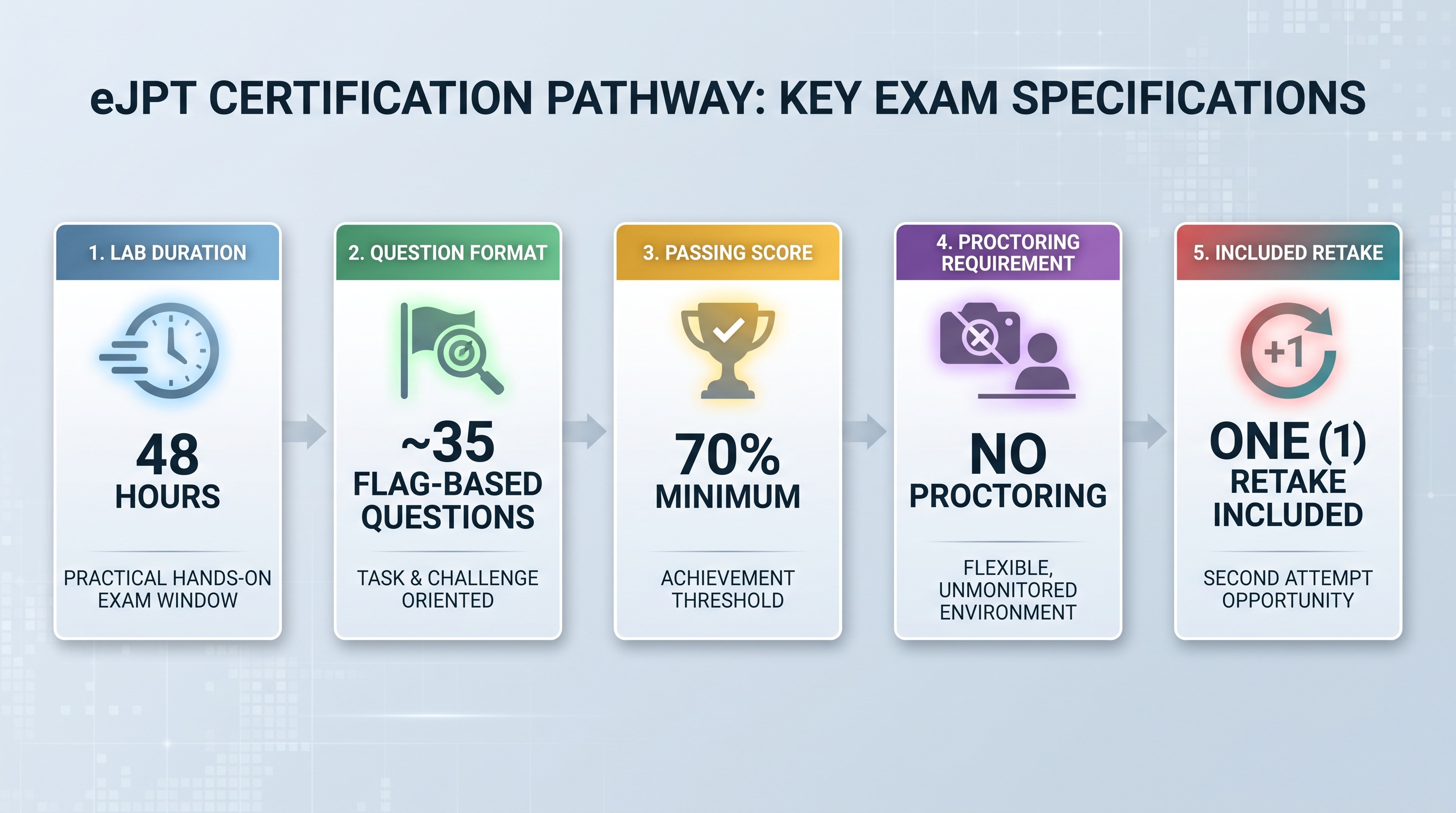
The eJPT exam is a fully hands-on, 48-hour assessment conducted inside a virtual lab, where candidates answer approximately 35 multiple-choice questions by actually performing tasks on live machines. There is no proctoring software or separate theory module; the lab is the exam.
Difficulty is intentionally kept at a beginner level. You are expected to perform basic network scanning with Nmap, exploit simple vulnerabilities using Metasploit, pivot between hosts using basic routing techniques, and interact with web applications to identify common weaknesses. Candidates who have completed INE’s free Starter Pass training consistently pass on their first attempt. The passing score is 70%, and INE allows a retake if you do not pass initially.
| Feature | Details |
|---|---|
| Exam Duration | 48 hours (lab access) |
| Question Format | ~35 flag-based multiple choice |
| Passing Score | 70% |
| Proctored | No |
| Retake Policy | One retake included |
| Validity | Does not expire |
eJPT vs PJPT: Which Should You Choose First?
The eJPT and PJPT (Practical Junior Penetration Tester by TCM Security) occupy the same beginner tier, but they differ in scope and community recognition. eJPT is broader in topic coverage, while PJPT focuses more narrowly on Active Directory and Windows exploitation, reflecting TCM Security’s course library.
PJPT is a fully written-report exam: you attack a small Active Directory environment and submit a professional pentest report. This makes it more realistic for junior consultant roles but also more demanding for complete beginners. eJPT requires no report writing, lowering the barrier for candidates who have never documented findings before. If you are targeting internal corporate pentesting or red team positions, PJPT’s AD focus gives it an edge. If you want the broadest skill-validation for a first certification, eJPT is the safer start.
| Criterion | eJPT | PJPT |
|---|---|---|
| Provider | INE Security | TCM Security |
| Exam Format | Flag-based lab questions | Report-based AD attack |
| Report Required | No | Yes |
| AD Coverage | Light | Strong |
| Price (approx.) | $200 | $30 |
| Best For | Absolute beginners | Beginners with some AD exposure |
For candidates looking to explore resources before committing to an exam, the eWPT certification exam dump and walkthrough reports on Cyber Services give a useful benchmark of what practical web-focused assessments look like at the next level up.
eJPT vs CompTIA PenTest+: A Practical Comparison
CompTIA PenTest+ is a vendor-neutral certification that sits between entry-level and intermediate, combining multiple-choice questions with a small set of performance-based tasks. eJPT, by contrast, is entirely lab-driven with no standalone theory section. PenTest+ is more widely recognized in government and enterprise procurement frameworks, partly because CompTIA holds DoD 8570/8140 approval for some of its certifications.
For pure skill development, eJPT provides more realistic pentesting practice per dollar of study time. For candidates targeting compliance-driven environments or government contractor roles, PenTest+ may carry more box-ticking value. Neither replaces OSCP or CPTS in terms of industry prestige, but both serve a legitimate purpose at the early career stage.
| Criterion | eJPT | CompTIA PenTest+ |
|---|---|---|
| Format | 100% hands-on lab | MCQ + performance tasks |
| DoD 8140 Approved | No | Yes (PenTest+) |
| Price (approx.) | $200 | $392 |
| Validity | Does not expire | 3 years (renewal required) |
| Skill Focus | Practical exploitation | Methodology + some practical |
Does the eJPT Have Real Career Value?
The eJPT is recognized as a genuine skills signal among hiring managers at smaller MSPs, boutique pentesting firms, and internship programs, even though large enterprises may not list it as a formal requirement. Its value is primarily as proof-of-concept: it tells a recruiter you have operated real tools in a real lab, not just studied flashcards.
Candidates who pair eJPT with a strong portfolio of Hack The Box or TryHackMe write-ups significantly increase their employability versus holding eJPT alone. The SANS Institute, a leading authority in cybersecurity education, consistently emphasizes that demonstrable, hands-on skill validation is what differentiates candidates in the current hiring market. eJPT directly aligns with that philosophy.
A certification only carries weight when it points to real skill. eJPT’s lab-based format ensures your credential reflects something you can actually do.
How to Prepare for the eJPT in 2026
A structured preparation path reduces wasted time and increases first-attempt pass rates. The steps below reflect a realistic 4-to-6-week plan for someone starting from scratch.
- Complete INE’s free Starter Pass content. INE offers free access to the Penetration Testing Student (PTS) course, which maps directly to the exam syllabus.
- Practice with Nmap, Metasploit, and Burp Suite Community Edition. These are the core tools tested. Spend at least 10 hours on each before the exam.
- Set up a personal lab. Use VirtualBox or VMware with Kali Linux as your attacker machine and Metasploitable or VulnHub targets to practice pivoting and basic exploitation offline.
- Review web application basics. The exam includes simple SQL injection and XSS identification tasks. OWASP Top 10 familiarity is sufficient at this level.
- Run timed mock sessions. Simulate exam pressure by working through INE’s practice labs with a timer. Aim to answer all questions within 24 hours, leaving buffer time for review.
- Read community write-ups. Forum threads and walkthrough-style reports sharpen your awareness of common exam scenarios without violating any NDA, since eJPT write-ups are generally permitted.
What Should You Know in Your eJPT Certification Review?
After passing eJPT, the natural progression depends on your target specialization. For broad network pentesting, CPTS (Certified Penetration Testing Specialist) by Hack The Box is the most respected intermediate option in 2026. For web application security, eWPT or BSCP offers a focused upgrade path. For those targeting offensive Active Directory skills, CRTP or CRTO are the logical next steps.
OSCP remains the gold standard for mid-level offensive security professionals, and the skills built during eJPT preparation form a usable foundation, though significant additional study is required. Candidates serious about OSCP should treat eJPT as a confidence-builder, not a direct prerequisite. You can explore structured OSCP preparation services and resources to plan your upgrade path.
eJPT is not a finish line. It is the on-ramp. Every hour you spend in the eJPT lab is time subtracted from your OSCP or CPTS learning curve.
Frequently Asked Questions
Is the eJPT worth it for someone with zero pentesting experience?
Yes. The eJPT is specifically designed for candidates with no prior hands-on pentesting background. Its lab-based format teaches you to operate real tools rather than memorize theory, making it one of the most practical starting points available in 2026. Pairing it with INE’s free PTS course is all the preparation most beginners need.
How does the eJPT compare to PNPT for a first certification?
eJPT is easier to pass and requires no report writing, making it the better first choice for absolute beginners. PNPT demands that you write a professional pentest report against an Active Directory environment, which is realistic but challenging without prior experience. If you can handle basic networking and have done any CTF work before, PNPT is a strong alternative. You can review the PNPT exam dump and walkthrough to gauge the difficulty gap before deciding.
Can the eJPT help me get a junior penetration tester job?
It can help, but it is rarely sufficient on its own. Employers at junior level look for a combination of certifications, a practical portfolio (Hack The Box, TryHackMe, GitHub projects), and ideally at least one intermediate certification such as CPTS or eWPT. eJPT validates that you have started the journey; the rest of your profile needs to show you have continued it.
How long does it take to prepare for the eJPT?
Most candidates with a basic IT or networking background are exam-ready within 4 to 6 weeks of consistent study, averaging roughly 1 to 2 hours per day. Candidates starting from a non-technical background may need 8 to 10 weeks. INE’s Penetration Testing Student course covers all exam objectives, so it serves as the primary study resource.
Did you like this article?
Everything you just read is available on our site-tools, resources, and updates are delivered directly to you. Click the “Buy Now” button on the homepage to get full access today.