
Most candidates want the same thing from mentor support: a shorter, cleaner path from “course beginner” to “exam-ready” without burning months on low-yield study or paying twice for retakes. With structured mentor support, that arc for entry and mid-tier OffSec certifications realistically runs about 8-12 weeks of focused work rather than a loosely managed grind, and mentor-backed exam resources typically sit at a mid three-figure investment per exam attempt. Understanding how mentor support works for certs starts with that trade: you exchange scattered study plus retake fees for one guided arc to a verified pass. At Cyber Services we build that arc around instantly delivered exam resources, report templates modeled on real submissions, and guidance that stays active until you certify.
To set expectations before you spend anything: OSWP and OSWA sit near the entry point with focused scope and shorter exams, making them a strong first mentor-guided win. OSCP remains the baseline pentesting credential most employers ask for. OSWE and OSEP are advanced, specializing in deep web exploitation and evasion or post-exploitation tradecraft. OSDA rounds out a profile with blue-team and hybrid-role skills. A mentor’s job is to line your preparation up against the exact style of machines and assessments each of these tests.
Table of contents
What mentor support actually means
Mentor support is a structured learning relationship where someone with deeper skills shares expertise and real-world experience through guided problem-solving and feedback. In a certification context that guidance concentrates on three things.
The first is exam-aligned technical skill. A mentor maps your current ability to what the exam actually tests, then designs a path across course topics, labs, and typical machine patterns so you stop spending hours on areas the exam rarely rewards. The second is methodology and decision-making. For web exams like OSWA, that means building vulnerability-class-based checklists, recon flows, and reporting habits instead of memorizing payloads; for advanced certs like OSEP, it means more time in debuggers and tooling that match the course’s evasion focus. The third is exam strategy and mental readiness. OffSec exams are long and mentally demanding, so a mentor helps you plan sleep, machine-rotation rules, and a disciplined first-hour recon block so your judgment holds across the full exam window.
The distinction that matters: mentoring shapes how you think under pressure, not just what commands you know. That is why a good mentor pushes you to explain why an exploit chain works and which evidence to capture, rather than handing you a script to replay.
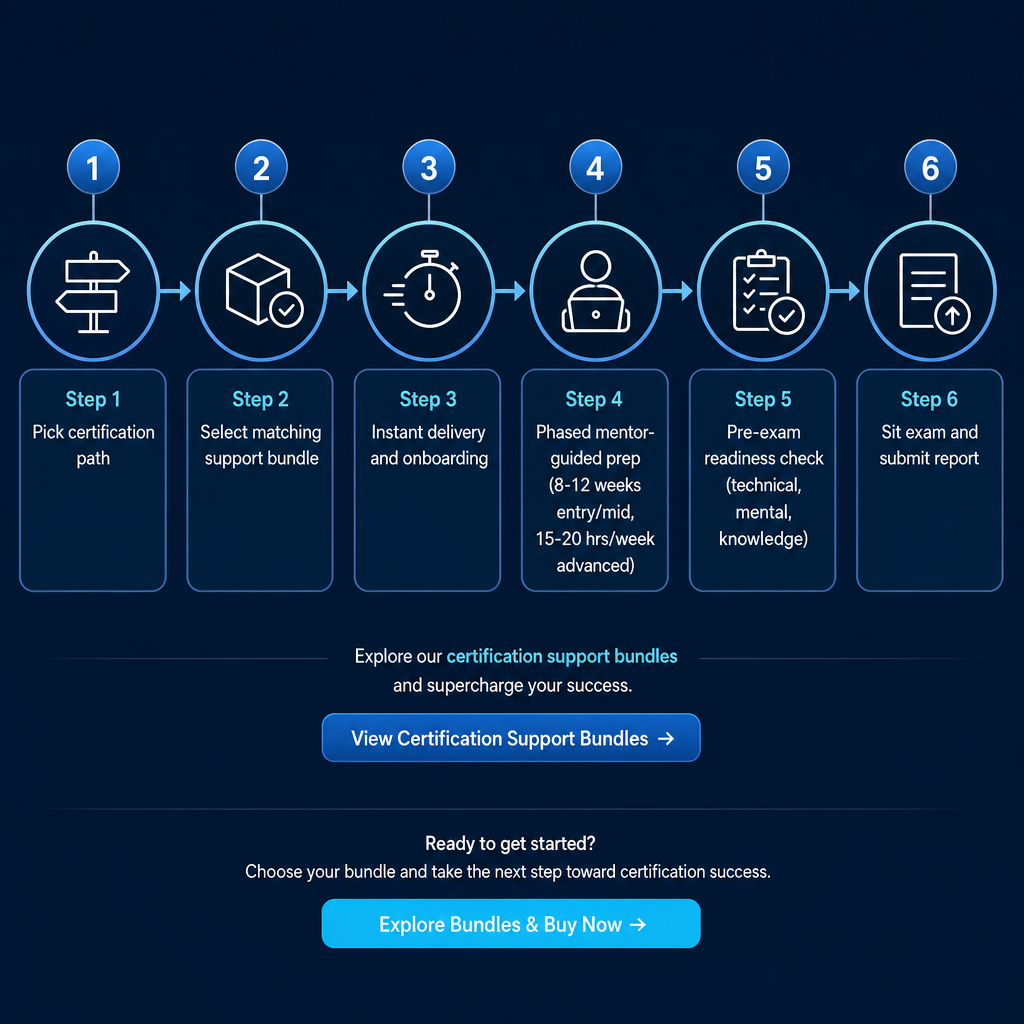
How our mentor-supported model is structured
We build mentor support on three pillars: instant delivery, exam-true materials, and support until you certify.
Instant delivery means that once you choose a certification and pick the matching bundle, the exam reports, walkthroughs, and supporting notes reach you immediately, so you can align your study with exam-style scenarios on day one instead of waiting on a fulfillment queue. Exam-true materials are the second pillar: the certificate reports we provide are identical in structure and format to the reports students submit to exam administrators, which gives you a concrete model of what a successful submission looks like. The curated walkthroughs mirror the decision logic of real exam machines, explaining why a chain works and which evidence belongs in the report, not just listing commands.
The third pillar is guidance that stays active until you pass, backed by a pass-on-success style guarantee for qualifying services. In practice that guidance includes an initial assessment of your current skills, timeline, and target exam; ongoing question-and-answer around lab machines and practice scenarios; targeted intervention when you keep stalling on the same vulnerability class; and pre-exam readiness checks with scenario-based drills. If you want to see how these bundles are organized around a specific credential, our OSCP exam support services page shows how materials and mentor coverage are packaged for one of the most requested certs, and our OffSec certification path overview helps you decide where a given exam fits in a longer plan.
Prerequisites checklist before you start
Mentor support accelerates prepared candidates; it does not substitute for the fundamentals. Have these in place before you commit.
- Technical baseline: comfort with Linux fundamentals and basic Windows usage, familiarity with networking (TCP/IP, routing, common services), and at least beginner-level ability in one scripting or programming language such as Python, Bash, or PowerShell.
- Official course access: active enrollment in the relevant official course (PEN-200 for OSCP, WEB-200 for OSWA, WEB-300 for OSWE, PEN-300 for OSEP, the wireless course for OSWP, or SOC-200 for OSDA), plus access to the official labs so guidance is tied to allowed training environments.
- Time blocks: roughly 10-15 focused hours per week over 8-12 weeks for entry and mid-tier certs like OSWP, OSWA, OSCP, and CPTS; plan for 15-20 hours per week for advanced certs like OSWE and OSEP to allow deep debugging and tradecraft practice.
- Mindset and commitment: a fixed exam date or target window to structure the arc, plus a willingness to follow the plan and share progress and blockers regularly.
- Ethics and exam rules: a commitment to do your own work during the live exam and report writing, using mentor support for preparation only and never for real-time exam assistance.
That last point is not a formality. The value of mentoring depends entirely on you being the one who can solve the machine when it counts.
Step-by-step: how mentor support runs
Step 1: Pick your certification path
Choose your next cert by career goal and current experience. New to pentesting? OSCP, or a lower-pressure first win like OSWP or OSWA. Already hold OSCP? Specialize with OSWE for deep web exploitation or OSEP for evasion and advanced tradecraft. Want broader coverage? Add OSDA for blue-team and hybrid roles.
Step 2: Select the matching support bundle
For each certification we maintain a dedicated resource set: exam-style machine walkthroughs aligned with the current format, report templates matching real student submissions, and methodology guides tuned to each exam’s focus, from web exploitation for OSWA and OSWE to full-scope pentesting for OSCP and CPTS, advanced tradecraft for OSEP, and defensive analysis for OSDA. Pick the bundle that explicitly names your target exam and confirm mentor support and pass-on-success coverage where relevant.
Step 3: Receive instant delivery and onboarding
After purchase your materials arrive immediately, giving you same-day access to exam-style reports, walkthroughs, and guides. Onboarding reviews your current skill level and course progress, sets a realistic prep arc (for example, 8-12 weeks for OSWA), and maps weekly checkpoints so both you and your mentor can see movement.
Step 4: Follow a phased, mentor-guided arc
For web exams like OSWA, guidance usually follows three phases. In weeks one to five you work the official course sequentially, documenting how to identify each vulnerability, what a working exploit looks like, and what evidence belongs in a report; your mentor helps convert course content into practical notes and checklists. In weeks six to twelve you shift from broad lab coverage to deliberate repetition where you stall: fail twice on the same vulnerability class and the mentor designs a dedicated drill block instead of another full-machine attempt. The final phase runs exam-style simulations that mirror the real structure, refining recon sequences, rotation rules, and reporting workflow. Analogous arcs exist for OSCP, OSWE, OSEP, and OSDA, each tuned to its focus area and lab environment. If you want to study how a finished report is actually structured, our worked examples such as the BSCP exam writeup and CPTS exam writeup show the evidence standard you are rehearsing toward.
Step 5: Pre-exam readiness check
As the date approaches, your mentor validates three pillars. Technical readiness means you can reliably solve representative machines in the allotted time and explain your chains. Mental readiness means sleep is scheduled and you hold a clear first-hour plan and rotation rules to avoid tunnel vision. Knowledge readiness means your methodology notes and checklists are complete enough to identify and pursue likely attack paths under pressure. Any weak pillar reshapes your final weeks.
Step 6: Sit the exam and submit your report
During the exam you work alone, following the provider’s rules and using only allowed resources. Afterward, your report uses the structure and evidence standards you rehearsed with our templates. Pass, and mentor support for that cert concludes; fall short with pass-on-success coverage, and the mentor builds a recovery arc toward the next attempt.
Common mistakes mentor support fixes
Five failure patterns show up again and again, and each has a specific corrective.
The first is memorizing dumps instead of understanding mechanics. Exams like OSWA test reasoning about how inputs flow through an application, where they are stored, and how the stack behaves, so a mentor drives you toward the model rather than the payload. The second is skipping official course material; leaning only on third-party resources leaves you fragile against unfamiliar stacks, so mentoring keeps you anchored in the official course and labs while treating supplements as accelerators, not replacements. The third is ignoring reconnaissance and methodology: candidates jump straight to exploitation and stall, so mentors install structured recon habits first. The fourth is underestimating exam duration and fatigue; OffSec exams can run 24-48 hours, so sleep planning, rotation rules, and a defined first 30-60 minutes cut decision fatigue. The fifth is failing to track weak spots, which a mentor counters by logging recurring failures and assigning focused drills so you stop leaking points in the same place.
DIY versus professional mentor support
A motivated, experienced practitioner can prepare independently by working the official course and labs, reading public writeups, and building personal methodology notes. That path is reasonable if you already hold one or more similar certifications, you have completed long technical exams before, and you can consistently commit 15-20 focused hours a week and self-diagnose weak areas.
Professional mentor support becomes the better choice under a different profile: you are new to OffSec-style practical exams and want a structured first win; you have repeatedly failed or postponed exams because of time or planning; you work full-time and must compress preparation into a realistic, time-bounded arc; or you want exam-true report examples and guided scenario work instead of reverse-engineering everything alone. If you are time-constrained, aiming at higher-end certs like OSWE or OSEP, or recovering from a previous failure, the investment usually pays for itself against the cost of another retake. When you are ready to match a specific exam to a bundle, our OffSec certification resource catalog is the place to start narrowing your target and timeline with us.
Frequently Asked Questions
Is mentor support allowed by certification providers?
Using third-party preparation materials and mentors for learning is generally acceptable as long as the exam work and report you submit are entirely your own and you follow all exam rules. Our mentor support is built around preparation, not real-time exam assistance, so you stay within typical certification policies.
Does mentor support guarantee I will pass?
We run a success-oriented model, including pass-on-success availability for some services and mentor support that continues until you certify. You still need to complete the official course, practice diligently, and perform your own work during the exam.
How much faster can I prepare with mentor support?
For web-focused certs like OSWA, a realistic prep arc is roughly 8-12 weeks, and mentoring helps you hit that window by prioritizing high-yield skills and closing weak spots systematically. For advanced certs like OSWE or OSEP, mentors mainly compress the “figuring out what matters” phase rather than removing the need for deep practice.
Will mentors walk me through the actual exam machines?
No. Ethical mentor support uses exam-style scenarios, practice machines, and report templates. It does not interact with your live exam environment or reveal specific live exam content; the focus is building the skills and methodology to solve similar challenges.
Can mentor support help if I already failed an exam?
Yes. Mentoring is especially effective after a failed attempt because your mentor can analyze where you lost points, whether technical gaps, methodology, time management, or reporting, and design a targeted recovery arc instead of repeating the same mistakes.
If your next attempt should follow a deliberate, mentor-guided path rather than a stressed scramble, the practical next move is to tell us your target certification, your exam window, and where you have stalled before, so we can point you to the right support bundle.