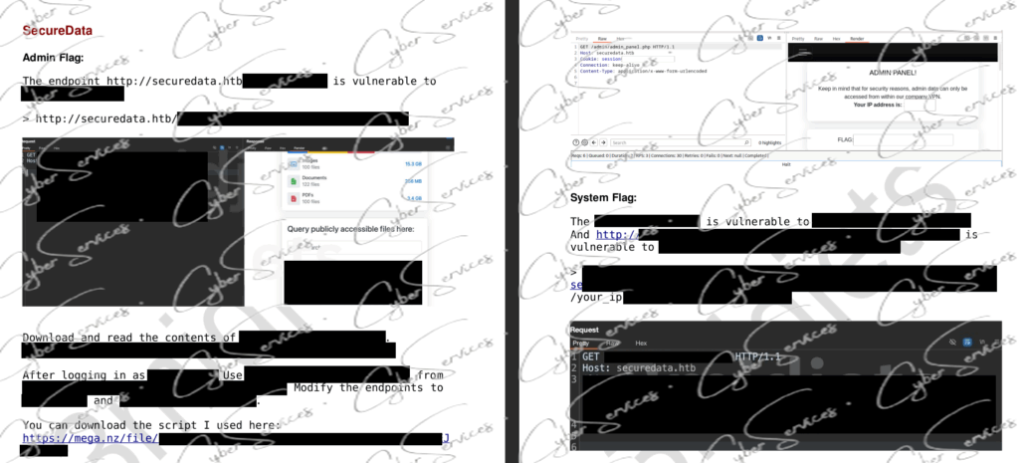
The HTB CWEE RoyalFlush SecureData VitaMedix Guide focuses on the methodology required to analyze complex web applications where a single obvious vulnerability is rarely enough to complete the assessment.
RoyalFlush, SecureData, and VitaMedix should be approached as separate application environments with their own authentication flows, business logic, source-code behavior, endpoints, and trust boundaries. The real CWEE skill is identifying how small weaknesses interact and turning them into a validated exploitation chain.
A useful mindset is:
Application Mapping → Source-Code Review → Input Analysis → Trust Boundary → Vulnerability → Exploit Chain → Impact → Patch
That final step matters. CWEE goes beyond finding vulnerabilities: candidates are expected to understand the underlying code, develop working exploitation logic, explain impact, and produce professional remediation.
RoyalFlush: Map the Application Before Exploitation
Start RoyalFlush by understanding how the application works rather than immediately testing random payloads.
Build a compact map covering:
- routes and endpoints;
- HTTP methods;
- parameters and JSON fields;
- authentication and session handling;
- user roles;
- API calls;
- JavaScript behavior;
- backend requests;
- file-processing functionality;
- error handling.
For every important request, record:
Endpoint → Input → Authentication → Backend Processing → Response
This makes it easier to identify where user-controlled data crosses a trust boundary.
Pay particular attention to functionality that accepts URLs, file paths, serialized data, templates, structured objects, identifiers, or values later reused by another backend component.
A parameter that looks harmless in the browser may become significantly more interesting after source-code review reveals where it ultimately reaches.
Compare Black-Box and White-Box Evidence
CWEE requires both perspectives.
From the black-box side, ask:
What behavior can I observe?
From the white-box side:
Which code path produces that behavior?
Then connect them.
For example:
Request
→ Route Handler
→ Validation
→ Business Logic
→ Sensitive Sink
Understanding that complete flow is more valuable than simply knowing that a payload works.
SecureData: Authentication, Authorization & Data Flow
SecureData should be approached with special attention to how identities and sensitive objects move through the application.
Map:
- registration and login;
- session creation;
- tokens and cookies;
- password recovery;
- user roles;
- object identifiers;
- API authorization;
- administrative functionality;
- sensitive-data access.
Do not confuse authentication with authorization.
A user being successfully authenticated does not mean they should be able to access every object or function.
For each sensitive request, ask:
Who is making the request?
Which object is being requested?
Where is ownership checked?
Is authorization enforced server-side?
Can the client influence the decision?
If an identifier changes from:
resource/1001
to:
resource/1002
the important question is not simply whether the request succeeds. Determine why the backend permits or denies it.
This becomes even more important when APIs and application frontends enforce different controls.
Preparing for HTB CWEE?
CWEE requires advanced web exploitation, source-code review, custom exploit development, and the ability to connect subtle weaknesses into practical attack chains.
Use our dedicated CWEE resources to reduce the time spent piecing together scattered preparation material.
✓ Instant digital delivery · ✓ Free updates · ✓ CWEE-focused practical resources
VitaMedix: Source-Code Review & Exploit Chains
VitaMedix is a good environment for applying a code-first mindset.
Do not read an entire codebase line by line from the beginning.
Start with externally reachable functionality and trace interesting input backward or forward through the application.
Prioritize:
- route definitions;
- controllers;
- middleware;
- authentication functions;
- authorization checks;
- database queries;
- serialization/deserialization;
- template rendering;
- filesystem operations;
- HTTP clients;
- command execution;
- cryptographic operations.
A useful review model is:
Source → Transformation → Validation → Sink
The source is attacker-controlled input.
The transformation describes how the application processes it.
The validation determines whether dangerous input is restricted.
The sink is where the value becomes security-sensitive.
This approach helps identify vulnerabilities that automated scanners may miss.
From Individual Bugs to CWEE Exploit Chains
One of the biggest differences between intermediate and advanced web exploitation is the importance of chaining weaknesses.
A low-impact information disclosure may expose an internal endpoint.
That endpoint may reveal an authentication mechanism.
A logic flaw may allow access to functionality that was previously unavailable.
Another weakness may then provide a path toward sensitive data or code execution.
Think in chains:
Information Disclosure
→ Internal Knowledge
→ Authentication / Authorization Weakness
→ Expanded Access
→ Second Vulnerability
→ Higher Impact
A vulnerability that looks minor in isolation can become critical when combined with another weakness.
This is why RoyalFlush, SecureData, and VitaMedix should not be reduced to lists of payloads.
The important question is:
What new capability did this finding give me?
Advanced Input & HTTP Analysis
At CWEE level, input handling should be examined beyond obvious query parameters.
Map attacker-controlled data in:
- URL parameters;
- POST bodies;
- JSON;
- XML;
- cookies;
- HTTP headers;
- multipart requests;
- path parameters;
- serialized objects;
- API requests.
Then trace where each value goes.
Depending on application behavior, relevant areas may include:
- advanced injection;
- server-side request manipulation;
- deserialization;
- template processing;
- authentication bypass;
- request smuggling or parsing inconsistencies;
- filter bypass;
- blind exploitation;
- business-logic weaknesses.
Do not test every vulnerability class against every input.
Let the application’s architecture guide the testing.
Authentication & Session Logic
RoyalFlush, SecureData, and VitaMedix may expose different authentication models, but the methodology remains consistent.
Review:
Login → Session Creation → Authorization → Privilege Change → Logout
Inspect:
- session identifiers;
- cookies;
- tokens;
- expiry;
- token validation;
- password-reset workflows;
- role checks;
- account recovery;
- multi-step authentication;
- session invalidation.
Then examine the source code responsible for enforcing these controls.
The question is not simply:
“Can authentication be bypassed?”
A better CWEE question is:
“Which assumption does the authentication mechanism trust, and can that assumption be violated?”
That perspective is much more useful for discovering logic vulnerabilities.
Filter Bypass & Validation Differences
Advanced applications often contain security controls specifically designed to block obvious attacks.
When input is rejected, determine where rejection occurs.
Possible layers include:
Browser → Proxy/CDN → WAF → Web Server → Framework → Application → Backend Service
A payload blocked at one layer may be interpreted differently by another.
Compare:
- encoding behavior;
- normalization;
- parameter duplication;
- content types;
- HTTP methods;
- case sensitivity;
- parser differences;
- alternate representations.
The objective is not to blindly mutate payloads.
Understand which component is interpreting the input differently.
That knowledge produces more reliable exploitation and better remediation guidance.
Custom Exploit Development
CWEE also emphasizes the ability to turn a vulnerability into reliable exploitation logic.
Once a weakness is validated, document:
- prerequisites;
- required authentication;
- vulnerable endpoint;
- controllable input;
- application behavior;
- expected response;
- exploitation sequence;
- resulting impact.
Then automate only what needs automation.
A useful exploit should be:
reproducible, understandable, minimal, and reliable.
Avoid creating unnecessarily complex tooling when a small Python script or controlled HTTP request demonstrates the vulnerability clearly.
The purpose of custom exploit development is not to make the attack look sophisticated.
It is to demonstrate the vulnerability consistently.
Secure Coding & Patch Validation
A major CWEE distinction is that finding the vulnerability is not the end of the assessment.
You should understand how it should be fixed.
For every confirmed issue, determine:
Root Cause → Vulnerable Code → Correct Security Control → Patch → Regression Test
For example, remediation may involve:
- server-side authorization;
- strict allow-list validation;
- safer APIs;
- prepared database queries;
- secure deserialization patterns;
- stronger session validation;
- correct output encoding;
- filesystem restrictions;
- safer backend request handling.
Then verify that the patch actually blocks the original exploit without breaking legitimate application behavior.
This makes source-code understanding particularly valuable.
Want More CWEE Exploit-Chain Practice?
Our CWEE preparation material focuses on practical advanced web scenarios, helping you compare enumeration decisions, source-code findings, vulnerability chains, and exploitation methodology across different applications.
→ Explore HTB CWEE Exam Material
Common RoyalFlush, SecureData & VitaMedix Mistakes
Running scanners before understanding the applications.
Automated tools can help with coverage, but CWEE-level logic flaws often require manual analysis.
Reading the entire source tree without prioritization.
Start from reachable functionality and trace attacker-controlled input toward sensitive operations.
Treating every vulnerability independently.
Ask what each weakness enables next.
Stopping after authentication bypass.
New access means new endpoints, roles, APIs, and code paths. Re-enumerate.
Ignoring HTTP behavior.
Headers, methods, parsers, encodings, and request-processing differences can be part of advanced exploitation.
Finding a bug without understanding the root cause.
CWEE requires deeper understanding than simply demonstrating a working payload.
Ignoring remediation.
A professional finding should explain how the vulnerable code should change.
Leaving reporting until the end.
Capture the request, vulnerable code, exploit evidence, impact, and remediation while the context is fresh.
A Compact CWEE Workflow
Use the same repeatable process across RoyalFlush, SecureData, and VitaMedix:
1. Map the application. Identify routes, parameters, APIs, roles, sessions, and major functionality.
2. Capture normal behavior. Establish a baseline before manipulating requests.
3. Review relevant source code. Trace attacker-controlled input toward security-sensitive operations.
4. Identify trust boundaries. Determine where the application assumes data or identity can be trusted.
5. Validate vulnerabilities manually. Confirm the behavior and root cause.
6. Look for chains. Determine whether one finding unlocks another endpoint, role, service, or vulnerability.
7. Develop a reliable exploit. Automate the minimum necessary steps when appropriate.
8. Re-enumerate after new access. Every privilege change exposes a new attack surface.
9. Develop and validate remediation. Understand how the vulnerable logic should be corrected.
10. Document everything. Preserve requests, responses, code references, exploit evidence, impact, and patch guidance.
This methodology transfers much better to new CWEE applications than memorizing one specific solution.
Why These Applications Matter for CWEE
The HTB CWEE RoyalFlush SecureData VitaMedix Guide represents the type of thinking expected from an advanced web penetration tester.
CWEE is not simply a harder version of basic web enumeration.
HTB’s official certification scope emphasizes advanced black-box and white-box penetration testing, large-codebase security review, custom exploit development, advanced injection, authentication attacks, blind web attacks, security-filter bypass, deserialization, and modern exploitation techniques.
Candidates are also expected to explain vulnerabilities professionally and provide appropriate fixes.
That means your workflow should increasingly look like:
Observe → Understand → Trace → Exploit → Chain → Patch → Report
For current requirements and certification scope, use the official HTB Certified Web Exploitation Expert (CWEE) page.
HTB CWEE RoyalFlush, SecureData & VitaMedix FAQ
What are RoyalFlush, SecureData and VitaMedix?
They are application names associated with the CWEE-focused environment discussed in this guide. Treat each application as its own attack surface while looking for relationships between authentication, data flow, application logic, and backend behavior.
What should I focus on for HTB CWEE?
Prioritize advanced black-box testing, white-box source-code review, authentication and authorization logic, advanced injections, deserialization, HTTP behavior, filter bypass, exploit development, secure coding, and professional reporting.
Is source-code review important for CWEE?
Yes. HTB explicitly includes white-box penetration testing and large-codebase security review in the CWEE knowledge domains.
Should I use automated scanners?
Use them for coverage and supporting enumeration, but do not depend on them. Logic flaws, exploit chains, unusual trust relationships, and code-level vulnerabilities often require manual analysis.
What is the most important CWEE habit?
Trace relationships. Understand how user input moves through code, how identities cross authorization boundaries, and how one vulnerability can enable another.
Final Thoughts
The central lesson from this HTB CWEE RoyalFlush SecureData VitaMedix Guide is that advanced web exploitation is about understanding applications rather than collecting payloads.
RoyalFlush may expose one type of trust boundary.
SecureData may require deeper authentication and authorization analysis.
VitaMedix may reward careful source-code review.
But the underlying process remains consistent:
Map the application.
Trace the input.
Understand the code.
Identify the broken assumption.
Validate the vulnerability.
Look for the next link in the chain.
Then explain how to fix it.
That methodology is what turns individual web vulnerabilities into professional advanced web penetration testing.
Ready to Prepare for HTB CWEE?
Get our CWEE preparation resources covering advanced web exploitation, source-code review, application analysis, vulnerability chains, custom exploit development, and exam-focused practical material.
✓ Instant digital delivery
✓ Free updates included
✓ Advanced CWEE-focused resources
✓ Practical preparation material
Use web security testing techniques only against applications you own or are explicitly authorized to assess.
Vendor: https://academy.hackthebox.com/preview/certifications/htb-certified-web-exploitation-expert
Get the material: CWEE exam material