
Choosing between OSCP and CPTS is rarely about which certificate is objectively superior. It is about which one matches your current skill level, the ecosystem you want to train in, and how much time you can realistically commit before your exam window. Both credentials prove hands-on penetration testing ability against live machines, both demand a written report, and both carry weight with hiring teams. The difference sits in the details: prerequisites, exam design, coverage, and how each vendor structures the path to the attempt. We built this comparison so you can decide with clear criteria instead of forum noise, and we back either choice with mentor-supported preparation so the decision leads straight into an efficient study plan.
Table of contents
OSCP and CPTS: Two practical but different alternatives
The OffSec Certified Professional (OSCP) is a hands-on penetration testing certification built around the PEN-200 training course. It concentrates on core offensive skills: enumeration, exploitation, and documenting proof of work in realistic lab environments. Candidates must attack and compromise multiple live machines in a controlled setting, then prove each success with clear evidence rather than theory or multiple-choice answers. That lab-based structure is why the industry treats OSCP as a technical proof of skill for penetration testers and ethical hackers. OffSec now also offers OSCP+, where the underlying OSCP credential remains valid indefinitely while the “+” designation requires renewal every three years.
The HTB Certified Penetration Testing Specialist (CPTS) from Hack The Box is equally hands-on, assessing the ability to run end-to-end penetration testing activities at an intermediate level. CPTS holders are expected to demonstrate a full workflow: methodology, reconnaissance, attacking Windows and Linux targets, Active Directory penetration testing, web application testing, exploitation, pivoting, post-exploitation, privilege escalation, and risk communication through report writing. The certification is designed around Hack The Box’s guided learning ecosystem, validating job-ready skills aligned with a modern offensive security engagement.
Both are practical, lab-based ways to prove real penetration testing capability. Where they part is ecosystem, assumed experience, and the exact shape of the exam, and those differences are what should drive your decision.
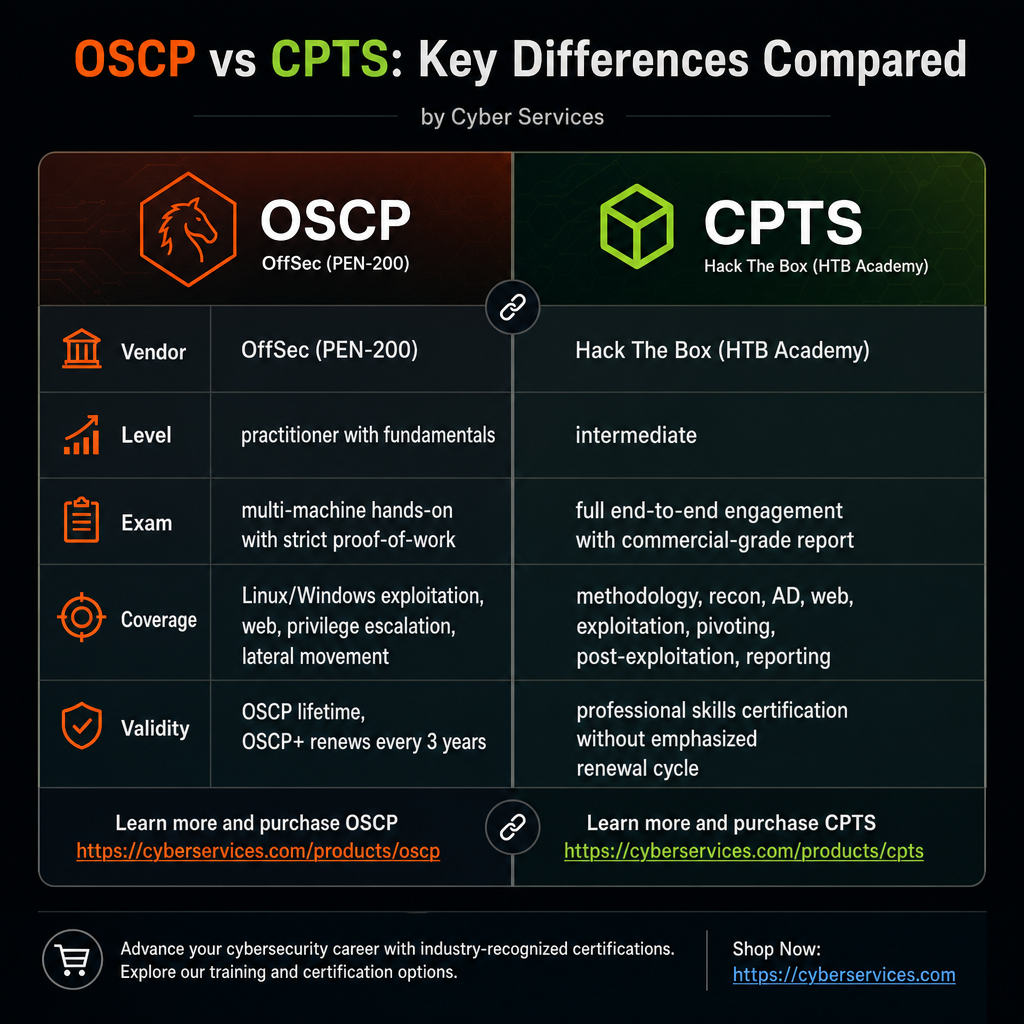
Criteria-by-criteria: where OSCP and CPTS diverge
Skill level and target audience
OSCP is aimed at practitioners who already understand basic networking, Linux, and scripting and want to prove they can independently compromise and document multiple targets under pressure. CPTS is framed as an intermediate credential validating a broad penetration testing skill set, including methodology, exploitation, and professional reporting for infrastructure assessments. If you are moving from junior toward mid-level tester, CPTS maps cleanly onto that intermediate profile. OSCP tends to serve as a milestone for professionals signalling deeper autonomy in complex assessments.
Training ecosystem
OSCP is delivered through OffSec’s PEN-200 course, a structured program focused on offensive fundamentals, lab exercises, and preparation tuned to the OSCP exam format. CPTS is tightly integrated with HTB Academy, where the Penetration Tester job-role path builds the required knowledge through interactive modules and hands-on labs. Both ecosystems are lab-driven, but the philosophies differ: OffSec centers on its PEN-series course, while CPTS leans on a job-role learning path and lab-heavy content.
Prerequisites and the path to the exam
OSCP has no formal prerequisites, though OffSec recommends solid familiarity with Linux, TCP/IP networking, scripting, and basic security concepts before attempting PEN-200 and the exam. CPTS is positioned as the capstone of the Penetration Tester job-role path, strongly implying that candidates complete that Academy path first to ensure they cover every tested domain. In practice this is a real difference in freedom: OSCP leaves more room in how you prepare, while CPTS offers a more prescriptive “complete this path, then attempt the exam” progression.
Exam format and experience
The OSCP exam is fully hands-on, requiring exploitation of multiple machines in a controlled lab environment, with strict documentation and reporting standards to prove each compromise with clear evidence and methodology. OSCP+ uses a stand-alone exam that renews the “+” status and keeps validated skills current over time. The CPTS exam is highly practical and structured around a complete engagement: reconnaissance, exploitation, privilege escalation, lateral movement, and professional reporting, designed to mirror real consulting scenarios where you must communicate risk in a commercial-grade report.
The distinction that matters on exam day: OSCP emphasizes breadth and depth across multiple hosts with rigorous proof-of-work, while CPTS emphasizes running one realistic penetration test end to end and reporting it as a consultant would.
Coverage and technical focus
OSCP focuses on Linux and Windows exploitation, web application vulnerabilities, privilege escalation, movement between systems, and proof-driven documentation. CPTS explicitly covers penetration testing processes and methodologies, reconnaissance and information gathering, attacking Windows and Linux targets, Active Directory penetration testing, web application testing, manual and automated exploitation, pivoting and post-exploitation, and vulnerability communication and reporting. CPTS articulates its scope as the full penetration testing lifecycle, whereas OSCP concentrates on deep exploitation and practical compromise under time pressure.
Certification validity and maintenance
| Criterion | OSCP / OSCP+ | CPTS |
|---|---|---|
| Vendor | OffSec (PEN-200) | Hack The Box (HTB Academy) |
| Assumed level | Practitioner with fundamentals | Intermediate |
| Exam shape | Multi-machine, strict proof-of-work | Full engagement plus report |
| Prep freedom | Flexible, no forced path | Job-role path then exam |
| Validity | OSCP lifetime; OSCP+ renews every 3 years | Professional cert, no emphasized renewal cycle |
If long-term validity matters to you, OSCP gives a lifetime baseline credential with an optional OSCP+ renewal on top. CPTS focuses more on demonstrating current, job-ready skills within the HTB ecosystem rather than a periodic renewal cadence.
Wherever you land after weighing these criteria, you can move faster with focused preparation: explore our CPTS exam writeup and support or our OSCP exam support services to turn the decision into an exam-ready plan.
When OSCP, when CPTS, and when neither fits yet
Choose OSCP when you want a widely recognized, technically demanding credential that signals autonomy and persistence in offensive roles; when you already hold solid fundamentals in Linux, networking, and scripting and are ready for a multi-target, high-pressure exam with rigorous reporting; and when your target roles, such as penetration tester, red teamer, or security consultant, frequently list OSCP as a preferred or distinguishing qualification. For time-constrained professionals, mentor-supported OSCP preparation and a condensed checklist can cut trial-and-error and reduce wasted effort, which matches how we structure our OSCP support.
Choose CPTS when you want a certification that mirrors a real-world engagement from methodology and exploitation through commercial-grade reporting; when you prefer an integrated learning path and want to build skills step by step through the Penetration Tester job-role modules before validating them; and when your focus includes Active Directory attacks, web app testing, pivoting, and clear communication of findings in environments that resemble modern corporate networks. Under a tight timeline, mentor-guided CPTS preparation and curated practice help you concentrate on the domains that carry the most exam weight.
Hold off on both if you are still building basic networking, Linux, and scripting skills and have not yet completed any introductory practical certification; if your work centers on blue-team, SOC, or governance roles where a hands-on offensive cert may not be the most direct value add; or if you have not spent time in lab platforms such as CTFs or practice ranges and would struggle with unstructured problem-solving under time pressure. In those cases, an earlier-stage practical certification or structured foundational training is a better stepping stone before committing to either exam.
How we support either path
We position ourselves as a fast-track, mentor-supported resource for OffSec, HTB, and related practical certifications, with instant delivery and a success-oriented model built for candidates who cannot afford months of unfocused study. The value we add is not the exam itself; it is compressing the distance between where your skills are today and where the exam expects them to be.
If you commit to OSCP, we provide dedicated OSCP exam support and a focused preparation checklist that helps you translate exam objectives into a concise action plan, apply mentor feedback to avoid common lab dead-ends, and work from writeups and guidance aligned with realistic exam scenarios. If you commit to CPTS, we provide a CPTS exam writeup and support package plus guidance on studying for the exam effectively, so you can prioritize the most exam-relevant HTB Academy modules, understand how CPTS assesses methodology and reporting, and shorten the path from Academy learner to exam-ready practitioner.
This is the point to pick a lane. Either commit to OSCP and pair it with our mentor-backed OSCP exam preparation checklist, or commit to CPTS and combine HTB Academy with our guide on how to study for the HTB CPTS exam effectively. Both routes end the same way: a structured plan instead of self-directed guesswork.
Where to go after you decide
A decision only matters once it becomes execution. If you are still torn on the core question, our companion piece HTB CPTS vs OffSec OSCP: which to choose walks through the choice from the ecosystem angle and pairs naturally with this comparison.
For OSCP-bound candidates, map your current skills against exam requirements first, then reinforce weak areas with mentor input and instant-access materials so you are not over-studying topics that will not move your score. For CPTS-bound candidates, align your HTB Academy progress with exam expectations and preview the exam flow and reporting standards before you open your attempt. Either way, the goal is to convert a high-stakes decision into a milestone-driven plan with a clear finish line. When you are ready to start immediately, our mentor-supported OSCP and CPTS packages exist to keep your effort focused only on what earns the pass.
Frequently Asked Questions
Is OSCP harder than CPTS?
Both are hands-on and demanding, and they target different levels and ecosystems. Difficulty depends heavily on your background: OSCP rewards comfort with OffSec-style labs and multi-machine pressure, while CPTS rewards familiarity with HTB Academy content and full-engagement workflow.
Which certification is better for getting a penetration testing job?
OSCP is widely recognized and frequently appears in job descriptions, while CPTS demonstrates modern, job-ready penetration testing skills. Employers value both, largely depending on their familiarity with the OffSec or HTB ecosystem.
Does OSCP expire, and what about OSCP+ and CPTS?
The OSCP certification itself does not expire and remains valid indefinitely. OSCP+ adds a renewable three-year designation on top of OSCP. CPTS is positioned as a professional skills certification without the same explicit renewal model emphasized for OSCP+.
Do I need formal prerequisites before attempting OSCP or CPTS?
OSCP recommends, but does not enforce, strong fundamentals in Linux, networking, and scripting before PEN-200 and the exam. CPTS aligns closely with completing the Penetration Tester job-role path on HTB Academy first, which ensures coverage of all tested domains.
How can I prepare efficiently with limited time?
Combine official training, OffSec PEN-200 or HTB Academy, with our mentor-supported resources such as OSCP exam support, CPTS exam writeups, and focused study guides. That pairing reduces wasted effort and moves you toward exam-ready status more directly than self-directed trial-and-error.