
The CRTO certification is the Certified Red Team Operator credential from Zero-Point Security, and if you have been asking what is crto certification, the short answer is this: it is a hands-on, lab-based qualification that proves you can run a full adversary simulation against a Windows Active Directory environment using Cobalt Strike and modern red team tradecraft. It sits in the mid-to-advanced tier of offensive security certifications and is built for people who want to move past classic penetration testing into realistic, stealthy operations.
Unlike an exam that quizzes you on theory, CRTO puts you inside a live enterprise-style network and asks you to behave like a genuine threat actor: gain initial access, establish command-and-control, escalate privileges, move laterally, and reach domain dominance while staying quiet. Below we break down what it tests, how the exam works, who should pursue it, and how we help time-constrained professionals prepare efficiently. If you already know CRTO is your next step, you can jump straight to our CRTO exam-prep materials.
Table of contents
What the CRTO certification actually is
CRTO is issued by Zero-Point Security and is tightly coupled to its Red Team Ops (RTO) training course. The RTO course teaches the principles, tools, and techniques of red teaming, and completing the course plus passing the practical exam is the official route to earning the CRTO badge.
At its core, the certification validates one specific capability: simulating adversarial attacks inside a Windows Active Directory enterprise, with Cobalt Strike as the primary command-and-control framework. The emphasis is deliberately on adversary simulation and emulation rather than the classic “find a vulnerability, pop a shell” model of a standard pentest. You are judged on whether you can behave like a real intrusion set across an entire campaign.
That framing is why CRTO is consistently described as a practical, operations-focused credential covering the full red team attack lifecycle, from initial compromise through domain dominance and controlled data exfiltration, all while maintaining stealth and disciplined operational security. Independent reviews repeatedly call it one of the most realistic mid-level red team certifications currently available.
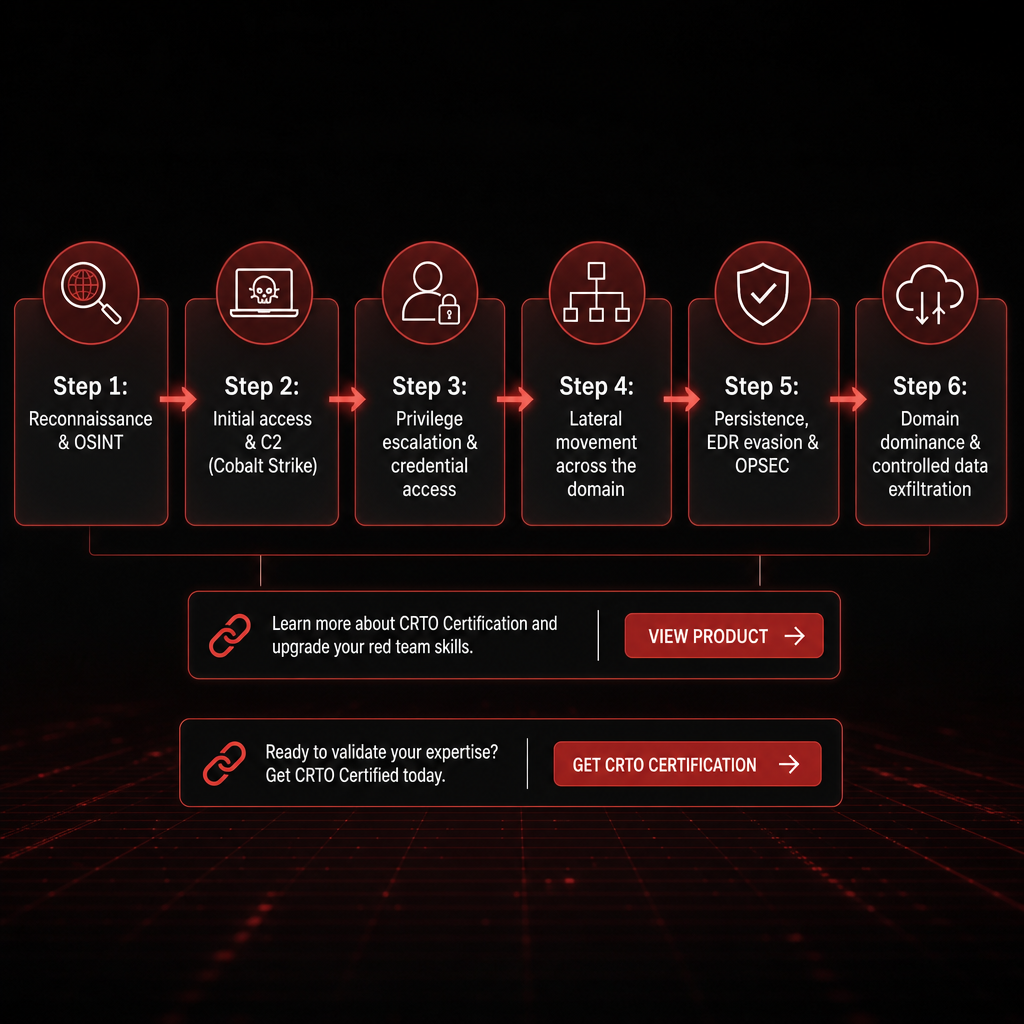
What CRTO tests: the core mechanisms
CRTO is built on the premise that a competent operator must execute every phase of a real engagement, not isolated exploits. The competency framework spans a full campaign, and each phase carries its own decision points.
- Reconnaissance and OSINT to identify viable attack paths into the target organization before you ever send a payload.
- Initial access and resilient C2 infrastructure using Cobalt Strike inside a Windows environment, so your foothold survives basic defensive response.
- Privilege escalation, credential access, and lateral movement across domain-joined hosts, chaining small wins into broad control.
- Persistence, EDR evasion, and OPSEC to stay undetected across extended operations rather than a single noisy session.
- Full domain compromise, data hunting, and controlled exfiltration to prove real business impact.
The mechanism underneath all of this is adversary simulation: you use the same tactics, techniques, and procedures a threat actor would, but bound by strict rules of engagement and safety. That is precisely what makes the credential valuable to teams who need operators capable of stress-testing defenses without generating obvious, easily flagged activity. The exam does not reward the loudest attacker; it rewards the one who reaches the objective quietly.
Exam format, requirements, and the official path
The CRTO exam is fully practical and lab-based, engineered to feel like a compressed red team operation rather than a written test. Knowing the format up front helps you plan realistically.
| Exam element | What to expect |
|---|---|
| Format | Hands-on lab engagement in a live Active Directory network |
| Duration | Roughly 48 hours of active lab access, often spread across several days |
| Objective | Compromise systems and escalate privileges using red team tradecraft |
| Scoring | Flag-based; passing typically requires around 6 of 8 flags |
| Report | No formal written report required; scoring is on technical objectives |
To earn CRTO, candidates must complete the Red Team Ops course and then pass the practical exam. This is reflected directly in the official CRTO badge criteria. There are no hard formal prerequisites, but the course and reviews assume you already understand basic penetration testing, Windows internals, and Active Directory concepts before you start.
One clarification matters because it causes confusion: other providers use “Certified Red Team Operator (CRTO)” language for unrelated training. The Zero-Point Security credential tied to Red Team Ops is the primary definitional reference used across the industry, and it is the one this guide describes. If you want a structured way to rehearse the objective-based style, our CRTO exam writeup and practice materials mirror the flag-driven format directly.
Who CRTO is for and how it compares
The decision to pursue CRTO comes down to a single question: do you want to operate as a true red teamer rather than a traditional pentester? Reviews describe it as a strong fit for penetration testers transitioning into red teaming, security professionals with some offensive experience, and defenders who want a deeper understanding of attacker tradecraft. Some sources call it entry-to-intermediate red team level; others frame it as advanced. That spread reflects a certification that is accessible but genuinely demanding.
Compared with exploit-heavy credentials or network-assessment-oriented paths, CRTO leans toward:
- Stealthy, long-term operations instead of short, noisy tests.
- Command-and-control, OPSEC, and persistence instead of single-host exploitation.
- Enterprise-scale tradecraft, including movement across domains, trusts, and segmented networks.
If your career target is “red team operator” or “adversary simulation specialist,” CRTO aligns directly with the role. If you are still building fundamentals and have done little Active Directory or Cobalt Strike work, it fits better as a second or third certification than as your first offensive credential. For readers still mapping the earlier rungs, our overviews of the OSCP certification and the CPTS certification show where a foundation-building path can start before red team specialization.
Benefits and risks worth weighing
CRTO carries real advantages, but also trade-offs you should size up honestly before committing budget and calendar time.
Key benefits
- Demonstrated ability to run a full red team assessment from OSINT to data exfiltration, stated explicitly in the official badge description.
- A heavy focus on Cobalt Strike and modern C2 tradecraft that maps closely to real attacker operations and many current red team job descriptions.
- A realistic, time-boxed exam that forces genuine planning, time management, and prioritization under pressure.
- A positive community reputation, with multiple independent reviews highlighting it as high-value and recognized by employers hiring for practical skills.
For operators who already hold general pentesting certifications, CRTO differentiates your profile as someone who can run stealthy, campaign-style operations rather than short spot checks.
Main risks and trade-offs
- Steep learning curve. It assumes familiarity with Windows, Active Directory, and offensive tooling; without that base, the course and exam can overwhelm you.
- Cobalt Strike dependence. The curriculum centers heavily on Cobalt Strike, so in shops that run different C2 frameworks you will need to translate the concepts into other tools.
- Time and cost. The combined course-and-exam bundle is not trivial in price, and the exam demands multi-day commitment with long sessions.
- Not a beginner first cert. Some motivated newcomers pass, but reviews consistently suggest tackling it after at least one core offensive certification or substantial hands-on practice.
Weighing these honestly tells you whether CRTO fits your current stage or belongs in a later, more advanced phase of your roadmap.
How we help you prepare for CRTO
CRTO is difficult by design, and the exam environment rewards candidates who already know the most effective paths through Active Directory compromise, C2 setup, and flag collection. That is exactly where structured, lab-aligned preparation earns its keep.
At Cyber Services, we position our CRTO materials as premium exam resources built around updated methodology rather than static, stale notes. Our CRTO-focused offering includes a curated question and scenario bank that reflects the major exam domains, paired with answer rationales that explain why each path works, not just which flag it produces. For a red team exam, where chaining and tradecraft matter as much as any single command, that reasoning is the part that actually transfers to the lab.
We also emphasize instant digital delivery and broad payment support, including credit and bank cards, PayPal, Apple Pay, and Google Pay, so you can start studying quickly after purchase instead of losing a day to onboarding. For professionals who want mentor-supported guidance and a compressed study window, this fits the goal of reaching a certification outcome with minimal wasted effort and repetition. You can review the full scope on our CRTO exam-prep page and secure your materials before you block out lab time.
How to decide if CRTO is right for you
Treat the CRTO decision as a balance of four dimensions: skills, goals, exam style, and time. Run yourself through each honestly.
Skills and background. If you are comfortable with Windows internals, Active Directory attacks, basic OPSEC, and at least one offensive toolkit, CRTO will feel challenging but achievable. If those areas are still largely new, working through fundamentals-focused certifications and labs first reduces the risk of burnout and failure.
Career and role goals. CRTO fits especially well if you want roles like red team operator, adversary simulation specialist, or an offensive engineer embedded in a detection team. Candidates focused purely on web application testing or narrow network auditing may gain less than those aiming for broad offensive responsibilities.
Exam style preference. Some professionals prefer report-heavy, multi-step exams; others want a pure technical engagement. The objective-based, report-less CRTO exam favors people who enjoy extended technical operations under time pressure. If you value methodology documentation as much as exploitation, pairing CRTO with a report-oriented certification builds a more balanced profile.
Time and preparation approach. The 48-hour window and depth of content mean you must reserve dedicated blocks for both study and the exam itself. Focused exam-prep material, such as scenario banks and lab-aligned practice rather than broad, unfocused reading, helps busy professionals fit preparation into limited evenings and weekends.
If CRTO still aligns after weighing these factors, building mentor-supported resources and realistic practice into your plan raises your odds of passing on the first attempt. Our CRTO practice materials are designed to turn limited study hours into a realistic first-attempt pass.
Frequently asked questions
Is CRTO an entry-level certification?
Most reviews place CRTO in the entry-to-intermediate red team space, but they stress that prior penetration testing and Windows/Active Directory experience is strongly recommended. It is not generally treated as a pure beginner credential.
How hard is the CRTO exam in practice?
It is widely described as challenging because of the realistic multi-host environment, long duration, and need for solid time management. It remains achievable for candidates who work through the Red Team Ops course thoroughly and rehearse similar scenarios.
What tools and technologies does CRTO focus on most?
CRTO centers on Cobalt Strike as the main C2 framework, plus Windows and Active Directory attacks, credential access, lateral movement, persistence, and evasion of modern EDR tooling, all within an adversary simulation context.
Is CRTO recognized by employers?
Independent reviews note growing recognition among organizations that run formal red teaming and adversary simulation programs, particularly where Cobalt Strike and similar C2 frameworks are in use.
How can Cyber Services help me pass CRTO faster?
We offer CRTO-focused, lab-aligned scenario banks with rationale, built to mirror real exam domains and help you understand effective attack chains instead of memorizing isolated commands. Combined with fast digital delivery and broad payment support, this makes targeted, efficient preparation practical for time-constrained professionals.