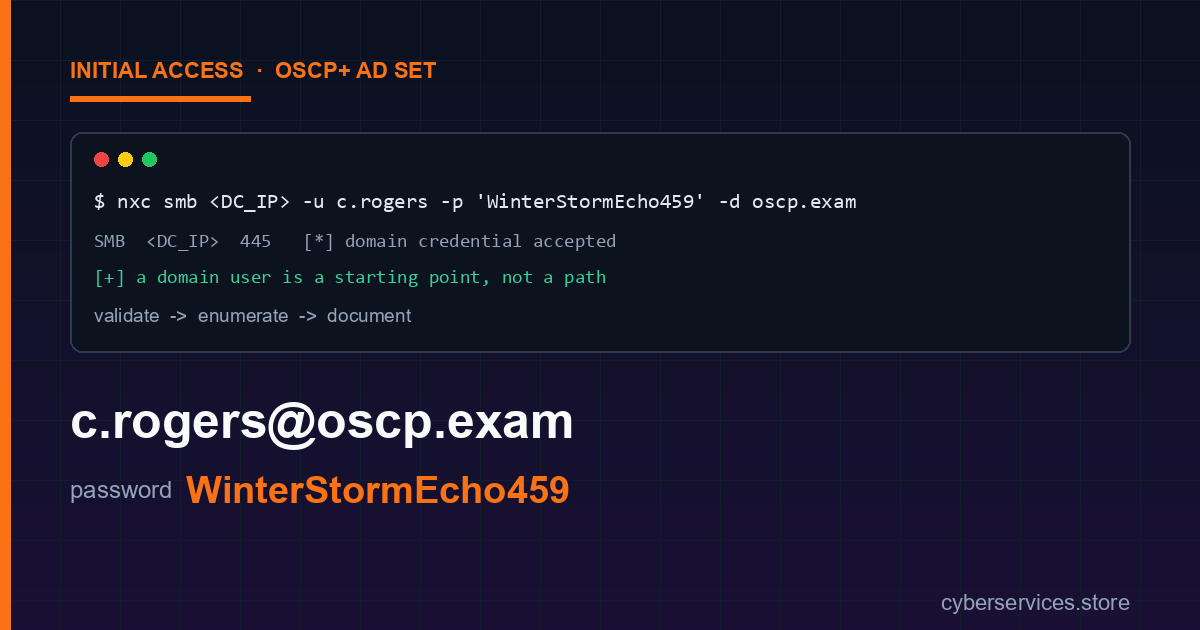
An OSCP AD set credential looks like this: c.rogers@oscp.exam:WinterStormEcho459 — the account c.rogers inside the oscp.exam Active Directory domain, with the password issued alongside it. It is not a mailbox and not a real company account. It is one of the starting points OffSec hands out in the OSCP+ Active Directory sets, and reading an OSCP AD set credential correctly tells you a lot about the environment before you run a single command.
| Field | What it means |
|---|---|
| Full credential | c.rogers@oscp.exam:WinterStormEcho459 |
| Account | c.rogers — a low-privilege domain user, not a local account |
| Domain | oscp.exam — the lab forest used across the OSCP+ AD sets |
| Password | WinterStormEcho459 — issued with the set, single value, per attempt |
| Format | user@domain:password, the shorthand every tool and report uses |
| Lifetime | Valid for your attempt; the lab is rebuilt between candidates |
What does an OSCP AD set credential tell you about the domain?
The domain part is the first piece of intelligence you get for free. A value written as c.rogers@oscp.exam is a domain account, so it authenticates against a domain controller rather than a local SAM database. That single fact changes your first move: you are not hunting for local administrator reuse, you are enumerating a forest. Everything that follows — LDAP queries, Kerberos tickets, Group Policy, delegated rights — depends on that distinction being clear from minute one.
It also tells you the account is deliberately ordinary. OffSec issues a user like c.rogers because the set expects you to work from a foothold, not from Domain Admin. If you assume privilege you do not have, you burn time on commands that return access denied instead of information.
How do you validate an OSCP AD set credential without wasting exam time?
Validate the pair with a single authentication that returns something useful, not with an exploit. A domain user list is the cheapest confirmation: it proves the password is correct, proves the domain resolves, and hands you the account inventory in the same request.
impacket-GetADUsers -all oscp.exam/c.rogers:'WinterStormEcho459' -dc-ip <DC_IP>If you prefer SMB, one line does the same job and tells you whether the host you are pointing at is the domain controller:
nxc smb <DC_IP> -u c.rogers -p 'WinterStormEcho459' -d oscp.exam --usersThree outcomes matter. Status OK with a user list means the credential works and you have found the DC. Status OK with no output means authentication succeeded but you are pointed at a member server — pivot the address. Logon failure means the password is stale, the domain is wrong, or the set uses a different suffix, and you should re-read the briefing rather than guess.
What do you enumerate first once the OSCP AD set credential works?
Order beats volume. A repeatable sequence keeps the report clean and stops you from drowning in output you will never cite:
- Users and their descriptions — the description field is where labs hide passwords.
- Groups and nesting — who can do what, and through which inherited group.
- Kerberoastable and AS-REP roastable accounts — cheap tickets for offline cracking.
- Delegation — unconstrained and constrained, the classic path to a higher account.
- Shares and ACLs — read access that exposes backup scripts or config files.
Each step produces evidence you can screenshot and reference. Document the command, the output and the timestamp as you go; reconstructing a chain from memory at hour twenty is where candidates lose marks.
Which AD set does this OSCP AD set credential belong to?
OffSec rotates the sets, so the credential alone is not a reliable fingerprint — the user list is. If enumeration reveals a specific pair of accounts alongside c.rogers, you are in a known set build and can expect the corresponding path. Treat the account names as the identifier, not the password, and confirm the build before you commit to an attack path.
What should go in the report?
A credential is an initial access finding, and examiners mark it as such. Write what you were given — in this case c.rogers@oscp.exam:WinterStormEcho459 — how you validated it, what level of access it granted, and what it unlocked. Do not paste the password into a paragraph without context; show the authentication, then the outcome. One clear screenshot of a successful domain authentication is worth five paragraphs of narrative.
Then close the loop: if c.rogers led to a share, a roastable ticket or a delegation right, name it explicitly and link it to the next step in your chain. The report is not a diary, it is an argument that each step was necessary.
Frequently asked questions
Is an OSCP AD set credential a real email address? No. oscp.exam is a lab domain; the address exists only inside the exam environment and cannot receive mail.
Does the password work across sets? No. An OSCP AD set credential is issued per attempt and the environment is rebuilt between candidates, so a value you see in a guide is documentation, not a shortcut.
Can I skip enumeration if I already have a domain user? You can, but you will not pass. The credential is a starting point; the marks come from the path you build out of it.
Where should I practise this? The OSCP+ sets are documented in our OSCP exam report and walkthrough hub, and the AD set methodology is covered in the OSCP AD set walkthrough.
Before you rely on the pair, confirm it in your own environment: an OSCP AD set credential is only useful once you have proved the domain answers. For the tooling used above, the Impacket repository documents every script, and the PEN-200 course page lists what the exam expects you to know.

Red team operator working across Active Directory and hybrid estates. OSCP, OSWE, CPTS and CRTO certified. Covers adversary simulation, evasion and report writing for red-team certifications.