The TryHackMe PT1 exam report certification is one of the most practical penetration testing exams I’ve taken. Rather than testing your ability to memorize commands, it evaluates how you approach a real engagement—from reconnaissance and enumeration to privilege escalation, Active Directory exploitation, and reporting.
In this writeup, I’ll share my methodology and overall experience while respecting the exam’s integrity. I won’t disclose protected flags or direct solutions, but I’ll explain the attack path, decision-making process, and lessons learned throughout the assessment.
Initial Reconnaissance pt1 exam report
Like every professional penetration test, the engagement began with Reconnaissance.
The first objective was identifying accessible hosts inside the provided network. After mapping the environment, I discovered several interesting services running within the 10.200.150.152/24 subnet.
Early enumeration quickly highlighted multiple web applications and Windows hosts that deserved further investigation.
One application immediately stood out:
http://10.200.150.100/loansThe loans portal became one of the primary attack surfaces during the engagement and demonstrated why thorough web enumeration is often more valuable than immediately searching for exploits.
Enumerating the Web Applications
Rather than relying solely on automated scanners, I manually inspected every endpoint.
Directory enumeration, parameter testing, HTTP response analysis, and authentication mechanisms all revealed useful information.
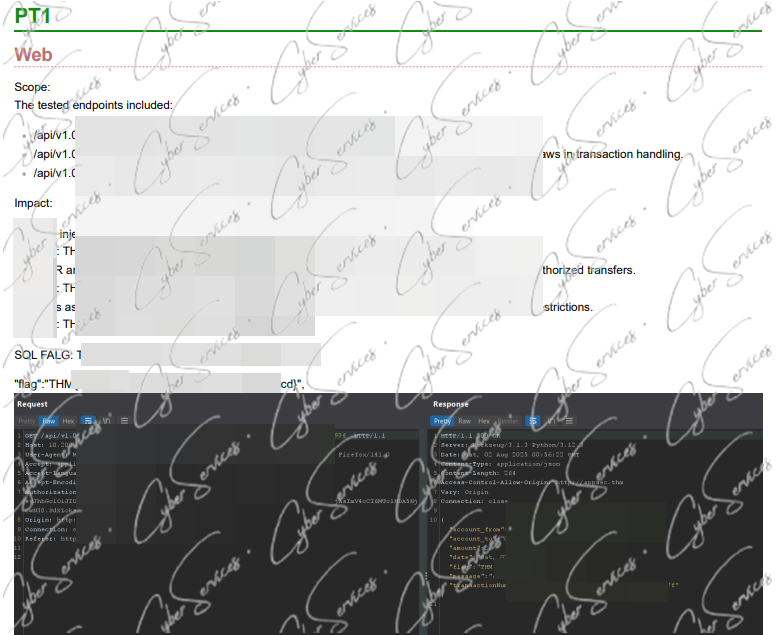
Another interesting discovery was a FASTapi application.
FASTapi has become increasingly common in modern environments, making it an important technology for penetration testers to understand. Proper API enumeration revealed several behaviors that significantly expanded the available attack surface.
This stage reinforced one important lesson:
Good enumeration creates opportunities that automated exploitation tools often miss.
Credential Discovery pt1 exam report
As the engagement progressed, several credentials and user accounts became valuable pivot points.
Among the findings were references to:
- TRYHACKME.LOC/Administrator:$DCC2$
- tryhackme.loc/john
- TRYHACKME\WRK
- tryhackme.loc/j.phillips
- scott user
Rather than assuming every credential would immediately grant privileged access, I treated each one as another piece of the puzzle.
Windows environments rarely fall because of a single vulnerability. Success usually comes from chaining together multiple weaknesses across different systems.
Active Directory Enumeration
Once access inside the domain was established, the focus shifted toward Active Directory.
At this stage, understanding relationships between users, groups, permissions, and delegated privileges became far more important than running additional exploit scripts.
BloodHound, PowerShell enumeration, and native Windows tools all contributed to building a complete picture of the domain.
Each discovered account opened additional attack paths that weren’t immediately obvious during the initial reconnaissance phase.
Privilege Escalation (Priv Esc)
One of the most enjoyable parts of the PT1 exam was the Priv Esc phase.
Instead of relying on a single misconfiguration, multiple small weaknesses combined to create a complete privilege escalation path.
Carefully reviewing service permissions, scheduled tasks, credentials, and Active Directory objects eventually provided the access needed to continue deeper into the environment.
This section perfectly reflects real-world internal penetration testing.
Professional engagements rarely involve one-click privilege escalation—they reward patience and careful observation.
Lateral Movement pt1 exam report
With additional privileges obtained, lateral movement became significantly easier.
Each compromised account exposed new systems and additional credentials.
At this point, maintaining organized notes became critical.
Tracking:
- compromised users
- discovered credentials
- accessible hosts
- privilege levels
- attack paths
saved an enormous amount of time later while preparing the final report.
Sequel Chat Discovery
Another interesting component encountered during the engagement was Sequel Chat.
Applications like this often contain sensitive business logic, authentication workflows, or configuration files that deserve careful analysis.
Rather than treating every application identically, I adjusted my testing methodology based on how the application behaved.
Understanding the technology stack proved far more effective than simply throwing automated tools at every endpoint.
Lessons Learned pt1 exam report
The biggest takeaway from PT1 wasn’t learning another exploit.
It was learning how important methodology really is.
Throughout the assessment I constantly returned to the same workflow:
- Reconnaissance
- Enumeration
- Validation
- Privilege Escalation
- Lateral Movement
- Documentation
Whenever progress slowed, the solution wasn’t searching for another exploit.
It was returning to enumeration and reviewing everything I’d already collected.
Final Thoughts
Overall, I found the TryHackMe PT1 certification to be an excellent practical exam for penetration testers looking to improve their real-world methodology.
The exam successfully combines web application testing, Windows privilege escalation, Active Directory enumeration, and reporting into a realistic enterprise scenario.
If you’re preparing for PT1, my advice is simple:
Don’t rush exploitation.
Focus on Reconnaissance, document everything, understand Active Directory, and always verify your assumptions before moving forward.
Those habits will help you far beyond the exam itself.
Buy this report
Vendor: https://tryhackme.com/certification/junior-penetration-tester
Check our certs: https://cyberservices.store/

Web application security specialist and bug bounty hunter. OSWA and OSWE certified, focused on web exploitation, API security and source-code review. Writes our web exploitation walkthroughs and reviews report structure for web-focused certifications.